Receptor tyrosine-protein kinase erbB-4 (EC 2.7.10.1) (Proto-oncogene-like protein c-ErbB-4) (Tyrosine kinase-type cell surface receptor HER4) (p180erbB4) [Cleaved into: ERBB4 intracellular domain (4ICD) (E4ICD) (s80HER4)]
1_MKPAT 6_ GLWVW 11_ VSLLV 16_ AAGTV 21_ QPSDS 26_ QSVCA 31_ GTENK 36_ LSSLS 41_ DLEQQ 46_ YRALR 51_ KYYEN 56_ CEVVM 61_ GNLEI 66_ TSIEH 71_ NRDLS 76_ FLRSV 81_ REVTG 86_ YVLVA 91_ LNQFR 96_ YLPLE 101_ NLRII 106_ RGTKL 111_ YEDRY 116_ ALAIF 121_ LNYRK 126_ DGNFG 131_ LQELG 136_ LKNLT 141_ EILNG 146_ GVYVD 151_ QNKFL 156_ CYADT 161_ IHWQD 166_ IVRNP 171_ WPSNL 176_ TLVST 181_ NGSSG 186_ CGRCH 191_ KSCTG 196_ RCWGP 201_ TENHC 206_ QTLTR 211_ TVCAE 216_ QCDGR 221_ CYGPY 226_ VSDCC 231_ HRECA 236_ GGCSG 241_ PKDTD 246_ CFACM 251_ NFNDS 256_ GACVT 261_ QCPQT 266_ FVYNP 271_ TTFQL 276_ EHNFN 281_ AKYTY 286_ GAFCV 291_ KKCPH 296_ NFVVD 301_ SSSCV 306_ RACPS 311_ SKMEV 316_ EENGI 321_ KMCKP 326_ CTDIC 331_ PKACD 336_ GIGTG 341_ SLMSA 346_ QTVDS 351_ SNIDK 356_ FINCT 361_ KINGN 366_ LIFLV 371_ TGIHG 376_ DPYNA 381_ IEAID 386_ PEKLN 391_ VFRTV 396_ REITG 401_ FLNIQ 406_ SWPPN 411_ MTDFS 416_ VFSNL 421_ VTIGG 426_ RVLYS 431_ GLSLL 436_ ILKQQ 441_ GITSL 446_ QFQSL 451_ KEISA 456_ GNIYI 461_ TDNSN 466_ LCYYH 471_ TINWT 476_ TLFST 481_ INQRI 486_ VIRDN 491_ RKAEN 496_ CTAEG 501_ MVCNH 506_ LCSSD 511_ GCWGP 516_ GPDQC 521_ LSCRR 526_ FSRGR 531_ ICIES 536_ CNLYD 541_ GEFRE 546_ FENGS 551_ ICVEC 556_ DPQCE 561_ KMEDG 566_ LLTCH 571_ GPGPD 576_ NCTKC 581_ SHFKD 586_ GPNCV 591_ EKCPD 596_ GLQGA 601_ NSFIF 606_ KYADP 611_ DRECH 616_ PCHPN 621_ CTQGC 626_ NGPTS 631_ HDCIY 636_ YPWTG 641_ HSTLP 646_ QHART 651_ PLIAA 656_ GVIGG 661_ LFILV 666_ IVGLT 671_ FAVYV 676_ RRKSI 681_ KKKRA 686_ LRRFL 691_ ETELV 696_ EPLTP 701_ SGTAP 706_ NQAQL 711_ RILKE 716_ TELKR 721_ VKVLG 726_ SGAFG 731_ TVYKG 736_ IWVPE 741_ GETVK 746_ IPVAI 751_ KILNE 756_ TTGPK 761_ ANVEF 766_ MDEAL 771_ IMASM 776_ DHPHL 781_ VRLLG 786_ VCLSP 791_ TIQLV 796_ TQLMP 801_ HGCLL 806_ EYVHE 811_ HKDNI 816_ GSQLL 821_ LNWCV 826_ QIAKG 831_ MMYLE 836_ ERRLV 841_ HRDLA 846_ ARNVL 851_ VKSPN 856_ HVKIT 861_ DFGLA 866_ RLLEG 871_ DEKEY 876_ NADGG 881_ KMPIK 886_ WMALE 891_ CIHYR 896_ KFTHQ 901_ SDVWS 906_ YGVTI 911_ WELMT 916_ FGGKP 921_ YDGIP 926_ TREIP 931_ DLLEK 936_ GERLP 941_ QPPIC 946_ TIDVY 951_ MVMVK 956_ CWMID 961_ ADSRP 966_ KFKEL 971_ AAEFS 976_ RMARD 981_ PQRYL 986_ VIQGD 991_ DRMKL 996_ PSPND 1001_ SKFFQ 1006_ NLLDE 1011_ EDLED 1016_ MMDAE 1021_ EYLVP 1026_ QAFNI 1031_ PPPIY 1036_ TSRAR 1041_ IDSNR 1046_ SEIGH 1051_ SPPPA 1056_ YTPMS 1061_ GNQFV 1066_ YRDGG 1071_ FAAEQ 1076_ GVSVP 1081_ YRAPT 1086_ STIPE 1091_ APVAQ 1096_ GATAE 1101_ IFDDS 1106_ CCNGT 1111_ LRKPV 1116_ APHVQ 1121_ EDSST 1126_ QRYSA 1131_ DPTVF 1136_ APERS 1141_ PRGEL 1146_ DEEGY 1151_ MTPMR 1156_ DKPKQ 1161_ EYLNP 1166_ VEENP 1171_ FVSRR 1176_ KNGDL 1181_ QALDN 1186_ PEYHN 1191_ ASNGP 1196_ PKAED 1201_ EYVNE 1206_ PLYLN 1211_ TFANT 1216_ LGKAE 1221_ YLKNN 1226_ ILSMP 1231_ EKAKK 1236_ AFDNP 1241_ DYWNH 1246_ SLPPR 1251_ STLQH 1256_ PDYLQ 1261_ EYSTK 1266_ YFYKQ 1271_ NGRIR 1276_ PIVAE 1281_ NPEYL 1286_ SEFSL 1291_ KPGTV 1296_ LPPPP 1301_YRHRN
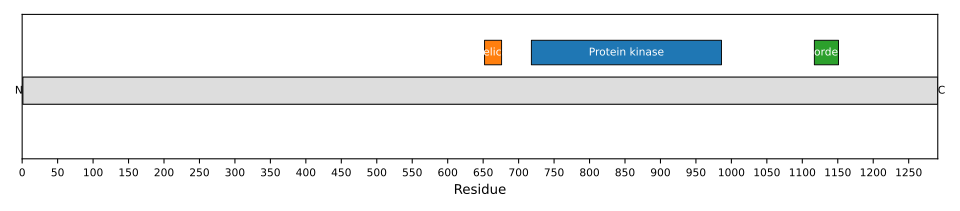
1: Tyrosine-protein kinase that plays an essential role as cell surface receptor for neuregulins and EGF family members and regulates development of the heart, the central nervous system and the mammary gland, gene transcription, cell proliferation, differentiation, migration and apoptosis. Required for normal cardiac muscle differentiation during embryonic development, and for postnatal cardiomyocyte proliferation. Required for normal development of the embryonic central nervous system, especially for normal neural crest cell migration and normal axon guidance. Required for mammary gland differentiation, induction of milk proteins and lactation. Acts as cell-surface receptor for the neuregulins NRG1, NRG2, NRG3 and NRG4 and the EGF family members BTC, EREG and HBEGF. Ligand binding triggers receptor dimerization and autophosphorylation at specific tyrosine residues that then serve as binding sites for scaffold proteins and effectors. Ligand specificity and signaling is modulated by alternative splicing, proteolytic processing, and by the formation of heterodimers with other ERBB family members, thereby creating multiple combinations of intracellular phosphotyrosines that trigger ligand- and context-specific cellular responses. Mediates phosphorylation of SHC1 and activation of the MAP kinases MAPK1/ERK2 and MAPK3/ERK1. Isoform JM-A CYT-1 and isoform JM-B CYT-1 phosphorylate PIK3R1, leading to the activation of phosphatidylinositol 3-kinase and AKT1 and protect cells against apoptosis. Isoform JM-A CYT-1 and isoform JM-B CYT-1 mediate reorganization of the actin cytoskeleton and promote cell migration in response to NRG1. Isoform JM-A CYT-2 and isoform JM-B CYT-2 lack the phosphotyrosine that mediates interaction with PIK3R1, and hence do not phosphorylate PIK3R1, do not protect cells against apoptosis, and do not promote reorganization of the actin cytoskeleton and cell migration. Proteolytic processing of isoform JM-A CYT-1 and isoform JM-A CYT-2 gives rise to the corresponding soluble intracellular domains (4ICD) that translocate to the nucleus, promote nuclear import of STAT5A, activation of STAT5A, mammary epithelium differentiation, cell proliferation and activation of gene expression. The ERBB4 soluble intracellular domains (4ICD) colocalize with STAT5A at the CSN2 promoter to regulate transcription of milk proteins during lactation. The ERBB4 soluble intracellular domains can also translocate to mitochondria and promote apoptosis