Mitogen-activated protein kinase 11 (MAP kinase 11) (MAPK 11) (EC 2.7.11.24) (Mitogen-activated protein kinase p38 beta) (MAP kinase p38 beta) (p38b) (Stress-activated protein kinase 2b) (SAPK2b) (p38-2)
1_MSGPR 6_ AGFYR 11_ QELNK 16_ TVWEV 21_ PQRLQ 26_ GLRPV 31_ GSGAY 36_ GSVCS 41_ AYDAR 46_ LRQKV 51_ AVKKL 56_ SRPFQ 61_ SLIHA 66_ RRTYR 71_ ELRLL 76_ KHLKH 81_ ENVIG 86_ LLDVF 91_ TPATS 96_ IEDFS 101_ EVYLV 106_ TTLMG 111_ ADLNN 116_ IVKCQ 121_ ALSDE 126_ HVQFL 131_ VYQLL 136_ RGLKY 141_ IHSAG 146_ IIHRD 151_ LKPSN 156_ VAVNE 161_ DCELR 166_ ILDFG 171_ LARQA 176_ DEEMT 181_ GYVAT 186_ RWYRA 191_ PEIML 196_ NWMHY 201_ NQTVD 206_ IWSVG 211_ CIMAE 216_ LLQGK 221_ ALFPG 226_ SDYID 231_ QLKRI 236_ MEVVG 241_ TPSPE 246_ VLAKI 251_ SSEHA 256_ RTYIQ 261_ SLPPM 266_ PQKDL 271_ SSIFR 276_ GANPL 281_ AIDLL 286_ GRMLV 291_ LDSDQ 296_ RVSAA 301_ EALAH 306_ AYFSQ 311_ YHDPE 316_ DEPEA 321_ EPYDE 326_ SVEAK 331_ ERTLE 336_ EWKEL 341_ TYQEV 346_ LSFKP 351_ PEPPK 356_PPGSL
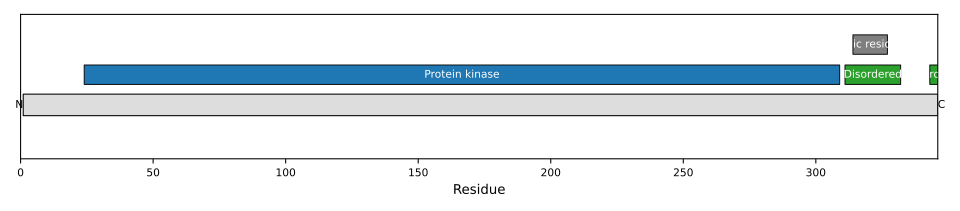
1: Serine/threonine kinase which acts as an essential component of the MAP kinase signal transduction pathway (PubMed:12452429, PubMed:20626350, PubMed:35857590). MAPK11 is one of the four p38 MAPKs which play an important role in the cascades of cellular responses evoked by extracellular stimuli such as pro-inflammatory cytokines or physical stress leading to direct activation of transcription factors (PubMed:12452429, PubMed:20626350, PubMed:35857590). Accordingly, p38 MAPKs phosphorylate a broad range of proteins and it has been estimated that they may have approximately 200 to 300 substrates each (PubMed:12452429, PubMed:20626350, PubMed:35857590). MAPK11 functions are mostly redundant with those of MAPK14 (PubMed:12452429, PubMed:20626350, PubMed:35857590). Some of the targets are downstream kinases which are activated through phosphorylation and further phosphorylate additional targets (PubMed:12452429, PubMed:20626350). RPS6KA5/MSK1 and RPS6KA4/MSK2 can directly phosphorylate and activate transcription factors such as CREB1, ATF1, the NF-kappa-B isoform RELA/NFKB3, STAT1 and STAT3, but can also phosphorylate histone H3 and the nucleosomal protein HMGN1 (PubMed:9687510). RPS6KA5/MSK1 and RPS6KA4/MSK2 play important roles in the rapid induction of immediate-early genes in response to stress or mitogenic stimuli, either by inducing chromatin remodeling or by recruiting the transcription machinery. On the other hand, two other kinase targets, MAPKAPK2/MK2 and MAPKAPK3/MK3, participate in the control of gene expression mostly at the post-transcriptional level, by phosphorylating ZFP36 (tristetraprolin) and ELAVL1, and by regulating EEF2K, which is important for the elongation of mRNA during translation. MKNK1/MNK1 and MKNK2/MNK2, two other kinases activated by p38 MAPKs, regulate protein synthesis by phosphorylating the initiation factor EIF4E2 (PubMed:11154262). In the cytoplasm, the p38 MAPK pathway is an important regulator of protein turnover. For example, CFLAR is an inhibitor of TNF-induced apoptosis whose proteasome-mediated degradation is regulated by p38 MAPK phosphorylation. Ectodomain shedding of transmembrane proteins is regulated by p38 MAPKs as well. In response to inflammatory stimuli, p38 MAPKs phosphorylate the membrane-associated metalloprotease ADAM17. Such phosphorylation is required for ADAM17-mediated ectodomain shedding of TGF-alpha family ligands, which results in the activation of EGFR signaling and cell proliferation. Additional examples of p38 MAPK substrates are the FGFR1. FGFR1 can be translocated from the extracellular space into the cytosol and nucleus of target cells, and regulates processes such as rRNA synthesis and cell growth. FGFR1 translocation requires p38 MAPK activation. In the nucleus, many transcription factors are phosphorylated and activated by p38 MAPKs in response to different stimuli. Classical examples include ATF1, ATF2, ATF6, ELK1, PTPRH, DDIT3, TP53/p53 and MEF2C and MEF2A (PubMed:10330143, PubMed:15356147, PubMed:9430721). The p38 MAPKs are emerging as important modulators of gene expression by regulating chromatin modifiers and remodelers (PubMed:10330143, PubMed:15356147, PubMed:9430721). The promoters of several genes involved in the inflammatory response, such as IL6, IL8 and IL12B, display a p38 MAPK-dependent enrichment of histone H3 phosphorylation on 'Ser-10' (H3S10ph) in LPS-stimulated myeloid cells. This phosphorylation enhances the accessibility of the cryptic NF-kappa-B-binding sites marking promoters for increased NF-kappa-B recruitment. Phosphorylates NLRP1 downstream of MAP3K20/ZAK in response to UV-B irradiation and ribosome collisions, promoting activation of the NLRP1 inflammasome and pyroptosis (PubMed:35857590). Phosphorylates methyltransferase DOT1L on 'Ser-834', 'Thr-900', 'Ser-902', 'Thr-984', 'Ser-1001', 'Ser-1009' and 'Ser-1104' (PubMed:38270553)