CD226 antigen (DNAX accessory molecule 1) (DNAM-1) (CD antigen CD226)
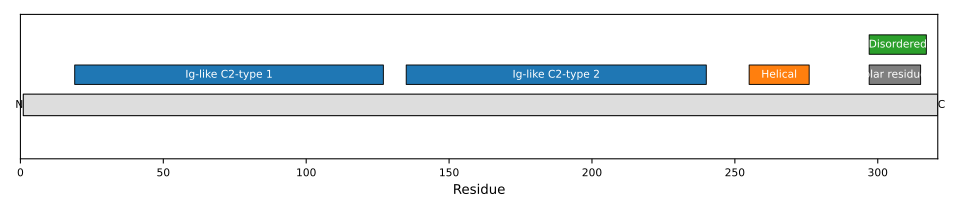
1_MDYPT 6_ LLLAL 11_ LHVYR 16_ ALCEE 21_ VLWHT 26_ SVPFA 31_ ENMSL 36_ ECVYP 41_ SMGIL 46_ TQVEW 51_ FKIGT 56_ QQDSI 61_ AIFSP 66_ THGMV 71_ IRKPY 76_ AERVY 81_ FLNST 86_ MASNN 91_ MTLFF 96_ RNASE 101_ DDVGY 106_ YSCSL 111_ YTYPQ 116_ GTWQK 121_ VIQVV 126_ QSDSF 131_ EAAVP 136_ SNSHI 141_ VSEPG 146_ KNVTL 151_ TCQPQ 156_ MTWPV 161_ QAVRW 166_ EKIQP 171_ RQIDL 176_ LTYCN 181_ LVHGR 186_ NFTSK 191_ FPRQI 196_ VSNCS 201_ HGRWS 206_ VIVIP 211_ DVTVS 216_ DSGLY 221_ RCYLQ 226_ ASAGE 231_ NETFV 236_ MRLTV 241_ AEGKT 246_ DNQYT 251_ LFVAG 256_ GTVLL 261_ LLFVI 266_ SITTI 271_ IVIFL 276_ NRRRR 281_ RERRD 286_ LFTES 291_ WDTQK 296_ APNNY 301_ RSPIS 306_ TSQPT 311_ NQSMD 316_ DTRED 321_ IYVNY 326_ PTFSR 331_RPKTR
1: Cell surface receptor that plays an important role in the immune system, particularly in intercellular adhesion, lymphocyte signaling, cytotoxicity and lymphokine secretion mediated by cytotoxic T-cells and NK cells (PubMed:8673704, PubMed:9712030). Functions as a costimulatory receptor upon recognition of target cells, such as virus-infected or tumor cells. Upon binding to its ligands PVR/CD155 or NECTIN2/CD112 on target cells, promotes the cytotoxic activity of NK cells and CTLs, enhancing their ability to kill these cells (PubMed:26755705, PubMed:31253644, PubMed:30591568). Mechanistically, phosphorylation by Src kinases such as LYN of FYN, enables binding to adapter GRB2, leading to activation of VAV1, PI3K and PLCG1. Promotes also activation of kinases ERK and AKT, as well as calcium fluxes (By similarity)