Histone-lysine N-methyltransferase EZH2 (EC 2.1.1.356) (ENX-1) (Enhancer of zeste homolog 2) (Lysine N-methyltransferase 6)
1_MGQTG 6_ KKSEK 11_ GPVCW 16_ RKRVK 21_ SEYMR 26_ LRQLK 31_ RFRRA 36_ DEVKS 41_ MFSSN 46_ RQKIL 51_ ERTEI 56_ LNQEW 61_ KQRRI 66_ QPVHI 71_ LTSVS 76_ SLRGT 81_ RECSV 86_ TSDLD 91_ FPTQV 96_ IPLKT 101_ LNAVA 106_ SVPIM 111_ YSWSP 116_ LQQNF 121_ MVEDE 126_ TVLHN 131_ IPYMG 136_ DEVLD 141_ QDGTF 146_ IEELI 151_ KNYDG 156_ KVHGD 161_ RECGF 166_ INDEI 171_ FVELV 176_ NALGQ 181_ YNDDD 186_ DDDDG 191_ DDPEE 196_ REEKQ 201_ KDLED 206_ HRDDK 211_ ESRPP 216_ RKFPS 221_ DKIFE 226_ AISSM 231_ FPDKG 236_ TAEEL 241_ KEKYK 246_ ELTEQ 251_ QLPGA 256_ LPPEC 261_ TPNID 266_ GPNAK 271_ SVQRE 276_ QSLHS 281_ FHTLF 286_ CRRCF 291_ KYDCF 296_ LHPFH 301_ ATPNT 306_ YKRKN 311_ TETAL 316_ DNKPC 321_ GPQCY 326_ QHLEG 331_ AKEFA 336_ AALTA 341_ ERIKT 346_ PPKRP 351_ GGRRR 356_ GRLPN 361_ NSSRP 366_ STPTI 371_ NVLES 376_ KDTDS 381_ DREAG 386_ TETGG 391_ ENNDK 396_ EEEEK 401_ KDETS 406_ SSSEA 411_ NSRCQ 416_ TPIKM 421_ KPNIE 426_ PPENV 431_ EWSGA 436_ EASMF 441_ RVLIG 446_ TYYDN 451_ FCAIA 456_ RLIGT 461_ KTCRQ 466_ VYEFR 471_ VKESS 476_ IIAPA 481_ PAEDV 486_ DTPPR 491_ KKKRK 496_ HRLWA 501_ AHCRK 506_ IQLKK 511_ DGSSN 516_ HVYNY 521_ QPCDH 526_ PRQPC 531_ DSSCP 536_ CVIAQ 541_ NFCEK 546_ FCQCS 551_ SECQN 556_ RFPGC 561_ RCKAQ 566_ CNTKQ 571_ CPCYL 576_ AVREC 581_ DPDLC 586_ LTCGA 591_ ADHWD 596_ SKNVS 601_ CKNCS 606_ IQRGS 611_ KKHLL 616_ LAPSD 621_ VAGWG 626_ IFIKD 631_ PVQKN 636_ EFISE 641_ YCGEI 646_ ISQDE 651_ ADRRG 656_ KVYDK 661_ YMCSF 666_ LFNLN 671_ NDFVV 676_ DATRK 681_ GNKIR 686_ FANHS 691_ VNPNC 696_ YAKVM 701_ MVNGD 706_ HRIGI 711_ FAKRA 716_ IQTGE 721_ ELFFD 726_ YRYSQ 731_ ADALK 736_ YVGIE 741_REMEI
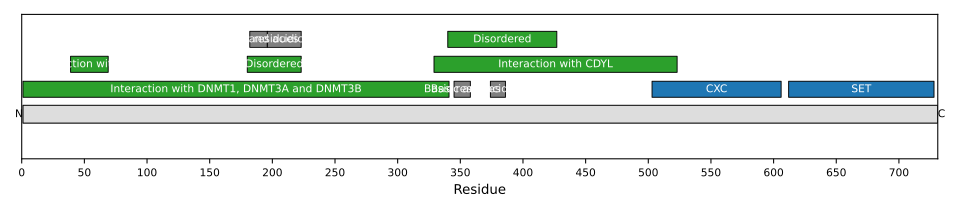
1: Polycomb group (PcG) protein. Catalytic subunit of the PRC2/EED-EZH2 complex, which methylates 'Lys-9' (H3K9me) and 'Lys-27' (H3K27me) of histone H3, leading to transcriptional repression of the affected target gene. Able to mono-, di- and trimethylate 'Lys-27' of histone H3 to form H3K27me1, H3K27me2 and H3K27me3, respectively. Displays a preference for substrates with less methylation, loses activity when progressively more methyl groups are incorporated into H3K27, H3K27me0 > H3K27me1 > H3K27me2 (PubMed:22323599, PubMed:30923826). Compared to EZH1-containing complexes, it is more abundant in embryonic stem cells and plays a major role in forming H3K27me3, which is required for embryonic stem cell identity and proper differentiation. The PRC2/EED-EZH2 complex may also serve as a recruiting platform for DNA methyltransferases, thereby linking two epigenetic repression systems. Genes repressed by the PRC2/EED-EZH2 complex include HOXC8, HOXA9, MYT1, CDKN2A and retinoic acid target genes. EZH2 can also methylate non-histone proteins such as the transcription factor GATA4 and the nuclear receptor RORA. Regulates the circadian clock via histone methylation at the promoter of the circadian genes. Essential for the CRY1/2-mediated repression of the transcriptional activation of PER1/2 by the CLOCK-BMAL1 heterodimer; involved in the di and trimethylation of 'Lys-27' of histone H3 on PER1/2 promoters which is necessary for the CRY1/2 proteins to inhibit transcription