Nuclear factor erythroid 2-related factor 2 (NF-E2-related factor 2) (NFE2-related factor 2) (Nrf-2) (HEBP1) (Nuclear factor, erythroid derived 2, like 2)
1_MMDLE 6_ LPPPG 11_ LPSQQ 16_ DMDLI 21_ DILWR 26_ QDIDL 31_ GVSRE 36_ VFDFS 41_ QRRKE 46_ YELEK 51_ QKKLE 56_ KERQE 61_ QLQKE 66_ QEKAF 71_ FAQLQ 76_ LDEET 81_ GEFLP 86_ IQPAQ 91_ HIQSE 96_ TSGSA 101_ NYSQV 106_ AHIPK 111_ SDALY 116_ FDDCM 121_ QLLAQ 126_ TFPFV 131_ DDNEV 136_ SSATF 141_ QSLVP 146_ DIPGH 151_ IESPV 156_ FIATN 161_ QAQSP 166_ ETSVA 171_ QVAPV 176_ DLDGM 181_ QQDIE 186_ QVWEE 191_ LLSIP 196_ ELQCL 201_ NIEND 206_ KLVET 211_ TMVPS 216_ PEAKL 221_ TEVDN 226_ YHFYS 231_ SIPSM 236_ EKEVG 241_ NCSPH 246_ FLNAF 251_ EDSFS 256_ SILST 261_ EDPNQ 266_ LTVNS 271_ LNSDA 276_ TVNTD 281_ FGDEF 286_ YSAFI 291_ AEPSI 296_ SNSMP 301_ SPATL 306_ SHSLS 311_ ELLNG 316_ PIDVS 321_ DLSLC 326_ KAFNQ 331_ NHPES 336_ TAEFN 341_ DSDSG 346_ ISLNT 351_ SPSVA 356_ SPEHS 361_ VESSS 366_ YGDTL 371_ LGLSD 376_ SEVEE 381_ LDSAP 386_ GSVKQ 391_ NGPKT 396_ PVHSS 401_ GDMVQ 406_ PLSPS 411_ QGQST 416_ HVHDA 421_ QCENT 426_ PEKEL 431_ PVSPG 436_ HRKTP 441_ FTKDK 446_ HSSRL 451_ EAHLT 456_ RDELR 461_ AKALH 466_ IPFPV 471_ EKIIN 476_ LPVVD 481_ FNEMM 486_ SKEQF 491_ NEAQL 496_ ALIRD 501_ IRRRG 506_ KNKVA 511_ AQNCR 516_ KRKLE 521_ NIVEL 526_ EQDLD 531_ HLKDE 536_ KEKLL 541_ KEKGE 546_ NDKSL 551_ HLLKK 556_ QLSTL 561_ YLEVF 566_ SMLRD 571_ EDGKP 576_ YSPSE 581_ YSLQQ 586_ TRDGN 591_ VFLVP 596_KSKKP
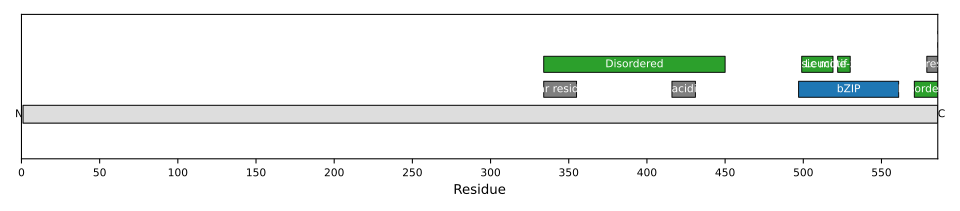
1: Transcription factor that plays a key role in the response to oxidative stress: binds to antioxidant response (ARE) elements present in the promoter region of many cytoprotective genes, such as phase 2 detoxifying enzymes, and promotes their expression, thereby neutralizing reactive electrophiles (PubMed:11035812, PubMed:19489739, PubMed:29018201, PubMed:31398338). In normal conditions, ubiquitinated and degraded in the cytoplasm by the BCR(KEAP1) complex (PubMed:11035812, PubMed:15601839, PubMed:29018201). In response to oxidative stress, electrophile metabolites inhibit activity of the BCR(KEAP1) complex, promoting nuclear accumulation of NFE2L2/NRF2, heterodimerization with one of the small Maf proteins and binding to ARE elements of cytoprotective target genes (PubMed:19489739, PubMed:29590092). The NFE2L2/NRF2 pathway is also activated in response to selective autophagy: autophagy promotes interaction between KEAP1 and SQSTM1/p62 and subsequent inactivation of the BCR(KEAP1) complex, leading to NFE2L2/NRF2 nuclear accumulation and expression of cytoprotective genes (PubMed:20452972). The NFE2L2/NRF2 pathway is also activated during the unfolded protein response (UPR), contributing to redox homeostasis and cell survival following endoplasmic reticulum stress (By similarity). May also be involved in the transcriptional activation of genes of the beta-globin cluster by mediating enhancer activity of hypersensitive site 2 of the beta-globin locus control region (PubMed:7937919). Also plays an important role in the regulation of the innate immune response and antiviral cytosolic DNA sensing. It is a critical regulator of the innate immune response and survival during sepsis by maintaining redox homeostasis and restraint of the dysregulation of pro-inflammatory signaling pathways like MyD88-dependent and -independent and TNF-alpha signaling (By similarity). Suppresses macrophage inflammatory response by blocking pro-inflammatory cytokine transcription and the induction of IL6 (By similarity). Binds to the proximity of pro-inflammatory genes in macrophages and inhibits RNA Pol II recruitment. The inhibition is independent of the NRF2-binding motif and reactive oxygen species level (By similarity). Represses antiviral cytosolic DNA sensing by suppressing the expression of the adapter protein STING1 and decreasing responsiveness to STING1 agonists while increasing susceptibility to infection with DNA viruses (PubMed:30158636). Once activated, limits the release of pro-inflammatory cytokines in response to human coronavirus SARS-CoV-2 infection and to virus-derived ligands through a mechanism that involves inhibition of IRF3 dimerization. Also inhibits both SARS-CoV-2 replication, as well as the replication of several other pathogenic viruses including Herpes Simplex Virus-1 and-2, Vaccinia virus, and Zika virus through a type I interferon (IFN)-independent mechanism (PubMed:33009401)