DNA damage-binding protein 1 (DDB p127 subunit) (DNA damage-binding protein a) (DDBa) (Damage-specific DNA-binding protein 1) (HBV X-associated protein 1) (XAP-1) (UV-damaged DNA-binding factor) (UV-damaged DNA-binding protein 1) (UV-DDB 1) (XPE-binding factor) (XPE-BF) (Xeroderma pigmentosum group E-complementing protein) (XPCe)
1_MSYNY 6_ VVTAQ 11_ KPTAV 16_ NGCVT 21_ GHFTS 26_ AEDLN 31_ LLIAK 36_ NTRLE 41_ IYVVT 46_ AEGLR 51_ PVKEV 56_ GMYGK 61_ IAVME 66_ LFRPK 71_ GESKD 76_ LLFIL 81_ TAKYN 86_ ACILE 91_ YKQSG 96_ ESIDI 101_ ITRAH 106_ GNVQD 111_ RIGRP 116_ SETGI 121_ IGIID 126_ PECRM 131_ IGLRL 136_ YDGLF 141_ KVIPL 146_ DRDNK 151_ ELKAF 156_ NIRLE 161_ ELHVI 166_ DVKFL 171_ YGCQA 176_ PTICF 181_ VYQDP 186_ QGRHV 191_ KTYEV 196_ SLREK 201_ EFNKG 206_ PWKQE 211_ NVEAE 216_ ASMVI 221_ AVPEP 226_ FGGAI 231_ IIGQE 236_ SITYH 241_ NGDKY 246_ LAIAP 251_ PIIKQ 256_ STIVC 261_ HNRVD 266_ PNGSR 271_ YLLGD 276_ MEGRL 281_ FMLLL 286_ EKEEQ 291_ MDGTV 296_ TLKDL 301_ RVELL 306_ GETSI 311_ AECLT 316_ YLDNG 321_ VVFVG 326_ SRLGD 331_ SQLVK 336_ LNVDS 341_ NEQGS 346_ YVVAM 351_ ETFTN 356_ LGPIV 361_ DMCVV 366_ DLERQ 371_ GQGQL 376_ VTCSG 381_ AFKEG 386_ SLRII 391_ RNGIG 396_ IHEHA 401_ SIDLP 406_ GIKGL 411_ WPLRS 416_ DPNRE 421_ TDDTL 426_ VLSFV 431_ GQTRV 436_ LMLNG 441_ EEVEE 446_ TELMG 451_ FVDDQ 456_ QTFFC 461_ GNVAH 466_ QQLIQ 471_ ITSAS 476_ VRLVS 481_ QEPKA 486_ LVSEW 491_ KEPQA 496_ KNISV 501_ ASCNS 506_ SQVVV 511_ AVGRA 516_ LYYLQ 521_ IHPQE 526_ LRQIS 531_ HTEME 536_ HEVAC 541_ LDITP 546_ LGDSN 551_ GLSPL 556_ CAIGL 561_ WTDIS 566_ ARILK 571_ LPSFE 576_ LLHKE 581_ MLGGE 586_ IIPRS 591_ ILMTT 596_ FESSH 601_ YLLCA 606_ LGDGA 611_ LFYFG 616_ LNIET 621_ GLLSD 626_ RKKVT 631_ LGTQP 636_ TVLRT 641_ FRSLS 646_ TTNVF 651_ ACSDR 656_ PTVIY 661_ SSNHK 666_ LVFSN 671_ VNLKE 676_ VNYMC 681_ PLNSD 686_ GYPDS 691_ LALAN 696_ NSTLT 701_ IGTID 706_ EIQKL 711_ HIRTV 716_ PLYES 721_ PRKIC 726_ YQEVS 731_ QCFGV 736_ LSSRI 741_ EVQDT 746_ SGGTT 751_ ALRPS 756_ ASTQA 761_ LSSSV 766_ SSSKL 771_ FSSST 776_ APHET 781_ SFGEE 786_ VEVHN 791_ LLIID 796_ QHTFE 801_ VLHAH 806_ QFLQN 811_ EYALS 816_ LVSCK 821_ LGKDP 826_ NTYFI 831_ VGTAM 836_ VYPEE 841_ AEPKQ 846_ GRIVV 851_ FQYSD 856_ GKLQT 861_ VAEKE 866_ VKGAV 871_ YSMVE 876_ FNGKL 881_ LASIN 886_ STVRL 891_ YEWTT 896_ EKELR 901_ TECNH 906_ YNNIM 911_ ALYLK 916_ TKGDF 921_ ILVGD 926_ LMRSV 931_ LLLAY 936_ KPMEG 941_ NFEEI 946_ ARDFN 951_ PNWMS 956_ AVEIL 961_ DDDNF 966_ LGAEN 971_ AFNLF 976_ VCQKD 981_ SAATT 986_ DEERQ 991_ HLQEV 996_ GLFHL 1001_ GEFVN 1006_ VFCHG 1011_ SLVMQ 1016_ NLGET 1021_ STPTQ 1026_ GSVLF 1031_ GTVNG 1036_ MIGLV 1041_ TSLSE 1046_ SWYNL 1051_ LLDMQ 1056_ NRLNK 1061_ VIKSV 1066_ GKIEH 1071_ SFWRS 1076_ FHTER 1081_ KTEPA 1086_ TGFID 1091_ GDLIE 1096_ SFLDI 1101_ SRPKM 1106_ QEVVA 1111_ NLQYD 1116_ DGSGM 1121_ KREAT 1126_ ADDLI 1131_KVVEE
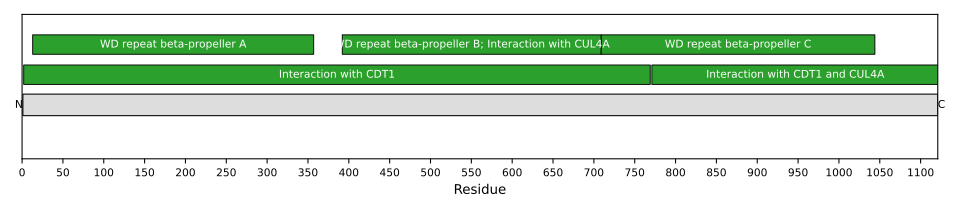
1: Protein, which is both involved in DNA repair and protein ubiquitination, as part of the UV-DDB complex and DCX (DDB1-CUL4-X-box) complexes, respectively (PubMed:14739464, PubMed:15448697, PubMed:16260596, PubMed:16407242, PubMed:16407252, PubMed:16482215, PubMed:16940174, PubMed:17079684). Core component of the UV-DDB complex (UV-damaged DNA-binding protein complex), a complex that recognizes UV-induced DNA damage and recruit proteins of the nucleotide excision repair pathway (the NER pathway) to initiate DNA repair (PubMed:15448697, PubMed:16260596, PubMed:16407242, PubMed:16940174). The UV-DDB complex preferentially binds to cyclobutane pyrimidine dimers (CPD), 6-4 photoproducts (6-4 PP), apurinic sites and short mismatches (PubMed:15448697, PubMed:16260596, PubMed:16407242, PubMed:16940174). Also functions as a component of numerous distinct DCX (DDB1-CUL4-X-box) E3 ubiquitin-protein ligase complexes which mediate the ubiquitination and subsequent proteasomal degradation of target proteins (PubMed:14739464, PubMed:16407252, PubMed:16482215, PubMed:17079684, PubMed:18332868, PubMed:18381890, PubMed:19966799, PubMed:22118460, PubMed:25043012, PubMed:25108355, PubMed:28886238). The functional specificity of the DCX E3 ubiquitin-protein ligase complex is determined by the variable substrate recognition component recruited by DDB1 (PubMed:14739464, PubMed:16407252, PubMed:16482215, PubMed:17079684, PubMed:18332868, PubMed:18381890, PubMed:19966799, PubMed:22118460, PubMed:25043012, PubMed:25108355). DCX(DDB2) (also known as DDB1-CUL4-ROC1, CUL4-DDB-ROC1 and CUL4-DDB-RBX1) may ubiquitinate histone H2A, histone H3 and histone H4 at sites of UV-induced DNA damage (PubMed:16473935, PubMed:16678110, PubMed:17041588, PubMed:18593899). The ubiquitination of histones may facilitate their removal from the nucleosome and promote subsequent DNA repair (PubMed:16473935, PubMed:16678110, PubMed:17041588, PubMed:18593899). DCX(DDB2) also ubiquitinates XPC, which may enhance DNA-binding by XPC and promote NER (PubMed:15882621). DCX(DTL) plays a role in PCNA-dependent polyubiquitination of CDT1 and MDM2-dependent ubiquitination of TP53 in response to radiation-induced DNA damage and during DNA replication (PubMed:17041588). DCX(ERCC8) (the CSA complex) plays a role in transcription-coupled repair (TCR) (PubMed:12732143, PubMed:32355176, PubMed:38316879). The DDB1-CUL4A-DTL E3 ligase complex regulates the circadian clock function by mediating the ubiquitination and degradation of CRY1 (PubMed:26431207). DDB1-mediated CRY1 degradation promotes FOXO1 protein stability and FOXO1-mediated gluconeogenesis in the liver (By similarity). By acting on TET dioxygenses, essential for oocyte maintenance at the primordial follicle stage, hence essential for female fertility (By similarity). Maternal factor required for proper zygotic genome activation and genome reprogramming (By similarity)