MAP kinase-activated protein kinase 3 (MAPK-activated protein kinase 3) (MAPKAP kinase 3) (MAPKAP-K3) (MAPKAPK-3) (MK-3) (EC 2.7.11.1) (Chromosome 3p kinase) (3pK)
1_MDGET 6_ AEEQG 11_ GPVPP 16_ PVAPG 21_ GPGLG 26_ GAPGG 31_ RREPK 36_ KYAVT 41_ DDYQL 46_ SKQVL 51_ GLGVN 56_ GKVLE 61_ CFHRR 66_ TGQKC 71_ ALKLL 76_ YDSPK 81_ ARQEV 86_ DHHWQ 91_ ASGGP 96_ HIVCI 101_ LDVYE 106_ NMHHG 111_ KRCLL 116_ IIMEC 121_ MEGGE 126_ LFSRI 131_ QERGD 136_ QAFTE 141_ REAAE 146_ IMRDI 151_ GTAIQ 156_ FLHSH 161_ NIAHR 166_ DVKPE 171_ NLLYT 176_ SKEKD 181_ AVLKL 186_ TDFGF 191_ AKETT 196_ QNALQ 201_ TPCYT 206_ PYYVA 211_ PEVLG 216_ PEKYD 221_ KSCDM 226_ WSLGV 231_ IMYIL 236_ LCGFP 241_ PFYSN 246_ TGQAI 251_ SPGMK 256_ RRIRL 261_ GQYGF 266_ PNPEW 271_ SEVSE 276_ DAKQL 281_ IRLLL 286_ KTDPT 291_ ERLTI 296_ TQFMN 301_ HPWIN 306_ QSMVV 311_ PQTPL 316_ HTARV 321_ LQEDK 326_ DHWDE 331_ VKEEM 336_ TSALA 341_ TMRVD 346_ YDQVK 351_ IKDLK 356_ TSNNR 361_ LLNKR 366_ RKKQA 371_ GSSSA 376_SQGCN
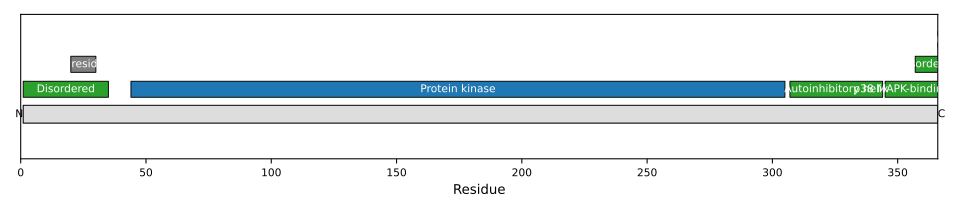
1: Stress-activated serine/threonine-protein kinase involved in cytokines production, endocytosis, cell migration, chromatin remodeling and transcriptional regulation. Following stress, it is phosphorylated and activated by MAP kinase p38-alpha/MAPK14, leading to phosphorylation of substrates. Phosphorylates serine in the peptide sequence, Hyd-X-R-X(2)-S, where Hyd is a large hydrophobic residue. MAPKAPK2 and MAPKAPK3, share the same function and substrate specificity, but MAPKAPK3 kinase activity and level in protein expression are lower compared to MAPKAPK2. Phosphorylates HSP27/HSPB1, KRT18, KRT20, RCSD1, RPS6KA3, TAB3 and TTP/ZFP36. Mediates phosphorylation of HSP27/HSPB1 in response to stress, leading to dissociate HSP27/HSPB1 from large small heat-shock protein (sHsps) oligomers and impair their chaperone activities and ability to protect against oxidative stress effectively. Involved in inflammatory response by regulating tumor necrosis factor (TNF) and IL6 production post-transcriptionally: acts by phosphorylating AU-rich elements (AREs)-binding proteins, such as TTP/ZFP36, leading to regulate the stability and translation of TNF and IL6 mRNAs. Phosphorylation of TTP/ZFP36, a major post-transcriptional regulator of TNF, promotes its binding to 14-3-3 proteins and reduces its ARE mRNA affinity leading to inhibition of dependent degradation of ARE-containing transcript. Involved in toll-like receptor signaling pathway (TLR) in dendritic cells: required for acute TLR-induced macropinocytosis by phosphorylating and activating RPS6KA3. Also acts as a modulator of Polycomb-mediated repression