Gamma-interferon-inducible protein 16 (Ifi-16) (Interferon-inducible myeloid differentiation transcriptional activator)
1_MGKKY 6_ KNIVL 11_ LKGLE 16_ VINDY 21_ HFRMV 26_ KSLLS 31_ NDLKL 36_ NLKMR 41_ EEYDK 46_ IQIAD 51_ LMEEK 56_ FRGDA 61_ GLGKL 66_ IKIFE 71_ DIPTL 76_ EDLAE 81_ TLKKE 86_ KLKVK 91_ GPALS 96_ RKRKK 101_ EVDAT 106_ SPAPS 111_ TSSTV 116_ KTEGA 121_ EATPG 126_ AQKRK 131_ KSTKE 136_ KAGPK 141_ GSKVS 146_ EEQTQ 151_ PPSPA 156_ GAGMS 161_ TAMGR 166_ SPSPK 171_ TSLSA 176_ PPNSS 181_ STENP 186_ KTVAK 191_ CQVTP 196_ RRNVL 201_ QKRPV 206_ IVKVL 211_ STTKP 216_ FEYET 221_ PEMEK 226_ KIMFH 231_ ATVAT 236_ QTQFF 241_ HVKVL 246_ NTSLK 251_ EKFNG 256_ KKIII 261_ ISDYL 266_ EYDSL 271_ LEVNE 276_ ESTVS 281_ EAGPN 286_ QTFEV 291_ PNKII 296_ NRAKE 301_ TLKID 306_ ILHKQ 311_ ASGNI 316_ VYGVF 321_ MLHKK 326_ TVNQK 331_ TTIYE 336_ IQDDR 341_ GKMDV 346_ VGTGQ 351_ CHNIP 356_ CEEGD 361_ KLQLF 366_ CFRLR 371_ KKNQM 376_ SKLIS 381_ EMHSF 386_ IQIKK 391_ KTNPR 396_ NNDPK 401_ SMKLP 406_ QEQRQ 411_ LPYPS 416_ EASTT 421_ FPESH 426_ LRTPQ 431_ MPPTT 436_ PSSSF 441_ FTKKS 446_ EDTIS 451_ KMNDF 456_ MRMQI 461_ LKEGS 466_ HFPGP 471_ FMTSI 476_ GPAES 481_ HPHTP 486_ QMPPS 491_ TPSSS 496_ FLTTK 501_ SEDTI 506_ SKMND 511_ FMRMQ 516_ ILKEG 521_ SHFPG 526_ PFMTS 531_ IGPAE 536_ SHPHT 541_ PQMPP 546_ STPSS 551_ SFLTT 556_ LKPRL 561_ KTEPE 566_ EVSIE 571_ DSAQS 576_ DLKEV 581_ MVLNA 586_ TESFV 591_ YEPKE 596_ QKKMF 601_ HATVA 606_ TENEV 611_ FRVKV 616_ FNIDL 621_ KEKFT 626_ PKKII 631_ AIANY 636_ VCRNG 641_ FLEVY 646_ PFTLV 651_ ADVNA 656_ DRNME 661_ IPKGL 666_ IRSAS 671_ VTPKI 676_ NQLCS 681_ QTKGS 686_ FVNGV 691_ FEVHK 696_ KNVRG 701_ EFTYY 706_ EIQDN 711_ TGKME 716_ VVVHG 721_ RLTTI 726_ NCEEG 731_ DKLKL 736_ TCFEL 741_ APKSG 746_ NTGEL 751_ RSVIH 756_ SHIKV 761_ IKTRK 766_ NKKDI 771_ LNPDS 776_SMETS
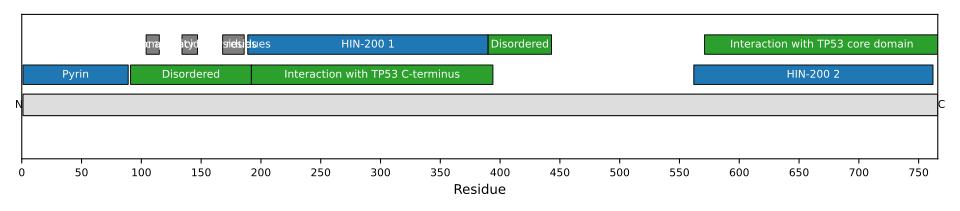
1: Binds double-stranded DNA. Binds preferentially to supercoiled DNA and cruciform DNA structures. Seems to be involved in transcriptional regulation. May function as a transcriptional repressor. Could have a role in the regulation of hematopoietic differentiation through activation of unknown target genes. Controls cellular proliferation by modulating the functions of cell cycle regulatory factors including p53/TP53 and the retinoblastoma protein. May be involved in TP53-mediated transcriptional activation by enhancing TP53 sequence-specific DNA binding and modulating TP53 phosphorylation status. Seems to be involved in energy-level-dependent activation of the ATM/ AMPK/TP53 pathway coupled to regulation of autophagy. May be involved in regulation of TP53-mediated cell death also involving BRCA1. May be involved in the senescence of prostate epithelial cells. Involved in innate immune response by recognizing viral dsDNA in the cytosol and probably in the nucleus. After binding to viral DNA in the cytoplasm recruits TMEM173/STING and mediates the induction of IFN-beta. Has anti-inflammatory activity and inhibits the activation of the AIM2 inflammasome, probably via association with AIM2. Proposed to bind viral DNA in the nucleus, such as of Kaposi's sarcoma-associated herpesvirus, and to induce the formation of nuclear caspase-1-activating inflammasome formation via association with PYCARD. Inhibits replication of herpesviruses such as human cytomegalovirus (HCMV) probably by interfering with promoter recruitment of members of the Sp1 family of transcription factors. Necessary to activate the IRF3 signaling cascade during human herpes simplex virus 1 (HHV-1) infection and promotes the assembly of heterochromatin on herpesviral DNA and inhibition of viral immediate-early gene expression and replication. Involved in the MTA1-mediated epigenetic regulation of ESR1 expression in breast cancer
2: Isoform that specifically inhibits the AIM2 inflammasome (PubMed:30104205). Binds double-stranded DNA (dsDNA) in the cytoplasm, impeding its detection by AIM2 (PubMed:30104205). Also prevents the interaction between AIM2 and PYCARD/ASC via its interaction with AIM2, thereby inhibiting assembly of the AIM2 inflammasome (PubMed:30104205). This isoform also weakly induce production of type I interferon-beta (IFNB1) via its interaction with STING1 (PubMed:30104205)