C-type lectin domain family 12 member B (Macrophage antigen H)
1_MSEEV 6_ TYATL 11_ TFQDS 16_ AGARN 21_ NRDGN 26_ NLRKR 31_ GHPAP 36_ SPIWR 41_ HAALG 46_ LVTLC 51_ LMLLI 56_ GLVTL 61_ GMMFL 66_ QISND 71_ INSDS 76_ EKLSQ 81_ LQKTI 86_ QQQQD 91_ NLSQQ 96_ LGNSN 101_ NLSME 106_ EEFLK 111_ SQISS 116_ VLKRQ 121_ EQMAI 126_ KLCQE 131_ LIIHT 136_ SDHRC 141_ NPCPK 146_ MWQWY 151_ QNSCY 156_ YFTTN 161_ EEKTW 166_ ANSRK 171_ DCIDK 176_ NSTLV 181_ KIDSL 186_ EEKDF 191_ LMSQP 196_ LLMFS 201_ FFWLG 206_ LSWDS 211_ SGRSW 216_ FWEDG 221_ SVPSP 226_ SLFST 231_ KELDQ 236_ INGSK 241_ GCAYF 246_ QKGNI 251_ YISRC 256_ SAEIF 261_ WICEK 266_ TAAPV 271_KTEDL
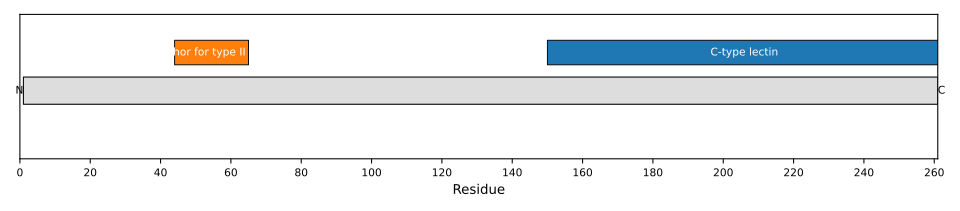
1: Inhibitory receptor postulated to negatively regulate immune and non-immune functions (PubMed:17562706, PubMed:34310951). Upon phosphorylation, recruits SH2 domain-containing PTPN6 and PTPN11 phosphatases to its ITIM motif and antagonizes activation signals (PubMed:17562706, PubMed:34310951). Although it inhibits KLRK1/NKG2D-mediated signaling, it does not bind known ligands of KLRK1/NKG2D and therefore is not its inhibitory counterpart (PubMed:17562706). May limit activation of myeloid cell subsets in response to infection or tissue inflammation (PubMed:17562706). May protect target cells against natural killer cell-mediated lysis (PubMed:17562706). May negatively regulate cell cycle and differentiation of melanocytes via inactivation of STAT3 (PubMed:34310951)