Kelch-like protein 22
1_MAEEQ 6_ EFTQL 11_ CKLPA 16_ QPSHP 21_ HCVNN 26_ TYRSA 31_ QHSQA 36_ LLRGL 41_ LALRD 46_ SGILF 51_ DVVLV 56_ VEGRH 61_ IEAHR 66_ ILLAA 71_ SCDYF 76_ RGMFA 81_ GGLKE 86_ MEQEE 91_ VLIHG 96_ VSYNA 101_ MCQIL 106_ HFIYT 111_ SELEL 116_ SLSNV 121_ QETLV 126_ AACQL 131_ QIPEI 136_ IHFCC 141_ DFLMS 146_ WVDEE 151_ NILDV 156_ YRLAE 161_ LFDLS 166_ RLTEQ 171_ LDTYI 176_ LKNFV 181_ AFSRT 186_ DKYRQ 191_ LPLEK 196_ VYSLL 201_ SSNRL 206_ EVSCE 211_ TEVYE 216_ GALLY 221_ HYSLE 226_ QVQAD 231_ QISLH 236_ EPPKL 241_ LETVR 246_ FPLME 251_ AEVLQ 256_ RLHDK 261_ LDPSP 266_ LRDTV 271_ ASALM 276_ YHRNE 281_ SLQPS 286_ LQSPQ 291_ TELRS 296_ DFQCV 301_ VGFGG 306_ IHSTP 311_ STVLS 316_ DQAKY 321_ LNPLL 326_ GEWKH 331_ FTASL 336_ APRMS 341_ NQGIA 346_ VLNNF 351_ VYLIG 356_ GDNNV 361_ QGFRA 366_ ESRCW 371_ RYDPR 376_ HNRWF 381_ QIQSL 386_ QQEHA 391_ DLSVC 396_ VVGRY 401_ IYAVA 406_ GRDYH 411_ NDLNA 416_ VERYD 421_ PATNS 426_ WAYVA 431_ PLKRE 436_ VYAHA 441_ GATLE 446_ GKMYI 451_ TCGRR 456_ GEDYL 461_ KETHC 466_ YDPGS 471_ NTWHT 476_ LADGP 481_ VRRAW 486_ HGMAT 491_ LLNKL 496_ YVIGG 501_ SNNDA 506_ GYRRD 511_ VHQVA 516_ CYSCT 521_ SGQWS 526_ SVCPL 531_ PAGHG 536_ EPGIA 541_ VLDNR 546_ IYVLG 551_ GRSHN 556_ RGSRT 561_ GYVHI 566_ YDVEK 571_ DCWEE 576_ GPQLD 581_ NSISG 586_ LAACV 591_ LTLPR 596_ SLLLE 601_ PPRGT 606_ PDRSQ 611_ ADPDF 616_ ASEVM 621_ SVSDW 626_EEFDN
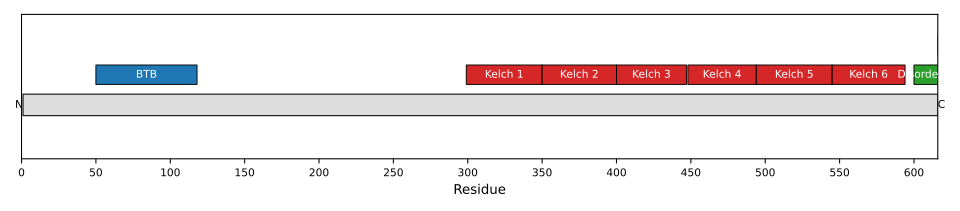
1: Substrate-specific adapter of a BCR (BTB-CUL3-RBX1) E3 ubiquitin ligase complex required for chromosome alignment and localization of PLK1 at kinetochores. The BCR(KLHL22) ubiquitin ligase complex mediates monoubiquitination of PLK1, leading to PLK1 dissociation from phosphoreceptor proteins and subsequent removal from kinetochores, allowing silencing of the spindle assembly checkpoint (SAC) and chromosome segregation. Monoubiquitination of PLK1 does not lead to PLK1 degradation (PubMed:19995937, PubMed:23455478). The BCR(KLHL22) ubiquitin ligase complex is also responsible for the amino acid-stimulated 'Lys-48' polyubiquitination and proteasomal degradation of DEPDC5. Through the degradation of DEPDC5, releases the GATOR1 complex-mediated inhibition of the TORC1 pathway. It is therefore an amino acid-dependent activator within the amino acid-sensing branch of the TORC1 pathway, indirectly regulating different cellular processes including cell growth and autophagy (PubMed:29769719)