Plasma membrane ascorbate-dependent reductase CYBRD1 (EC 7.2.1.3) (Cytochrome b reductase 1) (Duodenal cytochrome b) (Ferric-chelate reductase 3)
1_MAMEG 6_ YWRFL 11_ ALLGS 16_ ALLVG 21_ FLSVI 26_ FALVW 31_ VLHYR 36_ EGLGW 41_ DGSAL 46_ EFNWH 51_ PVLMV 56_ TGFVF 61_ IQGIA 66_ IIVYR 71_ LPWTW 76_ KCSKL 81_ LMKSI 86_ HAGLN 91_ AVAAI 96_ LAIIS 101_ VVAVF 106_ ENHNV 111_ NNIAN 116_ MYSLH 121_ SWVGL 126_ IAVIC 131_ YLLQL 136_ LSGFS 141_ VFLLP 146_ WAPLS 151_ LRAFL 156_ MPIHV 161_ YSGIV 166_ IFGTV 171_ IATAL 176_ MGLTE 181_ KLIFS 186_ LRDPA 191_ YSTFP 196_ PEGVF 201_ VNTLG 206_ LLILV 211_ FGALI 216_ FWIVT 221_ RPQWK 226_ RPKEP 231_ NSTIL 236_ HPNGG 241_ TEQGA 246_ RGSMP 251_ AYSGN 256_ NMDKS 261_ DSELN 266_ SEVAA 271_ RKRNL 276_ ALDEA 281_GQRST
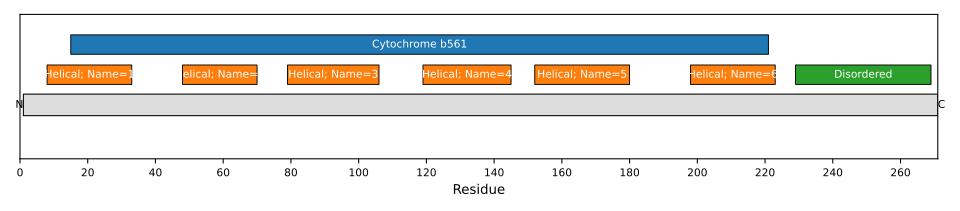
1: Plasma membrane reductase that uses cytoplasmic ascorbate as an electron donor to reduce extracellular Fe(3+) into Fe(2+) (PubMed:30272000). Probably functions in dietary iron absorption at the brush border of duodenal enterocytes by producing Fe(2+), the divalent form of iron that can be transported into enterocytes (PubMed:30272000). It is also able to reduce extracellular monodehydro-L-ascorbate and may be involved in extracellular ascorbate regeneration by erythrocytes in blood (PubMed:17068337). May also act as a ferrireductase in airway epithelial cells (Probable). May also function as a cupric transmembrane reductase (By similarity)