Endoribonuclease ZC3H12A (EC 3.1.-.-) (Monocyte chemotactic protein-induced protein 1) (MCP-induced protein 1) (MCPIP-1) (Regnase-1) (Reg1) (Zinc finger CCCH domain-containing protein 12A)
1_MSGPC 6_ GEKPV 11_ LEASP 16_ TMSLW 21_ EFEDS 26_ HSRQG 31_ TPRPG 36_ QELAA 41_ EEASA 46_ LELQM 51_ KVDFF 56_ RKLGY 61_ SSTEI 66_ HSVLQ 71_ KLGVQ 76_ ADTNT 81_ VLGEL 86_ VKHGT 91_ ATERE 96_ RQTSP 101_ DPCPQ 106_ LPLVP 111_ RGGGT 116_ PKAPN 121_ LEPPL 126_ PEEEK 131_ EGSDL 136_ RPVVI 141_ DGSNV 146_ AMSHG 151_ NKEVF 156_ SCRGI 161_ LLAVN 166_ WFLER 171_ GHTDI 176_ TVFVP 181_ SWRKE 186_ QPRPD 191_ VPITD 196_ QHILR 201_ ELEKK 206_ KILVF 211_ TPSRR 216_ VGGKR 221_ VVCYD 226_ DRFIV 231_ KLAYE 236_ SDGIV 241_ VSNDT 246_ YRDLQ 251_ GERQE 256_ WKRFI 261_ EERLL 266_ MYSFV 271_ NDKFM 276_ PPDDP 281_ LGRHG 286_ PSLDN 291_ FLRKK 296_ PLTLE 301_ HRKQP 306_ CPYGR 311_ KCTYG 316_ IKCRF 321_ FHPER 326_ PSCPQ 331_ RSVAD 336_ ELRAN 341_ ALLSP 346_ PRAPS 351_ KDKNG 356_ RRPSP 361_ SSQSS 366_ SLLTE 371_ SEQCS 376_ LDGKK 381_ LGAQA 386_ SPGSR 391_ QEGLT 396_ QTYAP 401_ SGRSL 406_ APSGG 411_ SGSSF 416_ GPTDW 421_ LPQTL 426_ DSLPY 431_ VSQDC 436_ LDSGI 441_ GSLES 446_ QMSEL 451_ WGVRG 456_ GGPGE 461_ PGPPR 466_ APYTG 471_ YSPYG 476_ SELPA 481_ TAAFS 486_ AFGRA 491_ MGAGH 496_ FSVPA 501_ DYPPA 506_ PPAFP 511_ PREYW 516_ SEPYP 521_ LPPPT 526_ SVLQE 531_ PPVQS 536_ PGAGR 541_ SPWGR 546_ AGSLA 551_ KEQAS 556_ VYTKL 561_ CGVFP 566_ PHLVE 571_ AVMGR 576_ FPQLL 581_ DPQQL 586_ AAEIL 591_SYKSQ
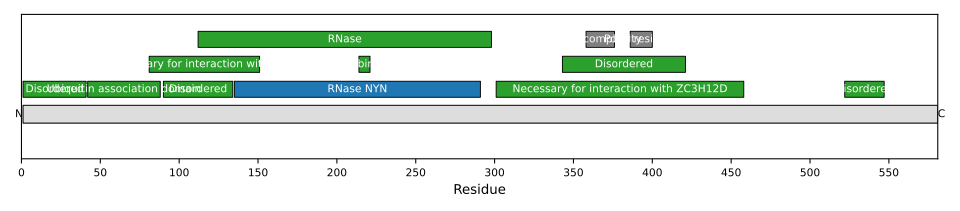
1: Endoribonuclease involved in various biological functions such as cellular inflammatory response and immune homeostasis, glial differentiation of neuroprogenitor cells, cell death of cardiomyocytes, adipogenesis and angiogenesis. Functions as an endoribonuclease involved in mRNA decay (PubMed:19909337). Modulates the inflammatory response by promoting the degradation of a set of translationally active cytokine-induced inflammation-related mRNAs, such as IL6 and IL12B, during the early phase of inflammation (PubMed:26320658). Prevents aberrant T-cell-mediated immune reaction by degradation of multiple mRNAs controlling T-cell activation, such as those encoding cytokines (IL6 and IL2), cell surface receptors (ICOS, TNFRSF4 and TNFR2) and transcription factor (REL) (By similarity). Inhibits cooperatively with ZC3H12A the differentiation of helper T cells Th17 in lungs. They repress target mRNA encoding the Th17 cell-promoting factors IL6, ICOS, REL, IRF4, NFKBID and NFKBIZ. The cooperation requires RNA-binding by RC3H1 and the nuclease activity of ZC3H12A (By similarity). Together with RC3H1, destabilizes TNFRSF4/OX40 mRNA by binding to the conserved stem loop structure in its 3'UTR (By similarity). Self regulates by destabilizing its own mRNA (By similarity). Cleaves mRNA harboring a stem-loop (SL), often located in their 3'-UTRs, during the early phase of inflammation in a helicase UPF1-dependent manner (PubMed:19909337, PubMed:22561375, PubMed:26134560, PubMed:26320658). Plays a role in the inhibition of microRNAs (miRNAs) biogenesis (PubMed:22055188). Cleaves the terminal loop of a set of precursor miRNAs (pre-miRNAs) important for the regulation of the inflammatory response leading to their degradation, and thus preventing the biosynthesis of mature miRNAs (PubMed:22055188). Also plays a role in promoting angiogenesis in response to inflammatory cytokines by inhibiting the production of antiangiogenic microRNAs via its anti-dicer RNase activity (PubMed:24048733). Affects the overall ubiquitination of cellular proteins (By similarity). Positively regulates deubiquitinase activity promoting the cleavage at 'Lys-48'- and 'Lys-63'-linked polyubiquitin chains on TNF receptor-associated factors (TRAFs), preventing JNK and NF-kappa-B signaling pathway activation, and hence negatively regulating macrophage-mediated inflammatory response and immune homeostasis (By similarity). Also induces deubiquitination of the transcription factor HIF1A, probably leading to its stabilization and nuclear import, thereby positively regulating the expression of proangiogenic HIF1A-targeted genes (PubMed:24048733). Involved in a TANK-dependent negative feedback response to attenuate NF-kappaB activation through the deubiquitination of IKBKG or TRAF6 in response to interleukin-1-beta (IL1B) stimulation or upon DNA damage (PubMed:25861989). Prevents stress granule (SGs) formation and promotes macrophage apoptosis under stress conditions, including arsenite-induced oxidative stress, heat shock and energy deprivation (By similarity). Plays a role in the regulation of macrophage polarization; promotes IL4-induced polarization of macrophages M1 into anti-inflammatory M2 state (By similarity). May also act as a transcription factor that regulates the expression of multiple genes involved in inflammatory response, angiogenesis, adipogenesis and apoptosis (PubMed:16574901, PubMed:18364357). Functions as a positive regulator of glial differentiation of neuroprogenitor cells through an amyloid precursor protein (APP)-dependent signaling pathway (PubMed:19185603). Attenuates septic myocardial contractile dysfunction in response to lipopolysaccharide (LPS) by reducing I-kappa-B-kinase (IKK)-mediated NF-kappa-B activation, and hence myocardial pro-inflammatory cytokine production (By similarity)
2: (Microbial infection) Binds to Japanese encephalitis virus (JEV) and Dengue virus (DEN) RNAs
3: (Microbial infection) Exhibits antiviral activity against HIV-1 in lymphocytes by decreasing the abundance of HIV-1 viral RNA species