C-type lectin domain family 12 member A (C-type lectin-like molecule 1) (CLL-1) (Dendritic cell-associated lectin 2) (DCAL-2) (Myeloid inhibitory C-type lectin-like receptor) (MICL) (CD antigen CD371)
1_MSEEV 6_ TYADL 11_ QFQNS 16_ SEMEK 21_ IPEIG 26_ KFGEK 31_ APPAP 36_ SHVWR 41_ PAALF 46_ LTLLC 51_ LLLLI 56_ GLGVL 61_ ASMFH 66_ VTLKI 71_ EMKKM 76_ NKLQN 81_ ISEEL 86_ QRNIS 91_ LQLMS 96_ NMNIS 101_ NKIRN 106_ LSTTL 111_ QTIAT 116_ KLCRE 121_ LYSKE 126_ QEHKC 131_ KPCPR 136_ RWIWH 141_ KDSCY 146_ FLSDD 151_ VQTWQ 156_ ESKMA 161_ CAAQN 166_ ASLLK 171_ INNKN 176_ ALEFI 181_ KSQSR 186_ SYDYW 191_ LGLSP 196_ EEDST 201_ RGMRV 206_ DNIIN 211_ SSAWV 216_ IRNAP 221_ DLNNM 226_ YCGYI 231_ NRLYV 236_ QYYHC 241_ TYKKR 246_ MICEK 251_ MANPV 256_QLGST
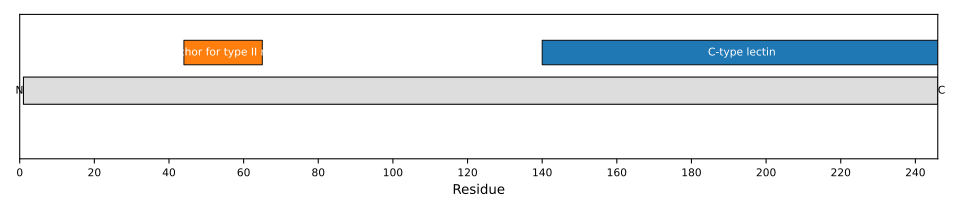
1: Myeloid inhibitory C-type lectin receptor that acts as a negative regulator of myeloid cell activation (PubMed:14739280, PubMed:15238421, PubMed:16239426, PubMed:34234773, PubMed:38367667, PubMed:38386511, PubMed:39143217). Myeloid cell inhibition is required to limit proinflammatory pathways and protect against excessive inflammation (By similarity). Specifically recognizes and binds various structures, such as neutrophil extracellular traps (NETs) or monosodium urate crystals (PubMed:38367667, PubMed:38386511, PubMed:39143217). Also acts as a pattern-recognition receptor for pathogen-associated molecules, such as plasmodium hemozoin or mycobacterial micolic acid (PubMed:31269448, PubMed:36542980). Ligand-binding induces phosphorylation of its ITIM motif, followed by recruitment of tyrosine-protein phosphatases PTPN6 and PTPN11, which counteract tyrosine-protein kinase SYK, thereby preventing myeloid cell activation (PubMed:14739280, PubMed:16239426, PubMed:34234773). Acts as a pattern-recognition receptor for NETs in neutrophils: specifically recognizes DNA in NETs, leading to inhibit neutrophil activation and limit further NET formation (PubMed:39143217). This regulation is essential for controlling key neutrophil responses and limit NET-mediated inflammatory conditions (By similarity). Also recognizes dead cells by acting as a receptor for monosodium urate crystals, leading to down-regulate neutrophil activation (PubMed:38367667, PubMed:38386511). Binding to monosodium urate crystals also promotes the type I interferon response (By similarity). Acts as an inhibitor of natural killer (NK) cell cytotoxicity (PubMed:15238421). Also acts as an ihibitor of dendritic cell maturation in an IL10-dependent manner (PubMed:16239426)