Alkaline ceramidase 2 (AlkCDase 2) (Alkaline CDase 2) (haCER2) (EC 3.5.1.-) (EC 3.5.1.23) (Acylsphingosine deacylase 3-like) (N-acylsphingosine amidohydrolase 3-like)
1_MGAPH 6_ WWDQL 11_ QAGSS 16_ EVDWC 21_ EDNYT 26_ IVPAI 31_ AEFYN 36_ TISNV 41_ LFFIL 46_ PPICM 51_ CLFRQ 56_ YATCF 61_ NSGIY 66_ LIWTL 71_ LVVVG 76_ IGSVY 81_ FHATL 86_ SFLGQ 91_ MLDEL 96_ AVLWV 101_ LMCAL 106_ AMWFP 111_ RRYLP 116_ KIFRN 121_ DRGRF 126_ KVVVS 131_ VLSAV 136_ TTCLA 141_ FVKPA 146_ INNIS 151_ LMTLG 156_ VPCTA 161_ LLIAE 166_ LKRCD 171_ NMRVF 176_ KLGLF 181_ SGLWW 186_ TLALF 191_ CWISD 196_ RAFCE 201_ LLSSF 206_ NFPYL 211_ HCMWH 216_ ILICL 221_ AAYLG 226_ CVCFA 231_ YFDAA 236_ SEIPE 241_ QGPVI 246_ KFWPN 251_ EKWAF 256_ IGVPY 261_ VSLLC 266_ANKKS
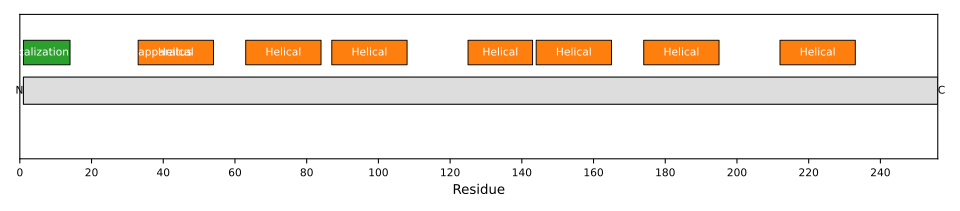
1: Golgi ceramidase that catalyzes the hydrolysis of ceramides into sphingoid bases like sphingosine and free fatty acids at alkaline pH (PubMed:16940153, PubMed:18945876, PubMed:20089856, PubMed:20207939). Ceramides, sphingosine, and its phosphorylated form sphingosine-1-phosphate are bioactive lipids that mediate cellular signaling pathways regulating several biological processes including cell proliferation, apoptosis and differentiation (PubMed:20207939). Has a better catalytic efficiency towards unsaturated long-chain ceramides, including C18:1-, C20:1- and C24:1-ceramides (PubMed:16940153, PubMed:18945876, PubMed:20089856, PubMed:20207939). Saturated long-chain ceramides and unsaturated very long-chain ceramides are also good substrates, whereas saturated very long-chain ceramides and short-chain ceramides are poor substrates (PubMed:20089856). Also hydrolyzes dihydroceramides to produce dihydrosphingosine (PubMed:20207939, PubMed:20628055). It is the ceramidase that controls the levels of circulating sphingosine-1-phosphate and dihydrosphingosine-1-phosphate in plasma through their production by hematopoietic cells (By similarity). Regulates cell proliferation, autophagy and apoptosis by the production of sphingosine and sphingosine-1-phosphate (PubMed:16940153, PubMed:26943039, PubMed:28294157, PubMed:29229990). As part of a p53/TP53-dependent pathway, promotes for instance autophagy and apoptosis in response to DNA damage (PubMed:26943039, PubMed:28294157, PubMed:29229990). Through the production of sphingosine, may also regulate the function of the Golgi complex and regulate the glycosylation of proteins (PubMed:18945876)