Exosome complex component MTR3 (Exosome component 6) (mRNA transport regulator 3 homolog) (hMtr3) (p11)
1_MPGDH 6_ RRIRG 11_ PEESQ 16_ PPQLY 21_ AADEE 26_ EAPGT 31_ RDPTR 36_ LRPVY 41_ ARAGL 46_ LSQAK 51_ GSAYL 56_ EAGGT 61_ KVLCA 66_ VSGPR 71_ QAEGG 76_ ERGGG 81_ PAGAG 86_ GEAPA 91_ ALRGR 96_ LLCDF 101_ RRAPF 106_ AGRRR 111_ RAPPG 116_ GCEER 121_ ELALA 126_ LQEAL 131_ EPAVR 136_ LGRYP 141_ RAQLE 146_ VSALL 151_ LEDGG 156_ SALAA 161_ ALTAA 166_ ALALA 171_ DAGVE 176_ MYDLV 181_ VGCGL 186_ SLAPG 191_ PAPTW 196_ LLDPT 201_ RLEEE 206_ RAAAG 211_ LTVAL 216_ MPVLN 221_ QVAGL 226_ LGSGE 231_ GGLTE 236_ SWAEA 241_ VRLGL 246_ EGCQR 251_ LYPVL 256_ QQSLV 261_ RAARR 266_RGAAA
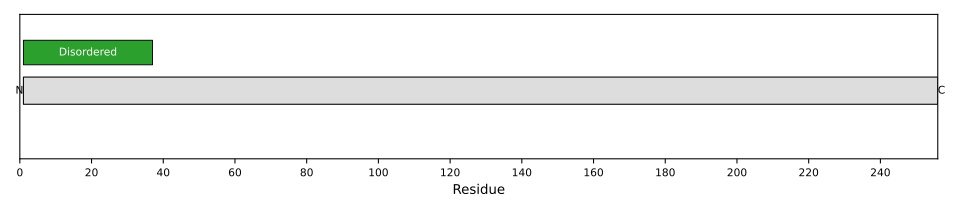
1: Non-catalytic component of the RNA exosome complex which has 3'->5' exoribonuclease activity and participates in a multitude of cellular RNA processing and degradation events. In the nucleus, the RNA exosome complex is involved in proper maturation of stable RNA species such as rRNA, snRNA and snoRNA, in the elimination of RNA processing by-products and non-coding 'pervasive' transcripts, such as antisense RNA species and promoter-upstream transcripts (PROMPTs), and of mRNAs with processing defects, thereby limiting or excluding their export to the cytoplasm. The RNA exosome may be involved in Ig class switch recombination (CSR) and/or Ig variable region somatic hypermutation (SHM) by targeting AICDA deamination activity to transcribed dsDNA substrates. In the cytoplasm, the RNA exosome complex is involved in general mRNA turnover and specifically degrades inherently unstable mRNAs containing AU-rich elements (AREs) within their 3' untranslated regions, and in RNA surveillance pathways, preventing translation of aberrant mRNAs. It seems to be involved in degradation of histone mRNA. The catalytic inactive RNA exosome core complex of 9 subunits (Exo-9) is proposed to play a pivotal role in the binding and presentation of RNA for ribonucleolysis, and to serve as a scaffold for the association with catalytic subunits and accessory proteins or complexes