ER membrane protein complex subunit 10 (Hematopoietic signal peptide-containing membrane domain-containing protein 1)
1_MAAAS 6_ AGATR 11_ LLLLL 16_ LMAVA 21_ APSRA 26_ RGSGC 31_ RAGTG 36_ ARGAG 41_ AEGRE 46_ GEACG 51_ TVGLL 56_ LEHSF 61_ EIDDS 66_ ANFRK 71_ RGSLL 76_ WNQQD 81_ GTLSL 86_ SQRQL 91_ SEEER 96_ GRLRD 101_ VAALN 106_ GLYRV 111_ RIPRR 116_ PGALD 121_ GLEAG 126_ GYVSS 131_ FVPAC 136_ SLVES 141_ HLSDQ 146_ LTLHV 151_ DVAGN 156_ VVGVS 161_ VVTHP 166_ GGCRG 171_ HEVED 176_ VDLEL 181_ FNTSV 186_ QLQPP 191_ TTAPG 196_ PETAA 201_ FIERL 206_ EMEQA 211_ QKAKN 216_ PQEQK 221_ SFFAK 226_ YWMYI 231_ IPVVL 236_ FLMMS 241_ GAPDT 246_ GGQGG 251_ GGGGG 256_GGGGS
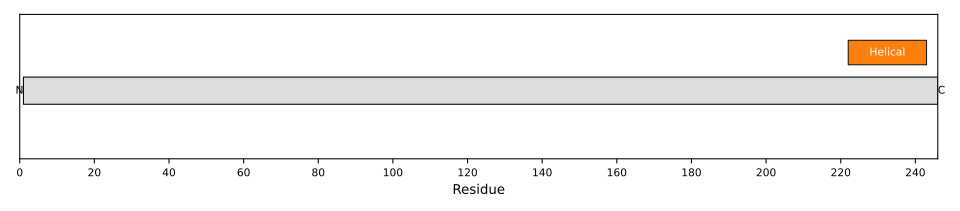
1: Part of the endoplasmic reticulum membrane protein complex (EMC) that enables the energy-independent insertion into endoplasmic reticulum membranes of newly synthesized membrane proteins (PubMed:29242231, PubMed:29809151, PubMed:30415835, PubMed:32439656, PubMed:32459176). Preferentially accommodates proteins with transmembrane domains that are weakly hydrophobic or contain destabilizing features such as charged and aromatic residues (PubMed:29242231, PubMed:29809151, PubMed:30415835). Involved in the cotranslational insertion of multi-pass membrane proteins in which stop-transfer membrane-anchor sequences become ER membrane spanning helices (PubMed:29809151, PubMed:30415835). It is also required for the post-translational insertion of tail-anchored/TA proteins in endoplasmic reticulum membranes (PubMed:29242231, PubMed:29809151). By mediating the proper cotranslational insertion of N-terminal transmembrane domains in an N-exo topology, with translocated N-terminus in the lumen of the ER, controls the topology of multi-pass membrane proteins like the G protein-coupled receptors (PubMed:30415835). By regulating the insertion of various proteins in membranes, it is indirectly involved in many cellular processes (Probable). Promotes angiogenesis and tissue repair in the heart after myocardial infarction. Stimulates cardiac endothelial cell migration and outgrowth via the activation of p38 MAPK, PAK and MAPK2 signaling pathways (PubMed:28931551)