Integrator complex subunit 3 (Int3) (SOSS complex subunit A) (Sensor of single-strand DNA complex subunit A) (SOSS-A) (Sensor of ssDNA subunit A)
1_MELQK 6_ GKGAA 11_ AAAAA 16_ SGAAG 21_ GGGGG 26_ AGAGA 31_ PGGGR 36_ LLLST 41_ SLDAK 46_ DELEE 51_ RLERC 56_ MSIVT 61_ SMTAG 66_ VSERE 71_ ANDAL 76_ NAYVC 81_ KGLPQ 86_ HEEIC 91_ LGLFT 96_ LILTE 101_ PAQAQ 106_ KCYRD 111_ LALVS 116_ RDGMN 121_ IVLNK 126_ INQIL 131_ MEKYL 136_ KLQDT 141_ CRTQL 146_ VWLVR 151_ ELVKS 156_ GVLGA 161_ DGVCM 166_ TFMKQ 171_ IAGGG 176_ DVTAK 181_ NIWLA 186_ ESVLD 191_ ILTEQ 196_ REWVL 201_ KSSIL 206_ IAMAV 211_ YTYLR 216_ LIVDH 221_ HGTAQ 226_ LQALR 231_ QKEVD 236_ FCISL 241_ LRERF 246_ MECLM 251_ IGRDL 256_ VRLLQ 261_ NVARI 266_ PEFEL 271_ LWKDI 276_ IHNPQ 281_ ALSPQ 286_ FTGIL 291_ QLLQS 296_ RTSRK 301_ FLACR 306_ LTPDM 311_ ETKLL 316_ FMTSR 321_ VRFGQ 326_ QKRYQ 331_ DWFQR 336_ QYLST 341_ PDSQS 346_ LRCDL 351_ IRYIC 356_ GVVHP 361_ SNEVL 366_ SSDIL 371_ PRWAI 376_ IGWLL 381_ TTCTS 386_ NVAAS 391_ NAKLA 396_ LFYDW 401_ LFFSP 406_ DKDSI 411_ MNIEP 416_ AILVM 421_ HHSMK 426_ PHPAI 431_ TATLL 436_ DFMCR 441_ IIPNF 446_ YPPLE 451_ GHVRQ 456_ GVFSS 461_ LNHIV 466_ EKRVL 471_ AHLAP 476_ LFDNP 481_ KLDKE 486_ LRAML 491_ REKFP 496_ EFCSS 501_ PSPPV 506_ EVKIE 511_ EPVSM 516_ EMDNH 521_ MSDKD 526_ ESCYD 531_ NAEAA 536_ FSDDE 541_ EDLNS 546_ KGKKR 551_ EFRFH 556_ PIKET 561_ VVEEP 566_ VDITP 571_ YLDQL 576_ DESLR 581_ DKVLQ 586_ LQKGS 591_ DTEAQ 596_ CEVMQ 601_ EIVDQ 606_ VLEED 611_ FDSEQ 616_ LSVLA 621_ SCLQE 626_ LFKAH 631_ FRGEV 636_ LPEEI 641_ TEESL 646_ EESVG 651_ KPLYL 656_ IFRNL 661_ CQMQE 666_ DNSSF 671_ SLLLD 676_ LLSEL 681_ YQKQP 686_ KIGYH 691_ LLYYL 696_ RASKA 701_ AAGKM 706_ NLYES 711_ FAQAT 716_ QLGDL 721_ HTCLM 726_ MDMKA 731_ CQEDD 736_ VRLLC 741_ HLTPS 746_ IYTEF 751_ PDETL 756_ RSGEL 761_ LNMIV 766_ AVIDS 771_ AQLQE 776_ LVCHV 781_ MMGNL 786_ VMFRK 791_ DSVLN 796_ ILIQS 801_ LDWET 806_ FEQYC 811_ AWQLF 816_ LAHNI 821_ PLETI 826_ IPILQ 831_ HLKYK 836_ EHPEA 841_ LSCLL 846_ LQLRR 851_ EKPSE 856_ EMVKM 861_ VLSRP 866_ CHPDD 871_ QFTTS 876_ ILRHW 881_ CMKHD 886_ ELLAE 891_ HIKSL 896_ LIKNN 901_ SLPRK 906_ RQSLR 911_ SSSSK 916_ LAQLT 921_ LEQIL 926_ EHLDN 931_ LRLNL 936_ TNTKQ 941_ NFFSQ 946_ TPILQ 951_ ALQHV 956_ QASCD 961_ EAHKM 966_ KFSDL 971_ FSLAE 976_ EYEDS 981_ STKPP 986_ KSRRK 991_ AALSS 996_ PRSRK 1001_ NATQP 1006_ PNAEE 1011_ ESGSS 1016_ SASEE 1021_ EDTKP 1026_ KPTKR 1031_ KRKGS 1036_SAVGS
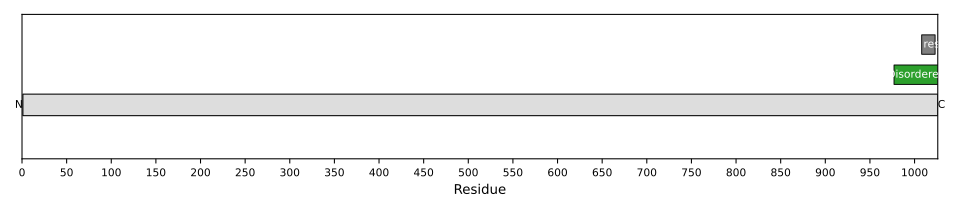
1: Component of the integrator complex, a multiprotein complex that terminates RNA polymerase II (Pol II) transcription in the promoter-proximal region of genes (PubMed:38570683). The integrator complex provides a quality checkpoint during transcription elongation by driving premature transcription termination of transcripts that are unfavorably configured for transcriptional elongation: the complex terminates transcription by (1) catalyzing dephosphorylation of the C-terminal domain (CTD) of Pol II subunit POLR2A/RPB1 and SUPT5H/SPT5, (2) degrading the exiting nascent RNA transcript via endonuclease activity and (3) promoting the release of Pol II from bound DNA (PubMed:38570683). The integrator complex is also involved in terminating the synthesis of non-coding Pol II transcripts, such as enhancer RNAs (eRNAs), small nuclear RNAs (snRNAs), telomerase RNAs and long non-coding RNAs (lncRNAs) (PubMed:16239144). Within the integrator complex, INTS3 is involved in the post-termination step: INTS3 binds INTS7 in the open conformation of integrator complex and prevents the rebinding of Pol II to the integrator after termination cycle (PubMed:38570683). Mediates recruitment of cytoplasmic dynein to the nuclear envelope, probably as component of the integrator complex (PubMed:23904267)
2: Component of the SOSS complex, a multiprotein complex that functions downstream of the MRN complex to promote DNA repair and G2/M checkpoint. The SOSS complex associates with single-stranded DNA at DNA lesions and influences diverse endpoints in the cellular DNA damage response including cell-cycle checkpoint activation, recombinational repair and maintenance of genomic stability. The SOSS complex is required for efficient homologous recombination-dependent repair of double-strand breaks (DSBs) and ATM-dependent signaling pathways. In the SOSS complex, it is required for the assembly of the complex and for stabilization of the complex at DNA damage sites