DNA oxidative demethylase ALKBH2 (EC 1.14.11.33) (Alkylated DNA repair protein alkB homolog 2) (Alpha-ketoglutarate-dependent dioxygenase alkB homolog 2) (Oxy DC1)
1_MDRFL 6_ VKGAQ 11_ GGLLR 16_ KQEEQ 21_ EPTGE 26_ EPAVL 31_ GGDKE 36_ STRKR 41_ PRREA 46_ PGNGG 51_ HSAGP 56_ SWRHI 61_ RAEGL 66_ DCSYT 71_ VLFGK 76_ AEADE 81_ IFQEL 86_ EKEVE 91_ YFTGA 96_ LARVQ 101_ VFGKW 106_ HSVPR 111_ KQATY 116_ GDAGL 121_ TYTFS 126_ GLTLS 131_ PKPWI 136_ PVLER 141_ IRDHV 146_ SGVTG 151_ QTFNF 156_ VLINR 161_ YKDGC 166_ DHIGE 171_ HRDDE 176_ RELAP 181_ GSPIA 186_ SVSFG 191_ ACRDF 196_ VFRHK 201_ DSRGK 206_ SPSRR 211_ VAVVR 216_ LPLAH 221_ GSLLM 226_ MNHPT 231_ NTHWY 236_ HSLPV 241_ RKKVL 246_ APRVN 251_ LTFRK 256_ILLTK
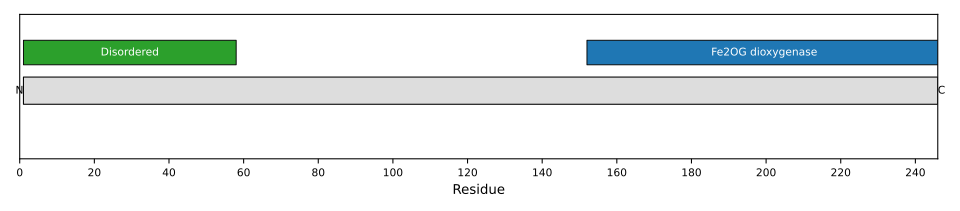
1: Dioxygenase that repairs alkylated nucleic acid bases by direct reversal oxidative dealkylation. Can process both double-stranded (ds) and single-stranded (ss) DNA substrates, with a strong preference for dsDNA (PubMed:12486230, PubMed:12594517, PubMed:16174769, PubMed:20714506, PubMed:23972994, PubMed:25797601). Uses molecular oxygen, 2-oxoglutarate and iron as cofactors to oxidize the alkyl groups that are subsequently released as aldehydes, regenerating the undamaged bases. Probes the base pair stability, locates a weakened base pair and flips the damaged base to accommodate the lesion in its active site for efficient catalysis (PubMed:18432238, PubMed:22659876). Repairs monoalkylated bases, specifically N1-methyladenine and N3-methylcytosine, as well as higher order alkyl adducts such as bases modified with exocyclic bridged adducts known as etheno adducts including 1,N6-ethenoadenine, 3,N4-ethenocytosine and 1,N2-ethenoguanine (PubMed:12486230, PubMed:12594517, PubMed:16174769, PubMed:20714506, PubMed:23972994, PubMed:25797601, PubMed:26408825). Acts as a gatekeeper of genomic integrity under alkylation stress. Efficiently repairs alkylated lesions in ribosomal DNA (rDNA). These lesions can cause ss- and dsDNA strand breaks that severely impair rDNA transcription (PubMed:23972994). In a response mechanism to DNA damage, associates with PCNA at replication forks to repair alkylated adducts prior to replication (PubMed:19736315, PubMed:26408825)