Kelch domain-containing protein 10
1_MSAAQ 6_ GWDRN 11_ RRRGG 16_ GAAGA 21_ GGGGS 26_ GAGGG 31_ SGGSG 36_ GRGTG 41_ QLNRF 46_ VQLSG 51_ RPHLP 56_ GKKKI 61_ RWDPV 66_ RRRFI 71_ QSCPI 76_ IRIPN 81_ RFLRG 86_ HRPPP 91_ ARSGH 96_ RCVAD 101_ NTNLY 106_ VFGGY 111_ NPDYD 116_ ESGGP 121_ DNEDY 126_ PLFRE 131_ LWRYH 136_ FATGV 141_ WHQMG 146_ TDGYM 151_ PRELA 156_ SMSLV 161_ LHGNN 166_ LLVFG 171_ GTGIP 176_ FGESN 181_ GNDVH 186_ VCNVK 191_ YKRWA 196_ LLSCR 201_ GKKPS 206_ RIYGQ 211_ AMAII 216_ NGSLY 221_ VFGGT 226_ TGYIY 231_ STDLH 236_ KLDLN 241_ TREWT 246_ QLKPN 251_ NLSCD 256_ LPEER 261_ YRHEI 266_ AHDGQ 271_ RIYIL 276_ GGGTS 281_ WTAYS 286_ LNKIH 291_ AYNLE 296_ TNAWE 301_ EIATK 306_ PHEKI 311_ GFPAA 316_ RRCHS 321_ CVQIK 326_ NDVFI 331_ CGGYN 336_ GEVIL 341_ GDIWK 346_ LNLQT 351_ FQWVK 356_ LPATM 361_ PEPVY 366_ FHCAA 371_ VTPAG 376_ CMYIH 381_ GGVVN 386_ IHENK 391_ RTGSL 396_ FKIWL 401_ VVPSL 406_ LELAW 411_ EKLLA 416_ AFPNL 421_ ANLSR 426_ TQLLH 431_ LGLTQ 436_GLIER
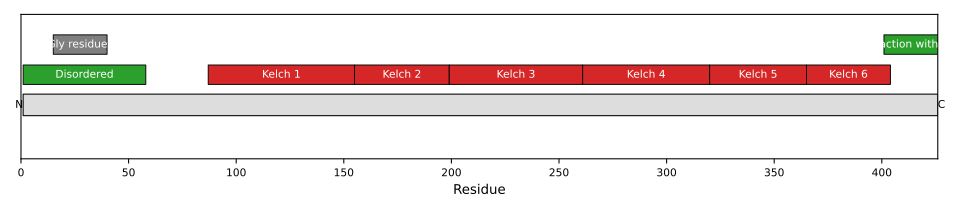
1: Substrate-recognition component of a Cul2-RING (CRL2) E3 ubiquitin-protein ligase complex of the DesCEND (destruction via C-end degrons) pathway, which recognizes a C-degron located at the extreme C-terminus of target proteins, leading to their ubiquitination and degradation (PubMed:29779948, PubMed:33909987). The C-degron recognized by the DesCEND pathway is usually a motif of less than ten residues and can be present in full-length proteins, truncated proteins or proteolytically cleaved forms (PubMed:29779948, PubMed:33909987, PubMed:39548056). The CRL2(KLHDC10) complex specifically recognizes proteins with a proline-glycine (Pro-Gly) or an alanine tail (CAT tail) at the C-terminus, leading to their ubiquitination and degradation (PubMed:29779948, PubMed:33909987). The CRL2(KLHDC10) complex is involved in the ribosome-associated quality control (RQC) pathway, which mediates the extraction of incompletely synthesized nascent chains from stalled ribosomes: CRL2(KLHDC10) acts downstream of NEMF and recognizes CAT tails associated with stalled nascent chains, leading to their ubiquitination and degradation (PubMed:33909987). Participates in the oxidative stress-induced cell death through MAP3K5 activation (PubMed:23102700). Inhibits PPP5C phosphatase activity on MAP3K5 (PubMed:23102700). Acts as a regulator of necroptosis (By similarity)