Solute carrier organic anion transporter family member 4C1 (OATP-H) (Organic anion transporter M1) (OATP-M1) (Solute carrier family 21 member 20)
1_MKSAK 6_ GIENL 11_ AFVPS 16_ SPDIL 21_ RRLSA 26_ SPSQI 31_ EVSAL 36_ SSDPQ 41_ RENSQ 46_ PQELQ 51_ KPQEP 56_ QKSPE 61_ PSLPS 66_ APPNV 71_ SEEKL 76_ RSLSL 81_ SEFEE 86_ GSYGW 91_ RNFHP 96_ QCLQR 101_ CNTPG 106_ GFLLH 111_ YCLLA 116_ VTQGI 121_ VVNGL 126_ VNISI 131_ STVEK 136_ RYEMK 141_ SSLTG 146_ LISSS 151_ YDISF 156_ CLLSL 161_ FVSFF 166_ GERGH 171_ KPRWL 176_ AFAAF 181_ MIGLG 186_ ALVFS 191_ LPQFF 196_ SGEYK 201_ LGSLF 206_ EDTCV 211_ TTRNS 216_ TSCTS 221_ STSSL 226_ SNYLY 231_ VFILG 236_ QLLLG 241_ AGGTP 246_ LYTLG 251_ TAFLD 256_ DSVPT 261_ HKSSL 266_ YIGTG 271_ YAMSI 276_ LGPAI 281_ GYVLG 286_ GQLLT 291_ IYIDV 296_ AMGES 301_ TDVTE 306_ DDPRW 311_ LGAWW 316_ IGFLL 321_ SWIFA 326_ WSLII 331_ PFSCF 336_ PKHLP 341_ GTAEI 346_ QAGKT 351_ SQAHQ 356_ SNSNA 361_ DVKFG 366_ KSIKD 371_ FPAAL 376_ KNLMK 381_ NAVFM 386_ CLVLS 391_ TSSEA 396_ LITTG 401_ FATFL 406_ PKFIE 411_ NQFGL 416_ TSSFA 421_ ATLGG 426_ AVLIP 431_ GAALG 436_ QILGG 441_ FLVSK 446_ FRMTC 451_ KNTMK 456_ FALFT 461_ SGVAL 466_ TLSFV 471_ FMYAK 476_ CENEP 481_ FAGVS 486_ ESYNG 491_ TGELG 496_ NLIAP 501_ CNANC 506_ NCSRS 511_ YYYPV 516_ CGDGV 521_ QYFSP 526_ CFAGC 531_ SNPVA 536_ HRKPK 541_ VYYNC 546_ SCIER 551_ KTEIT 556_ STAET 561_ FGFEA 566_ KAGKC 571_ ETHCA 576_ KLPIF 581_ LCIFF 586_ IVIIF 591_ TFMAG 596_ TPITV 601_ SILRC 606_ VNHRQ 611_ RSLAL 616_ GIQFM 621_ VLRLL 626_ GTIPG 631_ PIIFG 636_ FTIDS 641_ TCILW 646_ DINDC 651_ GIKGA 656_ CWIYD 661_ NIKMA 666_ HMLVA 671_ ISVTC 676_ KVITM 681_ FFNGF 686_ AIFLY 691_ KPPPS 696_ ATDVS 701_ FHKEN 706_ AVVTN 711_ VLAEQ 716_DLNKI
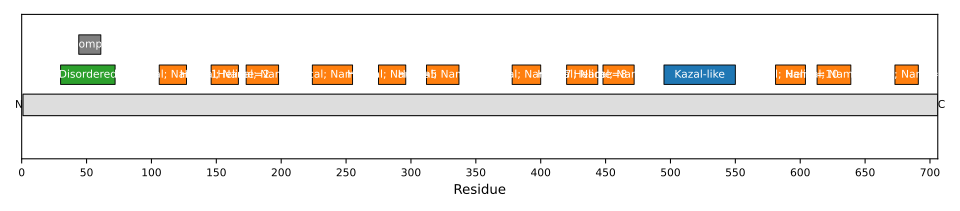
1: Mediates the transport of organic anions such as steroids (estrone 3-sulfate, chenodeoxycholate, glycocholate) and thyroid hormones (3,3',5-triiodo-L-thyronine (T3), L-thyroxine (T4)), in the kidney (PubMed:14993604, PubMed:19129463, PubMed:20610891). Capable of transporting cAMP and pharmacological substances such as digoxin, ouabain and methotrexate (PubMed:14993604). Transport is independent of sodium, chloride ion, and ATP (PubMed:14993604). Transport activity is stimulated by an acidic extracellular environment due to increased substrate affinity to the transporter (PubMed:19129463). The driving force for this transport activity is currently not known (By similarity). The role of hydrogencarbonate (HCO3(-), bicarbonate) as the probable counteranion that exchanges for organic anions is still not well defined (PubMed:19129463). Functions as an uptake transporter at the apical membrane, suggesting a role in renal reabsorption (By similarity). Involved in the renal secretion of the uremic toxin ADMA (N(omega),N(omega)-dimethyl-L-arginine or asymmetrical dimethylarginine), which is associated to cardiovascular events and mortality, and the structurally related amino acids L-arginine and L-homoarginine (a cardioprotective biomarker) (PubMed:30865704). Can act bidirectionally, suggesting a dual protective role of this transport protein; exporting L-homoarginine after being synthesized in proximal tubule cells, and mediating uptake of ADMA from the blood into proximal tubule cells where it is degraded by the enzyme dimethylarginine dimethylaminohydrolase 1 (DDAH1) (PubMed:30865704, PubMed:32642843). May be involved in sperm maturation by enabling directed movement of organic anions and compounds within or between cells (By similarity). This ion-transporting process is important to maintain the strict epididymal homeostasis necessary for sperm maturation (By similarity). May have a role in secretory functions since seminal vesicle epithelial cells are assumed to secrete proteins involved in decapacitation by modifying surface proteins to facilitate the acquisition of the ability to fertilize the egg (By similarity)