PAX-interacting protein 1 (PAX transactivation activation domain-interacting protein)
1_MSDQA 6_ PKVPE 11_ EMFRE 16_ VKYYA 21_ VGDID 26_ PQVIQ 31_ LLKAG 36_ KAKEV 41_ SYNAL 46_ ASHII 51_ SEDGD 56_ NPEVG 61_ EAREV 66_ FDLPV 71_ VKPSW 76_ VILSV 81_ QCGTL 86_ LPVNG 91_ FSPES 96_ CQIFF 101_ GITAC 106_ LSQVS 111_ SEDRS 116_ ALWAL 121_ VTFYG 126_ GDCQL 131_ TLNKK 136_ CTHLI 141_ VPEPK 146_ GEKYE 151_ CALKR 156_ ASIKI 161_ VTPDW 166_ VLDCV 171_ SEKTK 176_ KDEAF 181_ YHPRL 186_ IIYEE 191_ EEEEE 196_ EEEEE 201_ VENEE 206_ QDSQN 211_ EGSTD 216_ EKSSP 221_ ASSQE 226_ GSPSG 231_ DQQFS 236_ PKSNT 241_ EKSKG 246_ ELMFD 251_ DSSDS 256_ SPEKQ 261_ ERNLN 266_ WTPAE 271_ VPQLA 276_ AAKRR 281_ LPQGK 286_ EPGLI 291_ NLCAN 296_ VPPVP 301_ GNILP 306_ PEVRG 311_ NLMAA 316_ GQNLQ 321_ SSERS 326_ EMIAT 331_ WSPAV 336_ RTLRN 341_ ITNNA 346_ DIQQM 351_ NRPSN 356_ VAHIL 361_ QTLSA 366_ PTKNL 371_ EQQVN 376_ HSQQG 381_ HTNAN 386_ AVLFS 391_ QVKVT 396_ PETHM 401_ LQQQQ 406_ QAQQQ 411_ QQQHP 416_ VLHLQ 421_ PQQIM 426_ QLQQQ 431_ QQQQI 436_ SQQPY 441_ PQQPP 446_ HPFSQ 451_ QQQQQ 456_ QQAHP 461_ HQFSQ 466_ QQLQF 471_ PQQQL 476_ HPPQQ 481_ LHRPQ 486_ QQLQP 491_ FQQQH 496_ ALQQQ 501_ FHQLQ 506_ QHQLQ 511_ QQQLA 516_ QLQQQ 521_ HSLLQ 526_ QQQQQ 531_ QIQQQ 536_ QLQRM 541_ HQQQQ 546_ QQQMQ 551_ SQTAP 556_ HLSQT 561_ SQALQ 566_ HQVPP 571_ QQPPQ 576_ QQQQQ 581_ QPPPS 586_ PQQHQ 591_ LFGHD 596_ PAVEI 601_ PEEGF 606_ LLGCV 611_ FAIAD 616_ YPEQM 621_ SDKQL 626_ LATWK 631_ RIIQA 636_ HGGTV 641_ DPTFT 646_ SRCTH 651_ LLCES 656_ QVSSA 661_ YAQAI 666_ RERKR 671_ CVTAH 676_ WLNTV 681_ LKKKK 686_ MVPPH 691_ RALHF 696_ PVAFP 701_ PGGKP 706_ CSQHI 711_ ISVTG 716_ FVDSD 721_ RDDLK 726_ LMAYL 731_ AGAKY 736_ TGYLC 741_ RSNTV 746_ LICKE 751_ PTGLK 756_ YEKAK 761_ EWRIP 766_ CVNAQ 771_ WLGDI 776_ LLGNF 781_ EALRQ 786_ IQYSR 791_ YTAFS 796_ LQDPF 801_ APTQH 806_ LVLNL 811_ LDAWR 816_ VPLKV 821_ SAELL 826_ MSIRL 831_ PPKLK 836_ QNEVA 841_ NVQPS 846_ SKRAR 851_ IEDVP 856_ PPTKK 861_ LTPEL 866_ TPFVL 871_ FTGFE 876_ PVQVQ 881_ QYIKK 886_ LYILG 891_ GEVAE 896_ SAQKC 901_ THLIA 906_ SKVTR 911_ TVKFL 916_ TAISV 921_ VKHIV 926_ TPEWL 931_ EECFR 936_ CQKFI 941_ DEQNY 946_ ILRDA 951_ EAEVL 956_ FSFSL 961_ EESLK 966_ RAHVS 971_ PLFKA 976_ KYFYI 981_ TPGIC 986_ PSLST 991_ MKAIV 996_ ECAGG 1001_ KVLSK 1006_ QPSFR 1011_ KLMEH 1016_ KQNSS 1021_ LSEII 1026_ LISCE 1031_ NDLHL 1036_ CREYF 1041_ ARGID 1046_ VHNAE 1051_ FVLTG 1056_ VLTQT 1061_LDYES
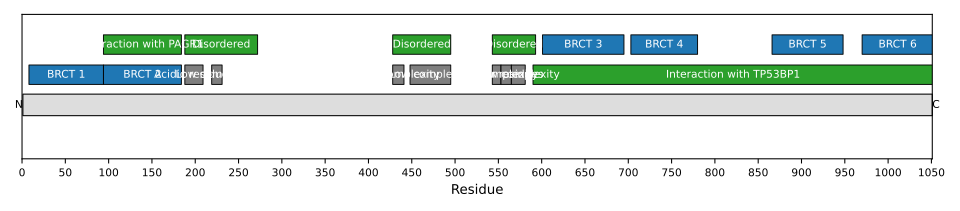
1: Involved in DNA damage response and in transcriptional regulation through histone methyltransferase (HMT) complexes. Plays a role in early development. In DNA damage response is required for cell survival after ionizing radiation. In vitro shown to be involved in the homologous recombination mechanism for the repair of double-strand breaks (DSBs). Its localization to DNA damage foci requires RNF8 and UBE2N. Recruits TP53BP1 to DNA damage foci and, at least in particular repair processes, effective DNA damage response appears to require the association with TP53BP1 phosphorylated by ATM at 'Ser-25'. Together with TP53BP1 regulates ATM association. Proposed to recruit PAGR1 to sites of DNA damage and the PAGR1:PAXIP1 complex is required for cell survival in response to DNA damage; the function is probably independent of MLL-containing histone methyltransferase (HMT) complexes. However, this function has been questioned (By similarity). Promotes ubiquitination of PCNA following UV irradiation and may regulate recruitment of polymerase eta and RAD51 to chromatin after DNA damage. Proposed to be involved in transcriptional regulation by linking MLL-containing histone methyltransferase (HMT) complexes to gene promoters by interacting with promoter-bound transcription factors such as PAX2. Associates with gene promoters that are known to be regulated by KMT2D/MLL2. During immunoglobulin class switching in activated B-cells is involved in trimethylation of histone H3 at 'Lys-4' and in transcription initiation of downstream switch regions at the immunoglobulin heavy-chain (Igh) locus; this function appears to involve the recruitment of MLL-containing HMT complexes. Conflictingly, its function in transcriptional regulation during immunoglobulin class switching is reported to be independent of the MLL2/MLL3 complex (By similarity)