Eukaryotic translation initiation factor 3 subunit M (eIF3m) (Fetal lung protein B5) (hFL-B5) (PCI domain-containing protein 1)
1_MSVPA 6_ FIDIS 11_ EEDQA 16_ AELRA 21_ YLKSK 26_ GAEIS 31_ EENSE 36_ GGLHV 41_ DLAQI 46_ IEACD 51_ VCLKE 56_ DDKDV 61_ ESVMN 66_ SVVSL 71_ LLILE 76_ PDKQE 81_ ALIES 86_ LCEKL 91_ VKFRE 96_ GERPS 101_ LRLQL 106_ LSNLF 111_ HGMDK 116_ NTPVR 121_ YTVYC 126_ SLIKV 131_ AASCG 136_ AIQYI 141_ PTELD 146_ QVRKW 151_ ISDWN 156_ LTTEK 161_ KHTLL 166_ RLLYE 171_ ALVDC 176_ KKSDA 181_ ASKVM 186_ VELLG 191_ SYTED 196_ NASQA 201_ RVDAH 206_ RCIVR 211_ ALKDP 216_ NAFLF 221_ DHLLT 226_ LKPVK 231_ FLEGE 236_ LIHDL 241_ LTIFV 246_ SAKLA 251_ SYVKF 256_ YQNNK 261_ DFIDS 266_ LGLLH 271_ EQNMA 276_ KMRLL 281_ TFMGM 286_ AVENK 291_ EISFD 296_ TMQQE 301_ LQIGA 306_ DDVEA 311_ FVIDA 316_ VRTKM 321_ VYCKI 326_ DQTQR 331_ KVVVS 336_ HSTHR 341_ TFGKQ 346_ QWQQL 351_ YDTLN 356_ AWKQN 361_ LNKVK 366_NSLLS
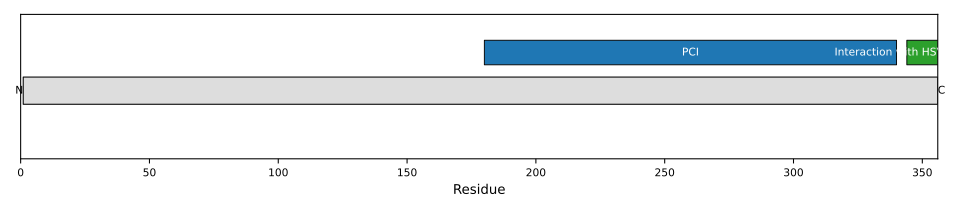
1: Component of the eukaryotic translation initiation factor 3 (eIF-3) complex, which is required for several steps in the initiation of protein synthesis (PubMed:17403899, PubMed:25849773, PubMed:27462815). The eIF-3 complex associates with the 40S ribosome and facilitates the recruitment of eIF-1, eIF-1A, eIF-2:GTP:methionyl-tRNAi and eIF-5 to form the 43S pre-initiation complex (43S PIC). The eIF-3 complex stimulates mRNA recruitment to the 43S PIC and scanning of the mRNA for AUG recognition. The eIF-3 complex is also required for disassembly and recycling of post-termination ribosomal complexes and subsequently prevents premature joining of the 40S and 60S ribosomal subunits prior to initiation (PubMed:17403899). The eIF-3 complex specifically targets and initiates translation of a subset of mRNAs involved in cell proliferation, including cell cycling, differentiation and apoptosis, and uses different modes of RNA stem-loop binding to exert either translational activation or repression (PubMed:25849773)
2: (Microbial infection) May favor virus entry in case of infection with herpes simplex virus 1 (HSV1) or herpes simplex virus 2 (HSV2)