Proton channel OTOP1 (Otopetrin-1) (hOtop1)
1_MLEGL 6_ GSPAS 11_ PRAAA 16_ SASVA 21_ GSSGP 26_ AACSP 31_ PSSSA 36_ PRSPE 41_ SPAPR 46_ RGGVR 51_ ASVPQ 56_ KLAEM 61_ LSSQY 66_ GLIVF 71_ VAGLL 76_ LLLAW 81_ AVHAA 86_ GVSKS 91_ DLLCF 96_ LTALM 101_ LLQLL 106_ WMLWY 111_ VGRSS 116_ AHRRL 121_ FRLKD 126_ THAGA 131_ GWLRG 136_ SITLF 141_ AVITV 146_ ILGCL 151_ KIGYF 156_ IGFSE 161_ CLSAT 166_ EGVFP 171_ VTHSV 176_ HTLLQ 181_ VYFLW 186_ GHAKD 191_ IIQSF 196_ KTLER 201_ FGVIH 206_ SVFTN 211_ LLLWA 216_ NGVLN 221_ ESKHQ 226_ LNEHK 231_ ERLIT 236_ LGFGN 241_ ITTVL 246_ DDHTP 251_ QCNCT 256_ PPTLC 261_ TAISH 266_ GIYYL 271_ YPFNI 276_ EYQIL 281_ ASTML 286_ YVLWK 291_ NIGRK 296_ VDSHQ 301_ HQKMQ 306_ FKSDG 311_ VMVGA 316_ VLGLT 321_ VLAAT 326_ IAVVV 331_ VYLIH 336_ IGRSK 341_ TKSES 346_ ALIMF 351_ YLYAI 356_ TLLML 361_ MGAAG 366_ LAGIR 371_ IYRID 376_ EKSLD 381_ ESKNP 386_ ARKLD 391_ SDLLV 396_ GTASG 401_ SWLIS 406_ WGSIL 411_ AILCA 416_ EGHPR 421_ YTWYN 426_ LPYSI 431_ LAIVE 436_ KYIQN 441_ LFIFE 446_ SIHRE 451_ PEKLS 456_ EDIQT 461_ LRVVT 466_ VCNGN 471_ TMPLA 476_ SSCPK 481_ SGGVA 486_ RDVAP 491_ QGKDM 496_ PPAAN 501_ GNVCM 506_ RESHD 511_ KEEEK 516_ QEESS 521_ WGGSP 526_ SPVRL 531_ PRFLQ 536_ GNAKR 541_ KVLRN 546_ IAAFL 551_ FLCNI 556_ SLWIP 561_ PAFGC 566_ RPEYD 571_ NGLEE 576_ IVFGF 581_ EPWII 586_ VVNLA 591_ MPFSI 596_ FYRMH 601_ AAASL 606_FEVYC
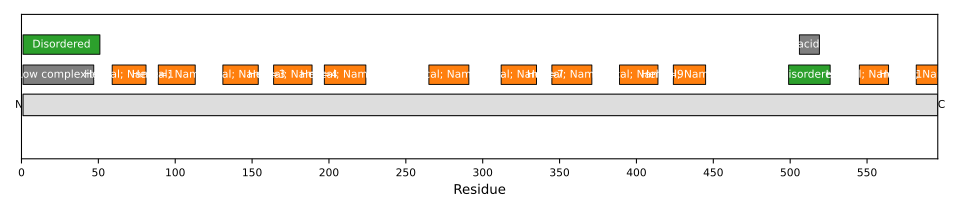
1: Proton-selective ion channel (PubMed:29371428, PubMed:36266567). Biphasically modulated by acid and alkali, mediating proton influx and efflux in response to extracellular acid and base stimulation, respectively. Sour taste receptor, which carries inward currents in response to extracellular acidification (By similarity). Sensor for ammonium chloride (NH(4)Cl) in taste receptor cells (PubMed:37798269). NH(4)Cl acts by increasing the intracellular pH, thereby generating a driving force for proton entry through OTOP1 channel (PubMed:37798269). Might also participate in alkaline sensation. Plays a role in the regulation of Ca(2+) flux in response to purigenic (ATP, ADP and UDP) stimuli, leading to increase in cytosolic Ca(2+) due to influx of extracellular calcium. May play this role by inhibiting P2Y purinoceptor-mediated Ca(2+) release in a Ca(2+)-dependent manner and promote an influx of Ca(2+) in response to ATP. Through this mechanism and possibly others, plays a role in the formation and function of calcium carbonate-based structures in the vestibular system of the inner ear, called otoconia, that sense gravity and linear acceleration. In obesity, may attenuate adipose tissue inflammation, through the negative regulation of IFNG signaling, hence may play an adaptive role in the maintainance of metabolic homeostasis. Following alkali activation, may also be permeable Na(+), K(+), Cs(+) and Li(+) (By similarity)