Potassium channel subfamily K member 18 (TWIK-related individual potassium channel) (TWIK-related spinal cord potassium channel)
1_MEVSG 6_ HPQAR 11_ RCCPE 16_ ALGKL 21_ FPGLC 26_ FLCFL 31_ VTYAL 36_ VGAVV 41_ FSAIE 46_ DGQVL 51_ VAADD 56_ GEFEK 61_ FLEEL 66_ CRILN 71_ CSETV 76_ VEDRK 81_ QDLQG 86_ HLQKV 91_ KPQWF 96_ NRTTH 101_ WSFLS 106_ SLFFC 111_ CTVFS 116_ TVGYG 121_ YIYPV 126_ TRLGK 131_ YLCML 136_ YALFG 141_ IPLMF 146_ LVLTD 151_ TGDIL 156_ ATILS 161_ TSYNR 166_ FRKFP 171_ FFTRP 176_ LLSKW 181_ CPKSL 186_ FKKKP 191_ DPKPA 196_ DEAVP 201_ QIIIS 206_ AEELP 211_ GPKLG 216_ TCPSR 221_ PSCSM 226_ ELFER 231_ SHALE 236_ KQNTL 241_ QLPPQ 246_ AMERS 251_ NSCPE 256_ LVLGR 261_ LSYSI 266_ ISNLD 271_ EVGQQ 276_ VERLD 281_ IPLPI 286_ IALIV 291_ FAYIS 296_ CAAAI 301_ LPFWE 306_ TQLDF 311_ ENAFY 316_ FCFVT 321_ LTTIG 326_ FGDTV 331_ LEHPN 336_ FFLFF 341_ SIYII 346_ VGMEI 351_ VFIAF 356_ KLVQN 361_ RLIDI 366_ YKNVM 371_ LFFAK 376_GKFYH
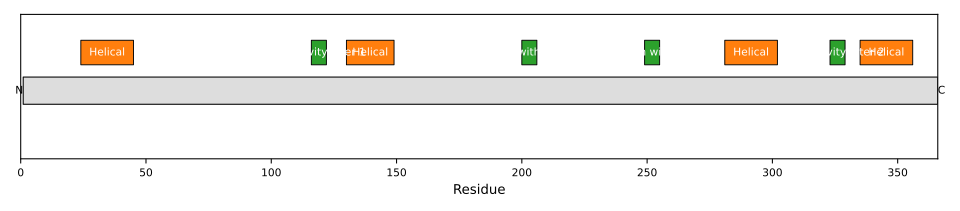
1: K(+) channel that conducts outward and inward rectifying currents at depolarized and hyperpolarized membrane potentials, respectively. The outward rectifying currents are voltage-dependent, coupled to K(+) electrochemical gradient across the membrane, whereas the inward currents can be induced in response to activation of Ca(2+)-mobilizing receptors (PubMed:12754259, PubMed:15562060, PubMed:20871611, PubMed:22355750, PubMed:26919430, PubMed:30573346). Homo- and heterodimerizes to form functional channels with distinct regulatory and gating properties. In trigeminal ganglia sensory neurons, the heterodimers of KCNK18/TRESK and KCNK2/TREK-1 or KCNK10/TREK-2 inhibit neuronal firing and neurogenic inflammation by stabilizing the resting membrane potential at K(+) equilibrium potential as well as by regulating the threshold of action potentials and the spike frequency (By similarity). In thymocytes, conducts K(+) currents upon T cell receptor (TCR) signaling leading to sustained Ca(2+) influx and NF-kappa-B activation, FOXP3 transcription and positive selection of regulatory T cell (Treg) progenitor subsets (PubMed:34702947). Appears to mediate the analgesics effects of hydroxy-alpha-sanshool, a metabolite naturally present in Schezuan pepper and other Xanthoxylum plants (By similarity)