N6-adenosine-methyltransferase catalytic subunit (EC 2.1.1.348) (Methyltransferase-like protein 3) (hMETTL3) (N6-adenosine-methyltransferase 70 kDa subunit) (MT-A70)
1_MSDTW 6_ SSIQA 11_ HKKQL 16_ DSLRE 21_ RLQRR 26_ RKQDS 31_ GHLDL 36_ RNPEA 41_ ALSPT 46_ FRSDS 51_ PVPTA 56_ PTSGG 61_ PKPST 66_ ASAVP 71_ ELATD 76_ PELEK 81_ KLLHH 86_ LSDLA 91_ LTLPT 96_ DAVSI 101_ CLAIS 106_ TPDAP 111_ ATQDG 116_ VESLL 121_ QKFAA 126_ QELIE 131_ VKRGL 136_ LQDDA 141_ HPTLV 146_ TYADH 151_ SKLSA 156_ MMGAV 161_ AEKKG 166_ PGEVA 171_ GTVTG 176_ QKRRA 181_ EQDST 186_ TVAAF 191_ ASSLV 196_ SGLNS 201_ SASEP 206_ AKEPA 211_ KKSRK 216_ HAASD 221_ VDLEI 226_ ESLLN 231_ QQSTK 236_ EQQSK 241_ KVSQE 246_ ILELL 251_ NTTTA 256_ KEQSI 261_ VEKFR 266_ SRGRA 271_ QVQEF 276_ CDYGT 281_ KEECM 286_ KASDA 291_ DRPCR 296_ KLHFR 301_ RIINK 306_ HTDES 311_ LGDCS 316_ FLNTC 321_ FHMDT 326_ CKYVH 331_ YEIDA 336_ CMDSE 341_ APGSK 346_ DHTPS 351_ QELAL 356_ TQSVG 361_ GDSSA 366_ DRLFP 371_ PQWIC 376_ CDIRY 381_ LDVSI 386_ LGKFA 391_ VVMAD 396_ PPWDI 401_ HMELP 406_ YGTLT 411_ DDEMR 416_ RLNIP 421_ VLQDD 426_ GFLFL 431_ WVTGR 436_ AMELG 441_ RECLN 446_ LWGYE 451_ RVDEI 456_ IWVKT 461_ NQLQR 466_ IIRTG 471_ RTGHW 476_ LNHGK 481_ EHCLV 486_ GVKGN 491_ PQGFN 496_ QGLDC 501_ DVIVA 506_ EVRST 511_ SHKPD 516_ EIYGM 521_ IERLS 526_ PGTRK 531_ IELFG 536_ RPHNV 541_ QPNWI 546_ TLGNQ 551_ LDGIH 556_ LLDPD 561_ VVARF 566_ KQRYP 571_DGIIS
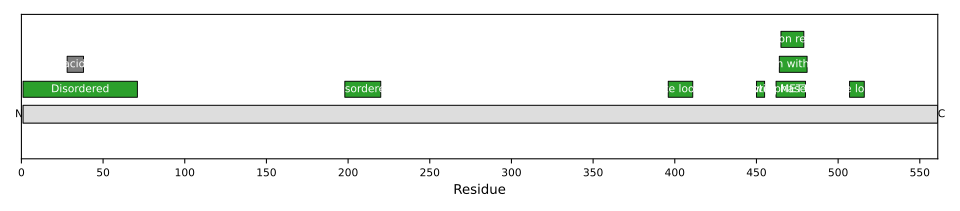
1: The METTL3-METTL14 heterodimer forms a N6-methyltransferase complex that methylates adenosine residues at the N(6) position of some RNAs and regulates various processes such as the circadian clock, differentiation of embryonic and hematopoietic stem cells, cortical neurogenesis, response to DNA damage, differentiation of T-cells and primary miRNA processing (PubMed:22575960, PubMed:24284625, PubMed:25719671, PubMed:25799998, PubMed:26321680, PubMed:26593424, PubMed:27281194, PubMed:27373337, PubMed:27627798, PubMed:28297716, PubMed:29348140, PubMed:29506078, PubMed:30428350, PubMed:9409616). In the heterodimer formed with METTL14, METTL3 constitutes the catalytic core (PubMed:27281194, PubMed:27373337, PubMed:27627798). N6-methyladenosine (m6A), which takes place at the 5'-[AG]GAC-3' consensus sites of some mRNAs, plays a role in mRNA stability, processing, translation efficiency and editing (PubMed:22575960, PubMed:24284625, PubMed:25719671, PubMed:25799998, PubMed:26321680, PubMed:26593424, PubMed:28297716, PubMed:9409616). M6A acts as a key regulator of mRNA stability: methylation is completed upon the release of mRNA into the nucleoplasm and promotes mRNA destabilization and degradation (PubMed:28637692). In embryonic stem cells (ESCs), m6A methylation of mRNAs encoding key naive pluripotency-promoting transcripts results in transcript destabilization, promoting differentiation of ESCs (By similarity). M6A regulates the length of the circadian clock: acts as an early pace-setter in the circadian loop by putting mRNA production on a fast-track for facilitating nuclear processing, thereby providing an early point of control in setting the dynamics of the feedback loop (By similarity). M6A also regulates circadian regulation of hepatic lipid metabolism (PubMed:30428350). M6A regulates spermatogonial differentiation and meiosis and is essential for male fertility and spermatogenesis (By similarity). Also required for oogenesis (By similarity). Involved in the response to DNA damage: in response to ultraviolet irradiation, METTL3 rapidly catalyzes the formation of m6A on poly(A) transcripts at DNA damage sites, leading to the recruitment of POLK to DNA damage sites (PubMed:28297716). M6A is also required for T-cell homeostasis and differentiation: m6A methylation of transcripts of SOCS family members (SOCS1, SOCS3 and CISH) in naive T-cells promotes mRNA destabilization and degradation, promoting T-cell differentiation (By similarity). Inhibits the type I interferon response by mediating m6A methylation of IFNB (PubMed:30559377). M6A also takes place in other RNA molecules, such as primary miRNA (pri-miRNAs) (PubMed:25799998). Mediates m6A methylation of Xist RNA, thereby participating in random X inactivation: m6A methylation of Xist leads to target YTHDC1 reader on Xist and promote transcription repression activity of Xist (PubMed:27602518). M6A also regulates cortical neurogenesis: m6A methylation of transcripts related to transcription factors, neural stem cells, the cell cycle and neuronal differentiation during brain development promotes their destabilization and decay, promoting differentiation of radial glial cells (By similarity). METTL3 mediates methylation of pri-miRNAs, marking them for recognition and processing by DGCR8 (PubMed:25799998). Acts as a positive regulator of mRNA translation independently of the methyltransferase activity: promotes translation by interacting with the translation initiation machinery in the cytoplasm (PubMed:27117702). Its overexpression in a number of cancer cells suggests that it may participate in cancer cell proliferation by promoting mRNA translation (PubMed:27117702). During human coronavirus SARS-CoV-2 infection, adds m6A modifications in SARS-CoV-2 RNA leading to decreased RIGI binding and subsequently dampening the sensing and activation of innate immune responses (PubMed:33961823)