Stimulator of interferon genes protein (hSTING) (Endoplasmic reticulum interferon stimulator) (ERIS) (Mediator of IRF3 activation) (hMITA) (Transmembrane protein 173)
1_MPHSS 6_ LHPSI 11_ PCPRG 16_ HGAQK 21_ AALVL 26_ LSACL 31_ VTLWG 36_ LGEPP 41_ EHTLR 46_ YLVLH 51_ LASLQ 56_ LGLLL 61_ NGVCS 66_ LAEEL 71_ RHIHS 76_ RYRGS 81_ YWRTV 86_ RACLG 91_ CPLRR 96_ GALLL 101_ LSIYF 106_ YYSLP 111_ NAVGP 116_ PFTWM 121_ LALLG 126_ LSQAL 131_ NILLG 136_ LKGLA 141_ PAEIS 146_ AVCEK 151_ GNFNV 156_ AHGLA 161_ WSYYI 166_ GYLRL 171_ ILPEL 176_ QARIR 181_ TYNQH 186_ YNNLL 191_ RGAVS 196_ QRLYI 201_ LLPLD 206_ CGVPD 211_ NLSMA 216_ DPNIR 221_ FLDKL 226_ PQQTG 231_ DHAGI 236_ KDRVY 241_ SNSIY 246_ ELLEN 251_ GQRAG 256_ TCVLE 261_ YATPL 266_ QTLFA 271_ MSQYS 276_ QAGFS 281_ REDRL 286_ EQAKL 291_ FCRTL 296_ EDILA 301_ DAPES 306_ QNNCR 311_ LIAYQ 316_ EPADD 321_ SSFSL 326_ SQEVL 331_ RHLRQ 336_ EEKEE 341_ VTVGS 346_ LKTSA 351_ VPSTS 356_ TMSQE 361_ PELLI 366_ SGMEK 371_PLPLR
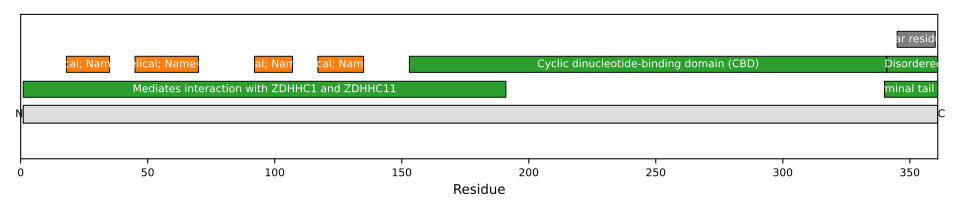
1: Facilitator of innate immune signaling that acts as a sensor of cytosolic DNA from bacteria and viruses and promotes the production of type I interferon (IFN-alpha and IFN-beta) (PubMed:18724357, PubMed:18818105, PubMed:19433799, PubMed:19776740, PubMed:23027953, PubMed:23747010, PubMed:23910378, PubMed:27801882, PubMed:29973723, PubMed:30842659, PubMed:35045565, PubMed:35388221, PubMed:36808561, PubMed:37832545, PubMed:25704810, PubMed:39255680). Innate immune response is triggered in response to non-CpG double-stranded DNA from viruses and bacteria delivered to the cytoplasm (PubMed:26300263). Acts by binding cyclic dinucleotides: recognizes and binds cyclic di-GMP (c-di-GMP), a second messenger produced by bacteria, cyclic UMP-AMP (2',3'-cUAMP), and cyclic GMP-AMP (cGAMP), a messenger produced by CGAS in response to DNA virus in the cytosol (PubMed:21947006, PubMed:23258412, PubMed:23707065, PubMed:23722158, PubMed:23747010, PubMed:23910378, PubMed:26229117, PubMed:30842659, PubMed:35388221, PubMed:37379839). Upon binding to c-di-GMP, cUAMP or cGAMP, STING1 oligomerizes, translocates from the endoplasmic reticulum and is phosphorylated by TBK1 on the pLxIS motif, leading to recruitment and subsequent activation of the transcription factor IRF3 to induce expression of type I interferon and exert a potent anti-viral state (PubMed:22394562, PubMed:25636800, PubMed:29973723, PubMed:30842653, PubMed:35045565, PubMed:35388221). Exhibits 2',3' phosphodiester linkage-specific ligand recognition: can bind both 2'-3' linked cGAMP (2'-3'-cGAMP) and 3'-3' linked cGAMP but is preferentially activated by 2'-3' linked cGAMP (PubMed:23747010, PubMed:23910378, PubMed:26300263). The preference for 2'-3'-cGAMP, compared to other linkage isomers is probably due to the ligand itself, whichs adopts an organized free-ligand conformation that resembles the STING1-bound conformation and pays low energy costs in changing into the active conformation (PubMed:26150511). In addition to promote the production of type I interferons, plays a direct role in autophagy (PubMed:30568238, PubMed:30842662). Following cGAMP-binding, STING1 buds from the endoplasmic reticulum into COPII vesicles, which then form the endoplasmic reticulum-Golgi intermediate compartment (ERGIC) (PubMed:30842662). The ERGIC serves as the membrane source for WIPI2 recruitment and LC3 lipidation, leading to formation of autophagosomes that target cytosolic DNA or DNA viruses for degradation by the lysosome (PubMed:30842662). Promotes autophagy by acting as a proton channel that directs proton efflux from the Golgi to facilitate MAP1LC3B/LC3B lipidation (PubMed:37535724). The autophagy- and interferon-inducing activities can be uncoupled and autophagy induction is independent of TBK1 phosphorylation (PubMed:30568238, PubMed:30842662). Autophagy is also triggered upon infection by bacteria: following c-di-GMP-binding, which is produced by live Gram-positive bacteria, promotes reticulophagy (By similarity). May be involved in translocon function, the translocon possibly being able to influence the induction of type I interferons (PubMed:18724357). May be involved in transduction of apoptotic signals via its association with the major histocompatibility complex class II (MHC-II) (By similarity)
2: (Microbial infection) Antiviral activity is antagonized by oncoproteins, such as papillomavirus (HPV) protein E7 and adenovirus early E1A protein (PubMed:26405230). Such oncoproteins prevent the ability to sense cytosolic DNA (PubMed:26405230)