Histone-arginine methyltransferase CARM1 (EC 2.1.1.319) (Coactivator-associated arginine methyltransferase 1) (Protein arginine N-methyltransferase 4)
1_MAAAA 6_ AAVGP 11_ GAGGA 16_ GSAVP 21_ GGAGP 26_ CATVS 31_ VFPGA 36_ RLLTI 41_ GDANG 46_ EIQRH 51_ AEQQA 56_ LRLEV 61_ RAGPD 66_ SAGIA 71_ LYSHE 76_ DVCVF 81_ KCSVS 86_ RETEC 91_ SRVGK 96_ QSFII 101_ TLGCN 106_ SVLIQ 111_ FATPN 116_ DFCSF 121_ YNILK 126_ TCRGH 131_ TLERS 136_ VFSER 141_ TEESS 146_ AVQYF 151_ QFYGY 156_ LSQQQ 161_ NMMQD 166_ YVRTG 171_ TYQRA 176_ ILQNH 181_ TDFKD 186_ KIVLD 191_ VGCGS 196_ GILSF 201_ FAAQA 206_ GARKI 211_ YAVEA 216_ STMAQ 221_ HAEVL 226_ VKSNN 231_ LTDRI 236_ VVIPG 241_ KVEEV 246_ SLPEQ 251_ VDIII 256_ SEPMG 261_ YMLFN 266_ ERMLE 271_ SYLHA 276_ KKYLK 281_ PSGNM 286_ FPTIG 291_ DVHLA 296_ PFTDE 301_ QLYME 306_ QFTKA 311_ NFWYQ 316_ PSFHG 321_ VDLSA 326_ LRGAA 331_ VDEYF 336_ RQPVV 341_ DTFDI 346_ RILMA 351_ KSVKY 356_ TVNFL 361_ EAKEG 366_ DLHRI 371_ EIPFK 376_ FHMLH 381_ SGLVH 386_ GLAFW 391_ FDVAF 396_ IGSIM 401_ TVWLS 406_ TAPTE 411_ PLTHW 416_ YQVRC 421_ LFQSP 426_ LFAKA 431_ GDTLS 436_ GTCLL 441_ IANKR 446_ QSYDI 451_ SIVAQ 456_ VDQTG 461_ SKSSN 466_ LLDLK 471_ NPFFR 476_ YTGTT 481_ PSPPP 486_ GSHYT 491_ SPSEN 496_ MWNTG 501_ STYNL 506_ SSGMA 511_ VAGMP 516_ TAYDL 521_ SSVIA 526_ SGSSV 531_ GHNNL 536_ IPLAN 541_ TGIVN 546_ HTHSR 551_ MGSIM 556_ STGIV 561_ QGSSG 566_ AQGSG 571_ GGSTS 576_ AHYAV 581_ NSQFT 586_ MGGPA 591_ ISMAS 596_ PMSIP 601_TNTMH
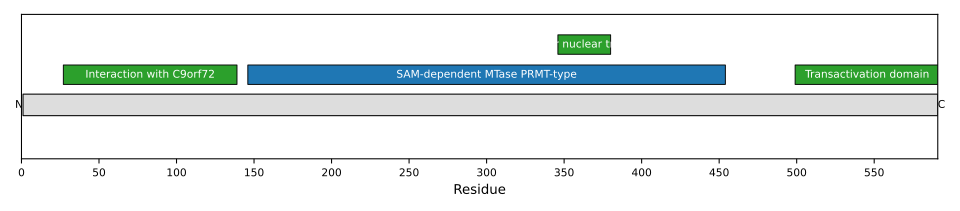
1: Methylates (mono- and asymmetric dimethylation) the guanidino nitrogens of arginyl residues in several proteins involved in DNA packaging, transcription regulation, pre-mRNA splicing, and mRNA stability (PubMed:12237300, PubMed:16497732, PubMed:19405910). Recruited to promoters upon gene activation together with histone acetyltransferases from EP300/P300 and p160 families, methylates histone H3 at 'Arg-17' (H3R17me), forming mainly asymmetric dimethylarginine (H3R17me2a), leading to activation of transcription via chromatin remodeling (PubMed:12237300, PubMed:16497732, PubMed:19405910). During nuclear hormone receptor activation and TCF7L2/TCF4 activation, acts synergically with EP300/P300 and either one of the p160 histone acetyltransferases NCOA1/SRC1, NCOA2/GRIP1 and NCOA3/ACTR or CTNNB1/beta-catenin to activate transcription (By similarity). During myogenic transcriptional activation, acts together with NCOA3/ACTR as a coactivator for MEF2C (By similarity). During monocyte inflammatory stimulation, acts together with EP300/P300 as a coactivator for NF-kappa-B (By similarity). Acts as a coactivator for PPARG, promotes adipocyte differentiation and the accumulation of brown fat tissue (By similarity). Plays a role in the regulation of pre-mRNA alternative splicing by methylation of splicing factors (By similarity). Also seems to be involved in p53/TP53 transcriptional activation (By similarity). Methylates EP300/P300, both at 'Arg-2142', which may loosen its interaction with NCOA2/GRIP1, and at 'Arg-580' and 'Arg-604' in the KIX domain, which impairs its interaction with CREB and inhibits CREB-dependent transcriptional activation (PubMed:15731352). Also methylates arginine residues in RNA-binding proteins PABPC1, ELAVL1 and ELAV4, which may affect their mRNA-stabilizing properties and the half-life of their target mRNAs (By similarity). Acts as a transcriptional coactivator of ACACA/acetyl-CoA carboxylase by enriching H3R17 methylation at its promoter, thereby positively regulating fatty acid synthesis (By similarity). Independently of its methyltransferase activity, involved in replication fork progression: promotes PARP1 recruitment to replication forks, leading to poly-ADP-ribosylation of chromatin at replication forks and reduced fork speed (PubMed:33412112)