Solute carrier family 13 member 5 (Na(+)/citrate cotransporter) (NaCT) (Sodium-coupled citrate transporter) (Sodium-dependent citrate transporter)
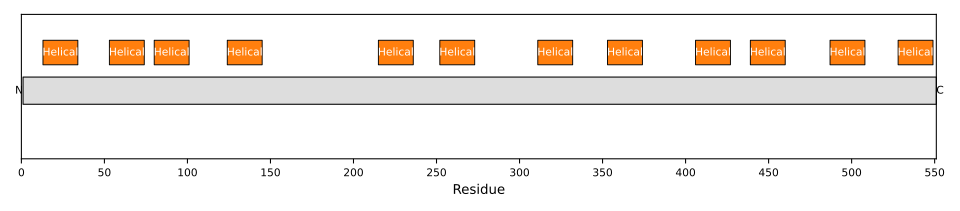
1_MASAL 6_ SYVSK 11_ FKSFV 16_ ILFVT 21_ PLLLL 26_ PLVIL 31_ MPAKF 36_ VRCAY 41_ VIILM 46_ AIYWC 51_ TEVIP 56_ LAVTS 61_ LMPVL 66_ LFPLF 71_ QILDS 76_ RQVCV 81_ QYMKD 86_ TNMLF 91_ LGGLI 96_ VAVAV 101_ ERWNL 106_ HKRIA 111_ LRTLL 116_ WVGAK 121_ PARLM 126_ LGFMG 131_ VTALL 136_ SMWIS 141_ NTATT 146_ AMMVP 151_ IVEAI 156_ LQQME 161_ ATSAA 166_ TEAGL 171_ ELVDK 176_ GKAKE 181_ LPGSQ 186_ VIFEG 191_ PTLGQ 196_ QEDQE 201_ RKRLC 206_ KAMTL 211_ CICYA 216_ ASIGG 221_ TATLT 226_ GTGPN 231_ VVLLG 236_ QMNEL 241_ FPDSK 246_ DLVNF 251_ ASWFA 256_ FAFPN 261_ MLVML 266_ LFAWL 271_ WLQFV 276_ YMRFN 281_ FKKSW 286_ GCGLE 291_ SKKNE 296_ KAALK 301_ VLQEE 306_ YRKLG 311_ PLSFA 316_ EINVL 321_ ICFFL 326_ LVILW 331_ FSRDP 336_ GFMPG 341_ WLTVA 346_ WVEGE 351_ TKYVS 356_ DATVA 361_ IFVAT 366_ LLFIV 371_ PSQKP 376_ KFNFR 381_ SQTEE 386_ ERKTP 391_ FYPPP 396_ LLDWK 401_ VTQEK 406_ VPWGI 411_ VLLLG 416_ GGFAL 421_ AKGSE 426_ ASGLS 431_ VWMGK 436_ QMEPL 441_ HAVPP 446_ AAITL 451_ ILSLL 456_ VAVFT 461_ ECTSN 466_ VATTT 471_ LFLPI 476_ FASMS 481_ RSIGL 486_ NPLYI 491_ MLPCT 496_ LSASF 501_ AFMLP 506_ VATPP 511_ NAIVF 516_ TYGHL 521_ KVADM 526_ VKTGV 531_ IMNII 536_ GVFCV 541_ FLAVN 546_ TWGRA 551_ IFDLD 556_ HFPDW 561_ANVTH
1: High-affinity sodium/citrate cotransporter that mediates the entry of citrate into cells, which is a critical participant of biochemical pathways (PubMed:12445824, PubMed:12826022, PubMed:26324167, PubMed:26384929, PubMed:30054523, PubMed:33597751). May function in various metabolic processes in which citrate has a critical role such as energy production (Krebs cycle), fatty acid synthesis, cholesterol synthesis, glycolysis, and gluconeogenesis (PubMed:12826022). Transports citrate into the cell in a Na(+)-dependent manner, recognizing the trivalent form of citrate (physiological pH) rather than the divalent form (PubMed:12445824, PubMed:12826022, PubMed:26324167, PubMed:26384929, PubMed:30054523, PubMed:33597751). Can recognize succinate as a substrate, but its affinity for succinate is several fold lower than for citrate (PubMed:26324167). The stoichiometry is probably 4 Na(+) for each carboxylate, irrespective of whether the translocated substrate is divalent or trivalent, rendering the process electrogenic (PubMed:12445824, PubMed:12826022). Involved in the regulation of citrate levels in the brain (By similarity)