Neuronal PAS domain-containing protein 4 (Neuronal PAS4) (Class E basic helix-loop-helix protein 79) (bHLHe79) (HLH-PAS transcription factor NXF) (PAS domain-containing protein 10)
1_MYRST 6_ KGASK 11_ ARRDQ 16_ INAEI 21_ RNLKE 26_ LLPLA 31_ EADKV 36_ RLSYL 41_ HIMSL 46_ ACIYT 51_ RKGVF 56_ FAGGT 61_ PLAGP 66_ TGLLS 71_ AQELE 76_ DIVAA 81_ LPGFL 86_ LVFTA 91_ EGKLL 96_ YLSES 101_ VSEHL 106_ GHSMV 111_ DLVAQ 116_ GDSIY 121_ DIIDP 126_ ADHLT 131_ VRQQL 136_ TLPSA 141_ LDTDR 146_ LFRCR 151_ FNTSK 156_ SLRRQ 161_ SAGNK 166_ LVLIR 171_ GRFHA 176_ HPPGA 181_ YWAGN 186_ PVFTA 191_ FCAPL 196_ EPRPR 201_ PGPGP 206_ GPGPA 211_ SLFLA 216_ MFQSR 221_ HAKDL 226_ ALLDI 231_ SESVL 236_ IYLGF 241_ ERSEL 246_ LCKSW 251_ YGLLH 256_ PEDLA 261_ HASAQ 266_ HYRLL 271_ AESGD 276_ IQAEM 281_ VVRLQ 286_ AKTGG 291_ WAWIY 296_ CLLYS 301_ EGPEG 306_ PITAN 311_ NYPIS 316_ DMEAW 321_ SLRQQ 326_ LNSED 331_ TQAAY 336_ VLGTP 341_ TMLPS 346_ FPENI 351_ LSQEE 356_ CSSTN 361_ PLFTA 366_ ALGAP 371_ RSTSF 376_ PSAPE 381_ LSVVS 386_ ASEEL 391_ PRPSK 396_ ELDFS 401_ YLTFP 406_ SGPEP 411_ SLQAE 416_ LSKDL 421_ VCTPP 426_ YTPHQ 431_ PGGCA 436_ FLFSL 441_ HEPFQ 446_ THLPT 451_ PSSTL 456_ QEQLT 461_ PSTAT 466_ FSDQL 471_ TPSSA 476_ TFPDP 481_ LTSPL 486_ QGQLT 491_ ETSVR 496_ SYEDQ 501_ LTPCT 506_ STFPD 511_ QLLPS 516_ TATFP 521_ EPLGS 526_ PAHEQ 531_ LTPPS 536_ TAFQA 541_ HLDSP 546_ SQTFP 551_ EQLSP 556_ NPTKT 561_ YFAQE 566_ GCSFL 571_ YEKLP 576_ PSPSS 581_ PGNGD 586_ CTLLA 591_ LAQLR 596_ GPLSV 601_ DVPLV 606_ PEGLL 611_ TPEAS 616_ PVKQS 621_ FFHYS 626_ EKEQN 631_ EIDRL 636_ IQQIS 641_ QLAQG 646_ MDRPF 651_ SAEAG 656_ TGGLE 661_ PLGGL 666_ EPLDS 671_ NLSLS 676_ GAGPP 681_ VLSLD 686_ LKPWK 691_ CQELD 696_ FLADP 701_ DNMFL 706_ EETPV 711_ EDIFM 716_ DLSTP 721_ DPSEE 726_ WGSGD 731_ PEAEG 736_ PGGAP 741_ SPCNN 746_ LSPED 751_ HSFLE 756_ DLATY 761_ ETAFE 766_ TGVSA 771_ FPYDG 776_ FTDEL 781_ HQLQS 786_ QVQDS 791_ FHEDG 796_SGGEP
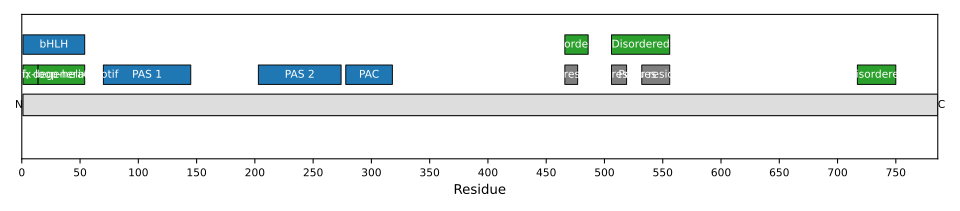
1: Transcription factor expressed in neurons of the brain that regulates the excitatory-inhibitory balance within neural circuits and is required for contextual memory in the hippocampus (By similarity). Plays a key role in the structural and functional plasticity of neurons (By similarity). Acts as an early-response transcription factor in both excitatory and inhibitory neurons, where it induces distinct but overlapping sets of late-response genes in these two types of neurons, allowing the synapses that form on inhibitory and excitatory neurons to be modified by neuronal activity in a manner specific to their function within a circuit, thereby facilitating appropriate circuit responses to sensory experience (By similarity). In excitatory neurons, activates transcription of BDNF, which in turn controls the number of GABA-releasing synapses that form on excitatory neurons, thereby promoting an increased number of inhibitory synapses on excitatory neurons (By similarity). In inhibitory neurons, regulates a distinct set of target genes that serve to increase excitatory input onto somatostatin neurons, probably resulting in enhanced feedback inhibition within cortical circuits (By similarity). The excitatory and inhibitory balance in neurons affects a number of processes, such as short-term and long-term memory, acquisition of experience, fear memory, response to stress and social behavior (By similarity). Acts as a regulator of dendritic spine development in olfactory bulb granule cells in a sensory-experience-dependent manner by regulating expression of MDM2 (By similarity). Efficient DNA binding requires dimerization with another bHLH protein, such as ARNT, ARNT2 or BMAL1 (PubMed:14701734). Can activate the CME (CNS midline enhancer) element (PubMed:14701734)