E3 ubiquitin-protein ligase SIAH1 (EC 2.3.2.27) (RING-type E3 ubiquitin transferase SIAH1) (Seven in absentia homolog 1) (Siah-1) (Siah-1a)
1_MSRQT 6_ ATALP 11_ TGTSK 16_ CPPSQ 21_ RVPAL 26_ TGTTA 31_ SNNDL 36_ ASLFE 41_ CPVCF 46_ DYVLP 51_ PILQC 56_ QSGHL 61_ VCSNC 66_ RPKLT 71_ CCPTC 76_ RGPLG 81_ SIRNL 86_ AMEKV 91_ ANSVL 96_ FPCKY 101_ ASSGC 106_ EITLP 111_ HTEKA 116_ DHEEL 121_ CEFRP 126_ YSCPC 131_ PGASC 136_ KWQGS 141_ LDAVM 146_ PHLMH 151_ QHKSI 156_ TTLQG 161_ EDIVF 166_ LATDI 171_ NLPGA 176_ VDWVM 181_ MQSCF 186_ GFHFM 191_ LVLEK 196_ QEKYD 201_ GHQQF 206_ FAIVQ 211_ LIGTR 216_ KQAEN 221_ FAYRL 226_ ELNGH 231_ RRRLT 236_ WEATP 241_ RSIHE 246_ GIATA 251_ IMNSD 256_ CLVFD 261_ TSIAQ 266_ LFAEN 271_ GNLGI 276_NVTIS
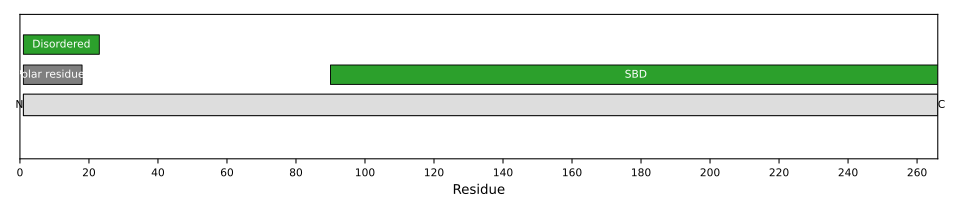
1: E3 ubiquitin-protein ligase that mediates ubiquitination and subsequent proteasomal degradation of target proteins (PubMed:14506261, PubMed:14645235, PubMed:14654780, PubMed:15064394, PubMed:16085652, PubMed:19224863, PubMed:20508617, PubMed:22483617, PubMed:28546513, PubMed:32430360, PubMed:33591310, PubMed:9334332, PubMed:9858595). E3 ubiquitin ligases accept ubiquitin from an E2 ubiquitin-conjugating enzyme in the form of a thioester and then directly transfers the ubiquitin to targeted substrates (PubMed:14506261, PubMed:14645235, PubMed:14654780, PubMed:15064394, PubMed:16085652, PubMed:19224863, PubMed:20508617, PubMed:22483617, PubMed:9334332, PubMed:9858595). Mediates E3 ubiquitin ligase activity either through direct binding to substrates or by functioning as the essential RING domain subunit of larger E3 complexes (PubMed:14506261, PubMed:14645235, PubMed:14654780, PubMed:15064394, PubMed:16085652, PubMed:19224863, PubMed:20508617, PubMed:22483617, PubMed:9334332, PubMed:9858595). Triggers the ubiquitin-mediated degradation of many substrates, including proteins involved in transcription regulation (ELL2, MYB, POU2AF1, PML and RBBP8), a cell surface receptor (DCC), the cell-surface receptor-type tyrosine kinase FLT3, the cytoplasmic signal transduction molecules (KLF10/TIEG1 and NUMB), an antiapoptotic protein (BAG1), a microtubule motor protein (KIF22), a protein involved in synaptic vesicle function in neurons (SYP), a structural protein (CTNNB1) and SNCAIP (PubMed:10747903, PubMed:11146551, PubMed:11389839, PubMed:11389840, PubMed:11483517, PubMed:11483518, PubMed:11752454, PubMed:12072443). Confers constitutive instability to HIPK2 through proteasomal degradation (PubMed:18536714, PubMed:33591310). It is thereby involved in many cellular processes such as apoptosis, tumor suppression, cell cycle, axon guidance, transcription regulation, spermatogenesis and TNF-alpha signaling (PubMed:14506261, PubMed:14645235, PubMed:14654780, PubMed:15064394, PubMed:16085652, PubMed:19224863, PubMed:20508617, PubMed:22483617, PubMed:9334332, PubMed:9858595). Has some overlapping function with SIAH2 (PubMed:14506261, PubMed:14645235, PubMed:14654780, PubMed:15064394, PubMed:16085652, PubMed:19224863, PubMed:20508617, PubMed:22483617, PubMed:9334332, PubMed:9858595). Induces apoptosis in cooperation with PEG3 (By similarity). Upon nitric oxid (NO) generation that follows apoptotic stimulation, interacts with S-nitrosylated GAPDH, mediating the translocation of GAPDH to the nucleus (By similarity). GAPDH acts as a stabilizer of SIAH1, facilitating the degradation of nuclear proteins (By similarity). Mediates ubiquitination and degradation of EGLN2 and EGLN3 in response to the unfolded protein response (UPR), leading to their degradation and subsequent stabilization of ATF4 (By similarity). Also part of the Wnt signaling pathway in which it mediates the Wnt-induced ubiquitin-mediated proteasomal degradation of AXIN1 (PubMed:28546513, PubMed:32430360)