5'-3' exonuclease PLD3 (EC 3.1.16.1) (Choline phosphatase 3) (HindIII K4L homolog) (Hu-K4) (Phosphatidylcholine-hydrolyzing phospholipase D3) (Phospholipase D3) (PLD 3)
1_MKPKL 6_ MYQEL 11_ KVPAE 16_ EPANE 21_ LPMNE 26_ IEAWK 31_ AAEKK 36_ ARWVL 41_ LVLIL 46_ AVVGF 51_ GALMT 56_ QLFLW 61_ EYGDL 66_ HLFGP 71_ NQRPA 76_ PCYDP 81_ CEAVL 86_ VESIP 91_ EGLDF 96_ PNAST 101_ GNPST 106_ SQAWL 111_ GLLAG 116_ AHSSL 121_ DIASF 126_ YWTLT 131_ NNDTH 136_ TQEPS 141_ AQQGE 146_ EVLRQ 151_ LQTLA 156_ PKGVN 161_ VRIAV 166_ SKPSG 171_ PQPQA 176_ DLQAL 181_ LQSGA 186_ QVRMV 191_ DMQKL 196_ THGVL 201_ HTKFW 206_ VVDQT 211_ HFYLG 216_ SANMD 221_ WRSLT 226_ QVKEL 231_ GVVMY 236_ NCSCL 241_ ARDLT 246_ KIFEA 251_ YWFLG 256_ QAGSS 261_ IPSTW 266_ PRFYD 271_ TRYNQ 276_ ETPME 281_ ICLNG 286_ TPALA 291_ YLASA 296_ PPPLC 301_ PSGRT 306_ PDLKA 311_ LLNVV 316_ DNARS 321_ FIYVA 326_ VMNYL 331_ PTLEF 336_ SHPHR 341_ FWPAI 346_ DDGLR 351_ RATYE 356_ RGVKV 361_ RLLIS 366_ CWGHS 371_ EPSMR 376_ AFLLS 381_ LAALR 386_ DNHTH 391_ SDIQV 396_ KLFVV 401_ PADEA 406_ QARIP 411_ YARVN 416_ HNKYM 421_ VTERA 426_ TYIGT 431_ SNWSG 436_ NYFTE 441_ TAGTS 446_ LLVTQ 451_ NGRGG 456_ LRSQL 461_ EAIFL 466_ RDWDS 471_ PYSHD 476_ LDTSA 481_DSVGN
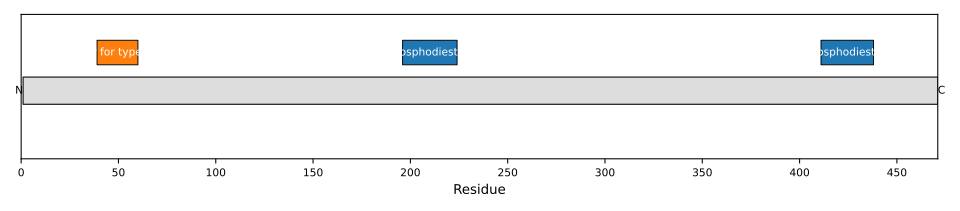
1: 5'->3' exonuclease that hydrolyzes the phosphodiester bond of single-stranded DNA (ssDNA) and RNA molecules to form nucleoside 3'-monophosphates and 5'-end 5'-hydroxy deoxyribonucleotide/ribonucleotide fragments (PubMed:30111894, PubMed:30312375, PubMed:34620855, PubMed:37225734, PubMed:37994783, PubMed:38537643, PubMed:38697119). Partially redundant with PLD4, can cleave all four nucleotides displaying higher efficiency for ssDNA and RNA fragments initiated with uridine and guanosine residues and lower efficiency for cytidine-initiated substrates (PubMed:30111894, PubMed:30312375, PubMed:34620855, PubMed:37225734, PubMed:37994783, PubMed:38537643, PubMed:38697119). As a result, it does not always degrade polynucleotides to the single nucleotide level, it can stall at specific sites sparing certain fragments from exonucleolytic degradation (PubMed:30111894, PubMed:30312375, PubMed:34620855, PubMed:37225734, PubMed:37994783, PubMed:38537643, PubMed:38697119). Processes self and pathogenic ssDNA and RNA molecules that reach the endolysosomal compartment via phagocytosis or autophagy and may serve as 'danger' signals for recognition by innate immune receptors such as toll-like receptors (TLRs) (PubMed:34620855, PubMed:37225734, PubMed:38697119). Degrades mitochondrial CpG-rich ssDNA fragments to prevent TLR9 activation and autoinflammatory response, but it can cleave viral RNA to generate ligands for TLR7 activation and initiate antiviral immune responses (PubMed:34620855, PubMed:37225734, PubMed:38697119). In plasmacytoid dendritic cells, it cooperates with endonuclease RNASET2 to release 2',3'-cyclic guanosine monophosphate (2',3'-cGMP), a potent stimulatory ligand for TLR7 (PubMed:34620855, PubMed:37225734, PubMed:38697119). Produces 2',3'-cGMPs and cytidine-rich RNA fragments that occupy TLR7 ligand-binding pockets and trigger a signaling-competent state (PubMed:34620855, PubMed:37225734, PubMed:38697119). Can exert polynucleotide phosphatase activity toward 5'-phosphorylated ssDNA substrates although at a slow rate (PubMed:38537643). Transphosphatidylase that catalyzes the exchange with R to S stereo-inversion of the glycerol moiety between (S,R)-lysophosphatidylglycerol (LPG) and monoacylglycerol (MAG) substrates to yield (S,S)-bis(monoacylglycero)phosphate (BMP) (PubMed:39423811). Can synthesize a variety of (S,S)-BMPs representing the main phospholipid constituent of lysosomal intralumenal vesicle (ILV) membranes that bind acid hydrolases for lipid degradation (PubMed:39423811). Regulates the homeostasis and interorganellar communication of the endolysosomal system with an overall impact on cellular removal of dysfunctional organelles via autophagy as well as proper protein and lipid turnover (PubMed:28128235, PubMed:29368044, PubMed:37225734). May play a role in myotube formation in response to ER stress (PubMed:22428023)