Cyclic GMP-AMP synthase (cGAMP synthase) (cGAS) (h-cGAS) (EC 2.7.7.86) (2'3'-cGAMP synthase) (Mab-21 domain-containing protein 1)
1_MQPWH 6_ GKAMQ 11_ RASEA 16_ GATAP 21_ KASAR 26_ NARGA 31_ PMDPT 36_ ESPAA 41_ PEAAL 46_ PKAGK 51_ FGPAR 56_ KSGSR 61_ QKKSA 66_ PDTQE 71_ RPPVR 76_ ATGAR 81_ AKKAP 86_ QRAQD 91_ TQPSD 96_ ATSAP 101_ GAEGL 106_ EPPAA 111_ REPAL 116_ SRAGS 121_ CRQRG 126_ ARCST 131_ KPRPP 136_ PGPWD 141_ VPSPG 146_ LPVSA 151_ PILVR 156_ RDAAP 161_ GASKL 166_ RAVLE 171_ KLKLS 176_ RDDIS 181_ TAAGM 186_ VKGVV 191_ DHLLL 196_ RLKCD 201_ SAFRG 206_ VGLLN 211_ TGSYY 216_ EHVKI 221_ SAPNE 226_ FDVMF 231_ KLEVP 236_ RIQLE 241_ EYSNT 246_ RAYYF 251_ VKFKR 256_ NPKEN 261_ PLSQF 266_ LEGEI 271_ LSASK 276_ MLSKF 281_ RKIIK 286_ EEIND 291_ IKDTD 296_ VIMKR 301_ KRGGS 306_ PAVTL 311_ LISEK 316_ ISVDI 321_ TLALE 326_ SKSSW 331_ PASTQ 336_ EGLRI 341_ QNWLS 346_ AKVRK 351_ QLRLK 356_ PFYLV 361_ PKHAK 366_ EGNGF 371_ QEETW 376_ RLSFS 381_ HIEKE 386_ ILNNH 391_ GKSKT 396_ CCENK 401_ EEKCC 406_ RKDCL 411_ KLMKY 416_ LLEQL 421_ KERFK 426_ DKKHL 431_ DKFSS 436_ YHVKT 441_ AFFHV 446_ CTQNP 451_ QDSQW 456_ DRKDL 461_ GLCFD 466_ NCVTY 471_ FLQCL 476_ RTEKL 481_ ENYFI 486_ PEFNL 491_ FSSNL 496_ IDKRS 501_ KEFLT 506_ KQIEY 511_ ERNNE 516_FPVFD
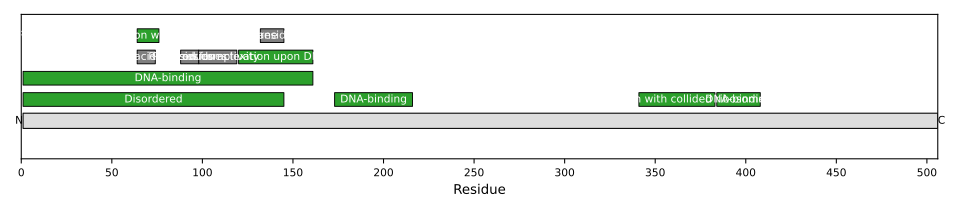
1: Nucleotidyltransferase that catalyzes the formation of cyclic GMP-AMP (2',3'-cGAMP) from ATP and GTP and plays a key role in innate immunity (PubMed:21478870, PubMed:23258413, PubMed:23707061, PubMed:23707065, PubMed:23722159, PubMed:24077100, PubMed:24116191, PubMed:24462292, PubMed:25131990, PubMed:26300263, PubMed:29976794, PubMed:30799039, PubMed:31142647, PubMed:32814054, PubMed:33273464, PubMed:33542149, PubMed:37217469, PubMed:37802025). Catalysis involves both the formation of a 2',5' phosphodiester linkage at the GpA step and the formation of a 3',5' phosphodiester linkage at the ApG step, producing c[G(2',5')pA(3',5')p] (PubMed:28214358, PubMed:28363908). Acts as a key DNA sensor: directly binds double-stranded DNA (dsDNA), inducing the formation of liquid-like droplets in which CGAS is activated, leading to synthesis of 2',3'-cGAMP, a second messenger that binds to and activates STING1, thereby triggering type-I interferon production (PubMed:28314590, PubMed:28363908, PubMed:29976794, PubMed:32817552, PubMed:33230297, PubMed:33606975, PubMed:35322803, PubMed:35438208, PubMed:35460603, PubMed:35503863). Preferentially recognizes and binds curved long dsDNAs of a minimal length of 40 bp (PubMed:30007416). Acts as a key foreign DNA sensor, the presence of double-stranded DNA (dsDNA) in the cytoplasm being a danger signal that triggers the immune responses (PubMed:28363908). Has antiviral activity by sensing the presence of dsDNA from DNA viruses in the cytoplasm (PubMed:28363908, PubMed:35613581). Also acts as an innate immune sensor of infection by retroviruses, such as HIV-2, by detecting the presence of reverse-transcribed DNA in the cytosol (PubMed:23929945, PubMed:24269171, PubMed:30270045, PubMed:32852081). In contrast, HIV-1 is poorly sensed by CGAS, due to its capsid that cloaks viral DNA from CGAS detection (PubMed:24269171, PubMed:30270045, PubMed:32852081). Detection of retroviral reverse-transcribed DNA in the cytosol may be indirect and be mediated via interaction with PQBP1, which directly binds reverse-transcribed retroviral DNA (PubMed:26046437). Also detects the presence of DNA from bacteria, such as M.tuberculosis (PubMed:26048138). 2',3'-cGAMP can be transferred from producing cells to neighboring cells through gap junctions, leading to promote STING1 activation and convey immune response to connecting cells (PubMed:24077100). 2',3'-cGAMP can also be transferred between cells by virtue of packaging within viral particles contributing to IFN-induction in newly infected cells in a cGAS-independent but STING1-dependent manner (PubMed:26229115). Also senses the presence of neutrophil extracellular traps (NETs) that are translocated to the cytosol following phagocytosis, leading to synthesis of 2',3'-cGAMP (PubMed:33688080). In addition to foreign DNA, can also be activated by endogenous nuclear or mitochondrial DNA (PubMed:28738408, PubMed:28759889, PubMed:31299200, PubMed:33031745, PubMed:33230297). When self-DNA leaks into the cytosol during cellular stress (such as mitochondrial stress, SARS-CoV-2 infection causing severe COVID-19 disease, DNA damage, mitotic arrest or senescence), or is present in form of cytosolic micronuclei, CGAS is activated leading to a state of sterile inflammation (PubMed:28738408, PubMed:28759889, PubMed:31299200, PubMed:33031745, PubMed:33230297, PubMed:35045565). Acts as a regulator of cellular senescence by binding to cytosolic chromatin fragments that are present in senescent cells, leading to trigger type-I interferon production via STING1 and promote cellular senescence (By similarity). Also involved in the inflammatory response to genome instability and double-stranded DNA breaks: acts by localizing to micronuclei arising from genome instability (PubMed:28738408, PubMed:28759889). Micronuclei, which are frequently found in cancer cells, consist of chromatin surrounded by their own nuclear membrane: following breakdown of the micronuclear envelope, a process associated with chromothripsis, CGAS binds self-DNA exposed to the cytosol, leading to 2',3'-cGAMP synthesis and subsequent activation of STING1 and type-I interferon production (PubMed:28738408, PubMed:28759889). Activated in response to prolonged mitotic arrest, promoting mitotic cell death (PubMed:31299200). In a healthy cell, CGAS is however kept inactive even in cellular events that directly expose it to self-DNA, such as mitosis, when cGAS associates with chromatin directly after nuclear envelope breakdown or remains in the form of postmitotic persistent nuclear cGAS pools bound to chromatin (PubMed:31299200, PubMed:33542149). Nuclear CGAS is inactivated by chromatin via direct interaction with nucleosomes, which block CGAS from DNA binding and thus prevent CGAS-induced autoimmunity (PubMed:31299200, PubMed:32911482, PubMed:32912999, PubMed:33051594, PubMed:33542149). Also acts as a suppressor of DNA repair in response to DNA damage: inhibits homologous recombination repair by interacting with PARP1, the CGAS-PARP1 interaction leading to impede the formation of the PARP1-TIMELESS complex (PubMed:30356214, PubMed:31544964). In addition to DNA, also sense translation stress: in response to translation stress, translocates to the cytosol and associates with collided ribosomes, promoting its activation and triggering type-I interferon production (PubMed:34111399). In contrast to other mammals, human CGAS displays species-specific mechanisms of DNA recognition and produces less 2',3'-cGAMP, allowing a more fine-tuned response to pathogens (PubMed:30007416)