Guanylate-binding protein 7 (EC 3.6.5.-) (GTP-binding protein 7) (GBP-7) (Guanine nucleotide-binding protein 7) (Guanylate-binding protein 4-like)
1_MASEI 6_ HMPGP 11_ VCLTE 16_ NTKGH 21_ LVVNS 26_ EALEI 31_ LSAIT 36_ QPVVV 41_ VAIVG 46_ LYRTG 51_ KSYLM 56_ NKLAG 61_ KNKGF 66_ PLGCT 71_ VKSET 76_ KGIWM 81_ WCVPH 86_ PSKPN 91_ HTLIL 96_ LDTEG 101_ LGDME 106_ KSDPK 111_ SDSWI 116_ FALAV 121_ LLSSS 126_ FVYNS 131_ MGTIN 136_ HQALE 141_ QLHYV 146_ TELTE 151_ LIRAK 156_ SCPRP 161_ DEVED 166_ SSEFV 171_ SFFPD 176_ FIWTV 181_ RDFTL 186_ ELKLD 191_ GHPIT 196_ EDEYL 201_ ENALK 206_ LISGK 211_ NPQIQ 216_ NSNKP 221_ REWIR 226_ HFFPK 231_ QKCFV 236_ FDRPI 241_ NDKKL 246_ LLHVE 251_ EVRED 256_ QLDSN 261_ FQMQS 266_ ENFCS 271_ YIFTH 276_ AKTKT 281_ LREGI 286_ LVTGN 291_ RLGML 296_ VETYL 301_ DAINS 306_ GATPC 311_ LENAM 316_ AVLAQ 321_ CENSA 326_ AVQRA 331_ ANHYS 336_ QQMAQ 341_ QVRFP 346_ TDTLQ 351_ ELLDV 356_ HAVCE 361_ REAIA 366_ VFMEY 371_ SFKDK 376_ SQEFQ 381_ KKLVD 386_ TMEKK 391_ KEDFV 396_ LQNEE 401_ ASAKY 406_ CQAEL 411_ KRLSE 416_ LLTES 421_ ISRGT 426_ FFVPG 431_ GHNIY 436_ LEAKK 441_ KIEQD 446_ YTLVP 451_ RKGVK 456_ ADEVL 461_ QSFLQ 466_ SQVVI 471_ EESIL 476_ QSDKA 481_ LTAGE 486_ KAIAA 491_ KQAKK 496_ EAAEK 501_ EQELL 506_ RQKQK 511_ EQQQM 516_ MEAQE 521_ RSFQE 526_ NIAQL 531_ KKKME 536_ REREN 541_ YMREL 546_ RKMLS 551_ HKMKV 556_ LEELL 561_ TEGFK 566_ EIFES 571_ LNEEI 576_ NRLKE 581_ QIEAA 586_ ENEEP 591_ SVFSQ 596_ ILDVA 601_ GSIFI 606_ AALPG 611_ AAKLV 616_ DLGMK 621_ ILSSL 626_ CNRLR 631_NPGKK
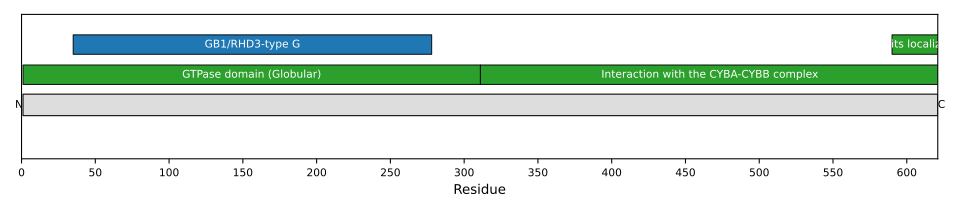
1: Interferon (IFN)-inducible GTPase that plays important roles in innate immunity against a diverse range of bacterial, viral and protozoan pathogens (By similarity). Hydrolyzes GTP to GMP in two consecutive cleavage reactions and predominantly uses GTP and not GDP or GMP as the substrate (By similarity). Following infection, recruited to the pathogen-containing vacuoles or vacuole-escaped bacteria and acts as a positive regulator of inflammasome assembly by promoting the release of inflammasome ligands from bacteria (By similarity). Acts by promoting lysis of pathogen-containing vacuoles, releasing pathogens into the cytosol (By similarity). Following pathogen release in the cytosol, promotes recruitment of proteins that mediate bacterial cytolysis: this liberates ligands that are detected by inflammasomes, such as lipopolysaccharide (LPS) that activates the non-canonical CASP4/CASP11 inflammasome or double-stranded DNA (dsDNA) that activates the AIM2 inflammasome (By similarity). Also promotes IFN-gamma-mediated host defense against bacterial infections by regulating oxidative responses and bacteriolytic peptide generation (By similarity). May help to assemble NADPH oxidase on phagosomal membranes by acting as a bridging protein between NADPH oxidase cytosolic subunits NCF2-NCF4 and the membrane subunits CYBA-CYBB (By similarity). Participates along with GBP1 in trafficking monoubiquinated protein cargo to autolysosomes for generating ubiquitin-derived antimicrobial peptides (By similarity). Facilitates influenza A virus replication by inhibiting the activation of NF-kappaB and JAK-STAT signaling pathways and the expression of type I, type III interferons and pro-inflammatory cytokines (PubMed:33408175). Confers protection to several pathogens, including the bacterial pathogens Listeria monocytogenes and Mycobacterium bovis BCG as well as the protozoan pathogen Toxoplasma gondii (By similarity). Required for disruption of the parasitophorous vacuole formed following T.gondii infection and subsequent killing of the parasite (By similarity)