Blood vessel epicardial substance (hBVES) (Popeye domain-containing protein 1) (Popeye protein 1)
1_MNYTE 6_ SSPLR 11_ ESTAI 16_ GFTPE 21_ LESII 26_ PVPSN 31_ KTTCE 36_ NWREI 41_ HHLVF 46_ HVANI 51_ CFAVG 56_ LVIPT 61_ TLHLH 66_ MIFLR 71_ GMLTL 76_ GCTLY 81_ IVWAT 86_ LYRCA 91_ LDIMI 96_ WNSVF 101_ LGVNI 106_ LHLSY 111_ LLYKK 116_ RPVKI 121_ EKELS 126_ GMYRR 131_ LFEPL 136_ RVPPD 141_ LFRRL 146_ TGQFC 151_ MIQTL 156_ KKGQT 161_ YAAED 166_ KTSVD 171_ DRLSI 176_ LLKGK 181_ MKVSY 186_ RGHFL 191_ HNIYP 196_ CAFID 201_ SPEFR 206_ STQMH 211_ KGEKF 216_ QVTII 221_ ADDNC 226_ RFLCW 231_ SRERL 236_ TYFLE 241_ SEPFL 246_ YEIFR 251_ YLIGK 256_ DITNK 261_ LYSLN 266_ DPTLN 271_ DKKAK 276_ KLEHQ 281_ LSLCT 286_ QISML 291_ EMRNS 296_ IASSS 301_ DSDDG 306_ LHQFL 311_ RGTSS 316_ MSSLH 321_ VSSPH 326_ QRASA 331_ KMKPI 336_ EEGAE 341_ DDDDV 346_ FEPAS 351_PNTLK
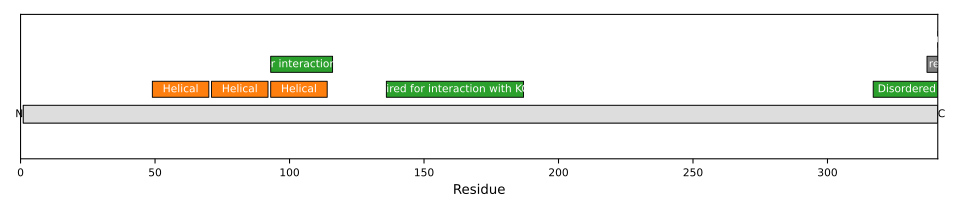
1: Cell adhesion molecule involved in the establishment and/or maintenance of cell integrity. Involved in the formation and regulation of the tight junction (TJ) paracellular permeability barrier in epithelial cells (PubMed:16188940). Plays a role in VAMP3-mediated vesicular transport and recycling of different receptor molecules through its interaction with VAMP3. Plays a role in the regulation of cell shape and movement by modulating the Rho-family GTPase activity through its interaction with ARHGEF25/GEFT. Induces primordial adhesive contact and aggregation of epithelial cells in a Ca(2+)-independent manner. Also involved in striated muscle regeneration and repair and in the regulation of cell spreading (By similarity). Important for the maintenance of cardiac function. Plays a regulatory function in heart rate dynamics mediated, at least in part, through cAMP-binding and, probably, by increasing cell surface expression of the potassium channel KCNK2 and enhancing current density (PubMed:26642364). Is also a caveolae-associated protein important for the preservation of caveolae structural and functional integrity as well as for heart protection against ischemia injury