DCC-interacting protein 13-beta (Dip13-beta) (Adapter protein containing PH domain, PTB domain and leucine zipper motif 2)
1_MPAVD 6_ KLLLE 11_ EALQD 16_ SPQTR 21_ SLLSV 26_ FEEDA 31_ GTLTD 36_ YTNQL 41_ LQAMQ 46_ RVYGA 51_ QNEMC 56_ LATQQ 61_ LSKQL 66_ LAYEK 71_ QNFAL 76_ GKGDE 81_ EVIST 86_ LHYFS 91_ KVVDE 96_ LNLLH 101_ TELAK 106_ QLADT 111_ MVLPI 116_ IQFRE 121_ KDLTE 126_ VSTLK 131_ DLFGL 136_ ASNEH 141_ DLSMA 146_ KYSRL 151_ PKKKE 156_ NEKVK 161_ TEVGK 166_ EVAAA 171_ RRKQH 176_ LSSLQ 181_ YYCAL 186_ NALQY 191_ RKQMA 196_ MMEPM 201_ IGFAH 206_ GQINF 211_ FKKGA 216_ EMFSK 221_ RMDSF 226_ LSSVA 231_ DMVQS 236_ IQVEL 241_ EAEAE 246_ KMRVS 251_ QQELL 256_ SVDES 261_ VYTPD 266_ SDVAA 271_ PQINR 276_ NLIQK 281_ AGYLN 286_ LRNKT 291_ GLVTT 296_ TWERL 301_ YFFTQ 306_ GGNLM 311_ CQPRG 316_ AVAGG 321_ LIQDL 326_ DNCSV 331_ MAVDC 336_ EDRRY 341_ CFQIT 346_ TPNGK 351_ SGIIL 356_ QAESR 361_ KENEE 366_ WICAI 371_ NNISR 376_ QIYLT 381_ DNPEA 386_ VAIKL 391_ NQTAL 396_ QAVTP 401_ ITSFG 406_ KKQES 411_ SCPSQ 416_ NLKNS 421_ EMENE 426_ NDKIV 431_ PKATA 436_ SLPEA 441_ EELIA 446_ PGTPI 451_ QFDIV 456_ LPATE 461_ FLDQN 466_ RGSRR 471_ TNPFG 476_ ETEDE 481_ SFPEA 486_ EDSLL 491_ QQMFI 496_ VRFLG 501_ SMAVK 506_ TDSTT 511_ EVIYE 516_ AMRQV 521_ LAARA 526_ IHNIF 531_ RMTES 536_ HLMVT 541_ SQSLR 546_ LIDPQ 551_ TQVSR 556_ ANFEL 561_ TSVTQ 566_ FAAHQ 571_ ENKRL 576_ VGFVI 581_ RVPES 586_ TGEES 591_ LSTYI 596_ FESNS 601_ EGEKI 606_ CYAIN 611_ LGKEI 616_ IEVQK 621_ DPEAL 626_ AQLML 631_ SIPLT 636_ NDGKY 641_ VLLND 646_ QPDDD 651_ DGNPN 656_EHRGA
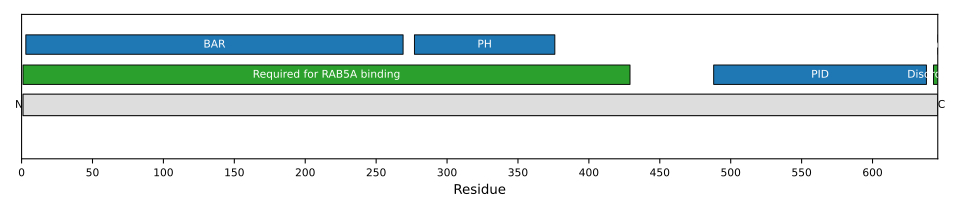
1: Multifunctional adapter protein that binds to various membrane receptors, nuclear factors and signaling proteins to regulate many processes, such as cell proliferation, immune response, endosomal trafficking and cell metabolism (PubMed:15016378, PubMed:24879834, PubMed:26583432). Regulates signaling pathway leading to cell proliferation through interaction with RAB5A and subunits of the NuRD/MeCP1 complex (PubMed:15016378). Plays a role in immune response by modulating phagocytosis, inflammatory and innate immune responses. In macrophages, enhances Fc-gamma receptor-mediated phagocytosis through interaction with RAB31 leading to activation of PI3K/Akt signaling. In response to LPS, modulates inflammatory responses by playing a key role on the regulation of TLR4 signaling and in the nuclear translocation of RELA/NF-kappa-B p65 and the secretion of pro- and anti-inflammatory cytokines. Also functions as a negative regulator of innate immune response via inhibition of AKT1 signaling pathway by forming a complex with APPL1 and PIK3R1 (By similarity). Plays a role in endosomal trafficking of TGFBR1 from the endosomes to the nucleus (PubMed:26583432). Plays a role in cell metabolism by regulating adiponecting ans insulin signaling pathways and adaptative thermogenesis (By similarity) (PubMed:24879834). In muscle, negatively regulates adiponectin-simulated glucose uptake and fatty acid oxidation by inhibiting adiponectin signaling pathway through APPL1 sequestration thereby antagonizing APPL1 action (By similarity). In muscles, negatively regulates insulin-induced plasma membrane recruitment of GLUT4 and glucose uptake through interaction with TBC1D1 (PubMed:24879834). Plays a role in cold and diet-induced adaptive thermogenesis by activating ventromedial hypothalamus (VMH) neurons throught AMPK inhibition which enhances sympathetic outflow to subcutaneous white adipose tissue (sWAT), sWAT beiging and cold tolerance (By similarity). Also plays a role in other signaling pathways namely Wnt/beta-catenin, HGF and glucocorticoid receptor signaling (By similarity) (PubMed:19433865). Positive regulator of beta-catenin/TCF-dependent transcription through direct interaction with RUVBL2/reptin resulting in the relief of RUVBL2-mediated repression of beta-catenin/TCF target genes by modulating the interactions within the beta-catenin-reptin-HDAC complex (PubMed:19433865). May affect adult neurogenesis in hippocampus and olfactory system via regulating the sensitivity of glucocorticoid receptor. Required for fibroblast migration through HGF cell signaling (By similarity)