Two pore channel protein 2 (Two pore calcium channel protein 2)
1_MAEPQ 6_ AESEP 11_ LLGGA 16_ RGGGG 21_ DWPAG 26_ LTTYR 31_ SIQVG 36_ PGAAA 41_ RWDLC 46_ IDQAV 51_ VFIED 56_ AIQYR 61_ SINHR 66_ VDASS 71_ MWLYR 76_ RYYSN 81_ VCQRT 86_ LSFTI 91_ FLILF 96_ LAFIE 101_ TPSSL 106_ TSTAD 111_ VRYRA 116_ APWEP 121_ PCGLT 126_ ESVEV 131_ LCLLV 136_ FAADL 141_ SVKGY 146_ LFGWA 151_ HFQKN 156_ LWLLG 161_ YLVVL 166_ VVSLV 171_ DWTVS 176_ LSLVC 181_ HEPLR 186_ IRRLL 191_ RPFFL 196_ LQNSS 201_ MMKKT 206_ LKCIR 211_ WSLPE 216_ MASVG 221_ LLLAI 226_ HLCLF 231_ TMFGM 236_ LLFAG 241_ GKQDD 246_ GQDRE 251_ RLTYF 256_ QNLPE 261_ SLTSL 266_ LVLLT 271_ TANNP 276_ DVMIP 281_ AYSKN 286_ RAYAI 291_ FFIVF 296_ TVIGS 301_ LFLMN 306_ LLTAI 311_ IYSQF 316_ RGYLM 321_ KSLQT 326_ SLFRR 331_ RLGTR 336_ AAFEV 341_ LSSMV 346_ GEGGA 351_ FPQAV 356_ GVKPQ 361_ NLLQV 366_ LQKVQ 371_ LDSSH 376_ KQAMM 381_ EKVRS 386_ YGSVL 391_ LSAEE 396_ FQKLF 401_ NELDR 406_ SVVKE 411_ HPPRP 416_ EYQSP 421_ FLQSA 426_ QFLFG 431_ HYYFD 436_ YLGNL 441_ IALAN 446_ LVSIC 451_ VFLVL 456_ DADVL 461_ PAERD 466_ DFILG 471_ ILNCV 476_ FIVYY 481_ LLEML 486_ LKVFA 491_ LGLRG 496_ YLSYP 501_ SNVFD 506_ GLLTV 511_ VLLVL 516_ EISTL 521_ AVYRL 526_ PHPGW 531_ RPEMV 536_ GLLSL 541_ WDMTR 546_ MLNML 551_ IVFRF 556_ LRIIP 561_ SMKLM 566_ AVVAS 571_ TVLGL 576_ VQNMR 581_ AFGGI 586_ LVVVY 591_ YVFAI 596_ IGINL 601_ FRGVI 606_ VALPG 611_ NSSLA 616_ PANGS 621_ APCGS 626_ FEQLE 631_ YWANN 636_ FDDFA 641_ AALVT 646_ LWNLM 651_ VVNNW 656_ QVFLD 661_ AYRRY 666_ SGPWS 671_ KIYFV 676_ LWWLV 681_ SSVIW 686_ VNLFL 691_ ALILE 696_ NFLHK 701_ WDPRS 706_ HLQPL 711_ AGTPE 716_ ATYQM 721_ TVELL 726_ FRDIL 731_ EEPGE 736_ DELTE 741_ RLSQH 746_PHLWL
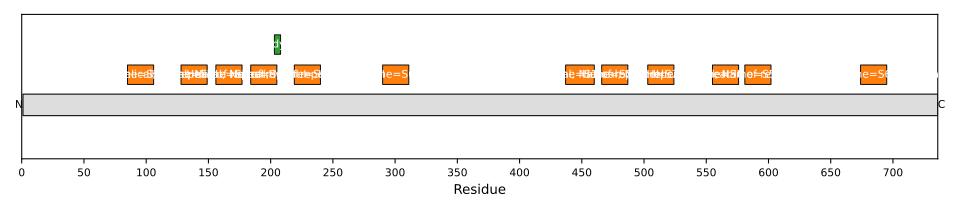
1: Intracellular channel initially characterized as a non-selective Ca(2+)-permeable channel activated by NAADP (nicotinic acid adenine dinucleotide phosphate), it is also a highly-selective Na(+) channel activated directly by PI(3,5)P2 (phosphatidylinositol 3,5-bisphosphate) (PubMed:19387438, PubMed:19620632, PubMed:20880839, PubMed:23063126, PubMed:23394946, PubMed:24502975, PubMed:24776928, PubMed:30860481, PubMed:31825310, PubMed:32167471). Localizes to the lysosomal and late endosome membranes where it regulates organellar membrane excitability, membrane trafficking, and pH homeostasis. Is associated with a plethora of physiological processes, including mTOR-dependent nutrient sensing, skin pigmentation and autophagy (PubMed:18488028, PubMed:23394946, PubMed:32167471). Ion selectivity is not fixed but rather agonist-dependent and under defined ionic conditions, can be readily activated by both NAADP and PI(3,5)P2 (PubMed:24502975, PubMed:31825310, PubMed:32167471). As calcium channel, it increases the pH in the lysosomal lumen, as sodium channel, it promotes lysosomal exocytosis (PubMed:31825310, PubMed:32167471). Plays a crucial role in endolysosomal trafficking in the endolysosomal degradation pathway and is potentially involved in the homeostatic control of many macromolecules and cell metabolites (By similarity) (PubMed:18488028, PubMed:19387438, PubMed:19620632, PubMed:20880839, PubMed:23063126, PubMed:23394946, PubMed:24502975, PubMed:24776928, PubMed:31825310, PubMed:32167471, PubMed:32679067). Also expressed in melanosomes of pigmented cells where mediates a Ca(2+) channel and/or PI(3,5)P2-activated melanosomal Na(+) channel to acidify pH and inhibit tyrosinase activity required for melanogenesis and pigmentation (PubMed:27140606). Unlike the voltage-dependent TPCN1, TPCN2 is voltage independent and can be activated solely by PI(3,5)P2 binding. In contrast, PI(4,5)P2, PI(3,4)P2, PI(3)P and PI(5)P have no obvious effect on channel activation (PubMed:30860481)
2: (Microbial infection) During Ebola virus (EBOV) infection, controls the movement of endosomes containing virus particles and is required by EBOV to escape from the endosomal network into the cell cytoplasm
3: (Microbial infection) Required for cell entry of coronaviruses SARS-CoV and SARS-CoV-2, as well as human coronavirus EMC (HCoV-EMC), by endocytosis