Endonuclease 8-like 3 (EC 3.2.2.-) (EC 4.2.99.18) (DNA glycosylase FPG2) (DNA glycosylase/AP lyase Neil3) (Endonuclease VIII-like 3) (Nei-like protein 3)
1_MVEGP 6_ GCTLN 11_ GEKIR 16_ ARVLP 21_ GQAVT 26_ GVRGS 31_ ALRSL 36_ QGRAL 41_ RLAAS 46_ TVVVS 51_ PQAAA 56_ LNNDS 61_ SQNVL 66_ SLFNG 71_ YVYSG 76_ VETLG 81_ KELFM 86_ YFGPK 91_ ALRIH 96_ FGMKG 101_ FIMIN 106_ PLEYK 111_ YKNGA 116_ SPVLE 121_ VQLTK 126_ DLICF 131_ FDSSV 136_ ELRNS 141_ MESQQ 146_ RIRMM 151_ KELDV 156_ CSPEF 161_ SFLRA 166_ ESEVK 171_ KQKGR 176_ MLGDV 181_ LMDQN 186_ VLPGV 191_ GNIIK 196_ NEALF 201_ DSGLH 206_ PAVKV 211_ CQLTD 216_ EQIHH 221_ LMKMI 226_ RDFSI 231_ LFYRC 236_ RKAGL 241_ ALSKH 246_ YKVYK 251_ RPNCG 256_ QCHCR 261_ ITVCR 266_ FGDNN 271_ RMTYF 276_ CPHCQ 281_ KENPQ 286_ HVDIC 291_ KLPTR 296_ NTIIS 301_ WTSSR 306_ VDHVM 311_ DSVAR 316_ KSEEH 321_ WTCVV 326_ CTLIN 331_ KPSSK 336_ ACDAC 341_ LTSRP 346_ IDSVL 351_ KSEEN 356_ STVFS 361_ HLMKY 366_ PCNTF 371_ GKPHT 376_ EVKIN 381_ RKTAF 386_ GTTTL 391_ VLTDF 396_ SNKSS 401_ TLERK 406_ TKQNQ 411_ ILDEE 416_ FQNSP 421_ PASVC 426_ LNDIQ 431_ HPSKK 436_ TTNDI 441_ TQPSS 446_ KVNIS 451_ PTISS 456_ ESKLF 461_ SPAHK 466_ KPKTA 471_ QYSSP 476_ ELKSC 481_ NPGYS 486_ NSELQ 491_ INMTD 496_ GPRTL 501_ NPDSP 506_ RCSKH 511_ NRLCI 516_ LRVVG 521_ KDGEN 526_ KGRQF 531_ YACPL 536_ PREAQ 541_ CGFFE 546_ WADLS 551_ FPFCN 556_ HGKRS 561_ TMKTV 566_ LKIGP 571_ NNGKN 576_ FFVCP 581_ LGKEK 586_ QCNFF 591_ QWAEN 596_GPGIK
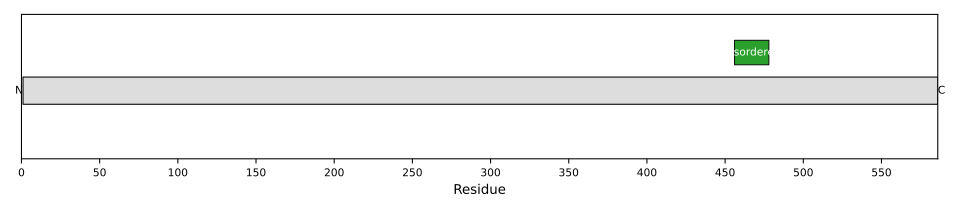
1: DNA glycosylase which prefers single-stranded DNA (ssDNA), or partially ssDNA structures such as bubble and fork structures, to double-stranded DNA (dsDNA) (PubMed:12433996, PubMed:19170771, PubMed:22569481, PubMed:23755964). Mediates interstrand cross-link repair in response to replication stress: acts by mediating DNA glycosylase activity, cleaving one of the two N-glycosyl bonds comprising the interstrand cross-link, which avoids the formation of a double-strand break but generates an abasic site that is bypassed by translesion synthesis polymerases (By similarity). In vitro, displays strong glycosylase activity towards the hydantoin lesions spiroiminodihydantoin (Sp) and guanidinohydantoin (Gh) in both ssDNA and dsDNA; also recognizes FapyA, FapyG, 5-OHU, 5-OHC, 5-OHMH, Tg and 8-oxoA lesions in ssDNA (PubMed:12433996, PubMed:19170771, PubMed:22569481, PubMed:23755964). No activity on 8-oxoG detected (PubMed:12433996, PubMed:19170771, PubMed:22569481, PubMed:23755964). Also shows weak DNA-(apurinic or apyrimidinic site) lyase activity (PubMed:12433996, PubMed:19170771, PubMed:22569481, PubMed:23755964). In vivo, appears to be the primary enzyme involved in removing Sp and Gh from ssDNA in neonatal tissues (PubMed:12433996, PubMed:19170771, PubMed:22569481, PubMed:23755964)