Short transient receptor potential channel 4-associated protein (Trp4-associated protein) (Trpc4-associated protein) (Protein TAP1) (TNF-receptor ubiquitous scaffolding/signaling protein) (Protein TRUSS)
1_MAAAP 6_ VAAGS 11_ GAGRG 16_ RRSAA 21_ TVAAW 26_ GGWGG 31_ RPRPG 36_ NILLQ 41_ LRQGQ 46_ LTGRG 51_ LVRAV 56_ QFTET 61_ FLTER 66_ DKQSK 71_ WSGIP 76_ QLLLK 81_ LHTTS 86_ HLHSD 91_ FVECQ 96_ NILKE 101_ ISPLL 106_ SMEAM 111_ AFVTE 116_ ERKLT 121_ QETTY 126_ PNTYI 131_ FDLFG 136_ GVDLL 141_ VEILM 146_ RPTIS 151_ IRGQK 156_ LKISD 161_ EMSKD 166_ CLSIL 171_ YNTCV 176_ CTEGV 181_ TKRLA 186_ EKNDF 191_ VIFLF 196_ TLMTS 201_ KKTFL 206_ QTATL 211_ IEDIL 216_ GVKKE 221_ MIRLD 226_ EVPNL 231_ SSLVS 236_ NFDQQ 241_ QLANF 246_ CRILA 251_ VTISE 256_ MDTGN 261_ DDKHT 266_ LLAKN 271_ AQQKK 276_ SLSLG 281_ PSAAE 286_ INQAA 291_ LLSIP 296_ GFVER 301_ LCKLA 306_ TRKVS 311_ ESTGT 316_ ASFLQ 321_ ELEEW 326_ YTWLD 331_ NALVL 336_ DALMR 341_ VANEE 346_ SEHNQ 351_ ASIVF 356_ PPPGA 361_ SEENG 366_ LPHTS 371_ ARTQL 376_ PQSMK 381_ IMHEI 386_ MYKLE 391_ VLYVL 396_ CVLLM 401_ GRQRN 406_ QVHRM 411_ IAEFK 416_ LIPGL 421_ NNLFD 426_ KLIWR 431_ KHSAS 436_ ALVLH 441_ GHNQN 446_ CDCSP 451_ DITLK 456_ IQFLR 461_ LLQSF 466_ SDHHE 471_ NKYLL 476_ LNNQE 481_ LNELS 486_ AISLK 491_ ANIPE 496_ VEAVL 501_ NTDRS 506_ LVCDG 511_ KRGLL 516_ TRLLQ 521_ VMKKE 526_ PAESS 531_ FRFWQ 536_ ARAVE 541_ SFLRG 546_ TTSYA 551_ DQMFL 556_ LKRGL 561_ LEHIL 566_ YCIVD 571_ SECKS 576_ RDVLQ 581_ SYFDL 586_ LGELM 591_ KFNVD 596_ AFKRF 601_ NKYIN 606_ TDAKF 611_ QVFLK 616_ QINSS 621_ LVDSN 626_ MLVRC 631_ VTLSL 636_ DRFEN 641_ QVDMK 646_ VAEVL 651_ SECRL 656_ LAYIS 661_ QVPTQ 666_ MSFLF 671_ RLINI 676_ IHVQT 681_ LTQEN 686_ VSCLN 691_ TSLVI 696_ LMLAR 701_ RKERL 706_ PLYLR 711_ LLQRM 716_ EHSKK 721_ YPGFL 726_ LNNFH 731_ NLLRF 736_ WQQHY 741_ LHKDK 746_ DSTCL 751_ ENSSC 756_ ISFSY 761_ WKETV 766_ SILLN 771_ PDRQS 776_ PSALV 781_ SYIEE 786_ PYMDI 791_DRDFT
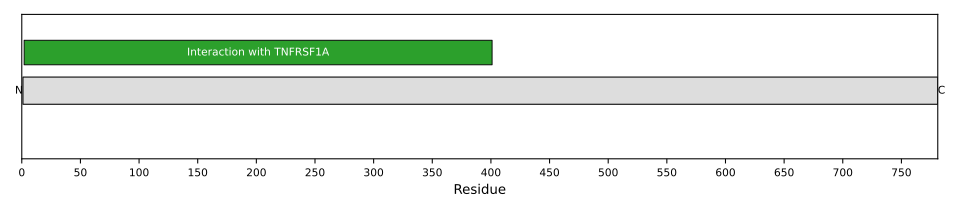
1: Substrate-recognition component of a DCX (DDB1-CUL4-X-box) E3 ubiquitin-protein ligase complex required for cell cycle control (PubMed:20551172, PubMed:29779948). The DCX(TRPC4AP) complex specifically mediates the polyubiquitination and subsequent degradation of MYC as part of the DesCEND (destruction via C-end degrons) pathway (PubMed:20551172, PubMed:29779948). The DesCEND (destruction via C-end degrons) pathway recognizes a C-degron located at the extreme C terminus of target proteins, leading to their ubiquitination and degradation (PubMed:29779948). The DCX(TRPC4AP) complex specifically recognizes proteins with an arginine at the minus 3 position (R-3 motif) at the C-terminus, such as MYC, leading to their ubiquitination and degradation (PubMed:29779948). Also participates in the activation of NFKB1 in response to ligation of TNFRSF1A, possibly by linking TNFRSF1A to the IKK signalosome (By similarity). Involved in JNK activation via its interaction with TRAF2 (By similarity). Also involved in elevation of endoplasmic reticulum Ca(2+) storage reduction in response to CHRM1 (By similarity)