Programmed cell death 6-interacting protein (PDCD6-interacting protein) (ALG-2-interacting protein 1) (ALG-2-interacting protein X) (Hp95)
1_MATFI 6_ SVQLK 11_ KTSEV 16_ DLAKP 21_ LVKFI 26_ QQTYP 31_ SGGEE 36_ QAQYC 41_ RAAEE 46_ LSKLR 51_ RAAVG 56_ RPLDK 61_ HEGAL 66_ ETLLR 71_ YYDQI 76_ CSIEP 81_ KFPFS 86_ ENQIC 91_ LTFTW 96_ KDAFD 101_ KGSLF 106_ GGSVK 111_ LALAS 116_ LGYEK 121_ SCVLF 126_ NCAAL 131_ ASQIA 136_ AEQNL 141_ DNDEG 146_ LKIAA 151_ KHYQF 156_ ASGAF 161_ LHIKE 166_ TVLSA 171_ LSREP 176_ TVDIS 181_ PDTVG 186_ TLSLI 191_ MLAQA 196_ QEVFF 201_ LKATR 206_ DKMKD 211_ AIIAK 216_ LANQA 221_ ADYFG 226_ DAFKQ 231_ CQYKD 236_ TLPKE 241_ VFPVL 246_ AAKHC 251_ IMQAN 256_ AEYHQ 261_ SILAK 266_ QQKKF 271_ GEEIA 276_ RLQHA 281_ AELIK 286_ TVASR 291_ YDEYV 296_ NVKDF 301_ SDKIN 306_ RALAA 311_ AKKDN 316_ DFIYH 321_ DRVPD 326_ LKDLD 331_ PIGKA 336_ TLVKS 341_ TPVNV 346_ PISQK 351_ FTDLF 356_ EKMVP 361_ VSVQQ 366_ SLAAY 371_ NQRKA 376_ DLVNR 381_ SIAQM 386_ REATT 391_ LANGV 396_ LASLN 401_ LPAAI 406_ EDVSG 411_ DTVPQ 416_ SILTK 421_ SRSVI 426_ EQGGI 431_ QTVDQ 436_ LIKEL 441_ PELLQ 446_ RNREI 451_ LDESL 456_ RLLDE 461_ EEATD 466_ NDLRA 471_ KFKER 476_ WQRTP 481_ SNELY 486_ KPLRA 491_ EGTNF 496_ RTVLD 501_ KAVQA 506_ DGQVK 511_ ECYQS 516_ HRDTI 521_ VLLCK 526_ PEPEL 531_ NAAIP 536_ SANPA 541_ KTMQG 546_ SEVVN 551_ VLKSL 556_ LSNLD 561_ EVKKE 566_ REGLE 571_ NDLKS 576_ VNFDM 581_ TSKFL 586_ TALAQ 591_ DGVIN 596_ EEALS 601_ VTELD 606_ RVYGG 611_ LTTKV 616_ QESLK 621_ KQEGL 626_ LKNIQ 631_ VSHQE 636_ FSKMK 641_ QSNNE 646_ ANLRE 651_ EVLKN 656_ LATAY 661_ DNFVE 666_ LVANL 671_ KEGTK 676_ FYNEL 681_ TEILV 686_ RFQNK 691_ CSDIV 696_ FARKT 701_ ERDEL 706_ LKDLQ 711_ QSIAR 716_ EPSAP 721_ SIPTP 726_ AYQSS 731_ PAGGH 736_ APTPP 741_ TPAPR 746_ TMPPT 751_ KPQPP 756_ ARPPP 761_ PVLPA 766_ NRAPS 771_ ATAPS 776_ PVGAG 781_ TAAPA 786_ PSQTP 791_ GSAPP 796_ PQAQG 801_ PPYPT 806_ YPGYP 811_ GYCQM 816_ PMPMG 821_ YNPYA 826_ YGQYN 831_ MPYPP 836_ VYHQS 841_ PGQAP 846_ YPGPQ 851_ QPSYP 856_ FPQPP 861_QQSYY
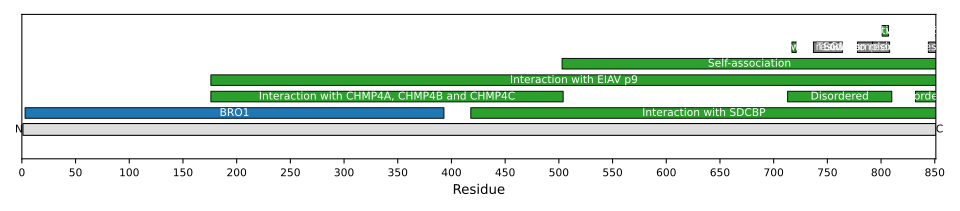
1: Multifunctional protein involved in endocytosis, multivesicular body biogenesis, membrane repair, cytokinesis, apoptosis and maintenance of tight junction integrity. Class E VPS protein involved in concentration and sorting of cargo proteins of the multivesicular body (MVB) for incorporation into intralumenal vesicles (ILVs) that are generated by invagination and scission from the limiting membrane of the endosome. Binds to the phospholipid lysobisphosphatidic acid (LBPA) which is abundant in MVBs internal membranes. The MVB pathway requires the sequential function of ESCRT-O, -I,-II and -III complexes (PubMed:14739459). The ESCRT machinery also functions in topologically equivalent membrane fission events, such as the terminal stages of cytokinesis (PubMed:17556548, PubMed:17853893). Adapter for a subset of ESCRT-III proteins, such as CHMP4, to function at distinct membranes. Required for completion of cytokinesis (PubMed:17556548, PubMed:17853893, PubMed:18641129). May play a role in the regulation of both apoptosis and cell proliferation. Regulates exosome biogenesis in concert with SDC1/4 and SDCBP (PubMed:22660413). By interacting with F-actin, PARD3 and TJP1 secures the proper assembly and positioning of actomyosin-tight junction complex at the apical sides of adjacent epithelial cells that defines a spatial membrane domain essential for the maintenance of epithelial cell polarity and barrier (By similarity)
2: (Microbial infection) Involved in HIV-1 virus budding. Can replace TSG101 it its role of supporting HIV-1 release; this function requires the interaction with CHMP4B. The ESCRT machinery also functions in topologically equivalent membrane fission events, such as enveloped virus budding (HIV-1 and other lentiviruses)