Solute carrier family 13 member 3 (Na(+)/dicarboxylate cotransporter 3) (NaDC-3) (hNaDC3) (Sodium-dependent high-affinity dicarboxylate transporter 2)
1_MAALA 6_ AAAKK 11_ VWSAR 16_ RLLVL 21_ LFTPL 26_ ALLPV 31_ VFALP 36_ PKEGR 41_ CLFVI 46_ LLMAV 51_ YWCTE 56_ ALPLS 61_ VTALL 66_ PIVLF 71_ PFMGI 76_ LPSNK 81_ VCPQY 86_ FLDTN 91_ FLFLS 96_ GLIMA 101_ SAIEE 106_ WNLHR 111_ RIALK 116_ ILMLV 121_ GVQPA 126_ RLILG 131_ MMVTT 136_ SFLSM 141_ WLSNT 146_ ASTAM 151_ MLPIA 156_ NAILK 161_ SLFGQ 166_ KEVRK 171_ DPSQE 176_ SEENT 181_ AAVRR 186_ NGLHT 191_ VPTEM 196_ QFLAS 201_ TEAKD 206_ HPGET 211_ EVPLD 216_ LPADS 221_ RKEDE 226_ YRRNI 231_ WKGFL 236_ ISIPY 241_ SASIG 246_ GTATL 251_ TGTAP 256_ NLILL 261_ GQLKS 266_ FFPQC 271_ DVVNF 276_ GSWFI 281_ FAFPL 286_ MLLFL 291_ LAGWL 296_ WISFL 301_ YGGLS 306_ FRGWR 311_ KNKSE 316_ IRTNA 321_ EDRAR 326_ AVIRE 331_ EYQNL 336_ GPIKF 341_ AEQAV 346_ FILFC 351_ MFAIL 356_ LFTRD 361_ PKFIP 366_ GWASL 371_ FNPGF 376_ LSDAV 381_ TGVAI 386_ VTILF 391_ FFPSQ 396_ RPSLK 401_ WWFDF 406_ KAPNT 411_ ETEPL 416_ LTWKK 421_ AQETV 426_ PWNII 431_ LLLGG 436_ GFAMA 441_ KGCEE 446_ SGLSV 451_ WIGGQ 456_ LHPLE 461_ NVPPA 466_ LAVLL 471_ ITVVI 476_ AFFTE 481_ FASNT 486_ ATIII 491_ FLPVL 496_ AELAI 501_ RLRVH 506_ PLYLM 511_ IPGTV 516_ GCSFA 521_ FMLPV 526_ STPPN 531_ SIAFA 536_ SGHLL 541_ VKDMV 546_ RTGLL 551_ MNLMG 556_ VLLLS 561_ LAMNT 566_ WAQTI 571_ FQLGT 576_ FPDWA 581_ DMYSV 586_ NVTAL 591_ PPTLA 596_NDTFR
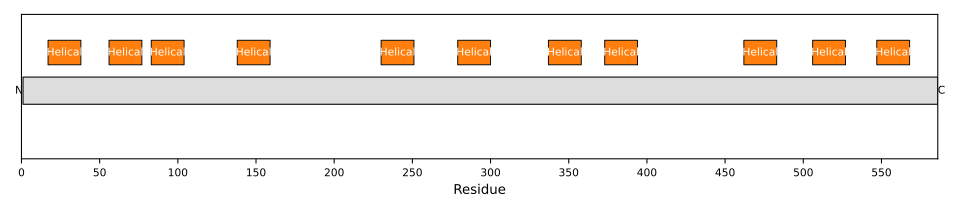
1: High-affinity sodium-dicarboxylate cotransporter that accepts a range of substrates with 4-6 carbon atoms, such as the citric acid cycle intermediates succinate and alpha-ketoglutarate (2-oxoglutarate), as well as other compounds including N-acetyl-L-aspartate (PubMed:10794676, PubMed:10992006, PubMed:15561973, PubMed:17356845, PubMed:17426067, PubMed:24247155, PubMed:30635937). Transports the dicarboxylate into the cell with a probable stoichiometry of 3 Na(+) for 1 divalent dicarboxylate, rendering the process electrogenic (PubMed:10794676, PubMed:10992006). Can transport citrate in a Na(+)-dependent manner, recognizing the divalent form of citrate rather than the trivalent form which is normally found in blood (PubMed:10794676). Imports itaconate in hepatocytes leading to activation of TFEB-dependent lysosomal biogenesis involved in antibacterial innate immune response