C-type lectin domain family 4 member D (C-type lectin superfamily member 8) (C-type lectin-like receptor 6) (CLEC-6) (Dendritic cell-associated C-type lectin 3) (DC-associated C-type lectin 3) (Dectin-3) (CD antigen CD368)
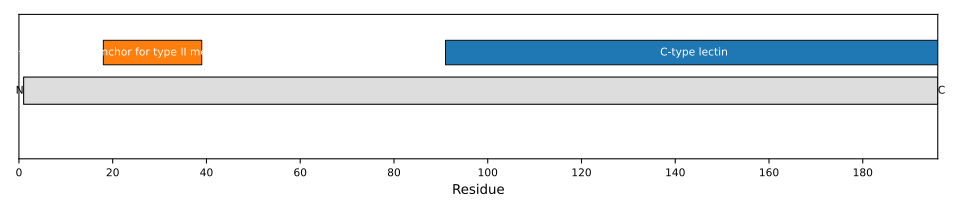
1_MGLEK 6_ PQSKL 11_ EGGMH 16_ PQLIP 21_ SVIAV 26_ VFILL 31_ LSVCF 36_ IASCL 41_ VTHHN 46_ FSRCK 51_ RGTGV 56_ HKLEH 61_ HAKLK 66_ CIKEK 71_ SELKS 76_ AEGST 81_ WNCCP 86_ IDWRA 91_ FQSNC 96_ YFPLT 101_ DNKTW 106_ AESER 111_ NCSGM 116_ GAHLM 121_ TISTE 126_ AEQNF 131_ IIQFL 136_ DRRLS 141_ YFLGL 146_ RDENA 151_ KGQWR 156_ WVDQT 161_ PFNPR 166_ RVFWH 171_ KNEPD 176_ NSQGE 181_ NCVVL 186_ VYNQD 191_ KWAWN 196_ DVPCN 201_ FEASR 206_ICKIP
1: Calcium-dependent lectin that acts as a pattern recognition receptor (PRR) of the innate immune system: recognizes damage-associated molecular patterns (DAMPs) of pathogen-associated molecular patterns (PAMPs) of bacteria and fungi (PubMed:23602766, PubMed:23911656). The PAMPs include alpha-mannans on C.albicans hypheas and mycobacterial trehalose 6,6'-dimycolate (TDM) (PubMed:23602766, PubMed:23911656). Interacts with signaling adapter Fc receptor gamma chain/FCER1G, likely via CLEC4E, to form a functional complex in myeloid cells (By similarity). Binding of mycobacterial TDM or C.albicans alpha-mannans to this receptor complex leads to phosphorylation of the immunoreceptor tyrosine-based activation motif (ITAM) of FCER1G, triggering activation of SYK, CARD9 and NF-kappa-B, consequently driving maturation of antigen-presenting cells and shaping antigen-specific priming of T-cells toward effector T-helper 1 and T-helper 17 cell subtypes (PubMed:23602766, PubMed:23911656). The heterodimer formed with CLEC6A is active against fungal infection (PubMed:23911656). Functions as an endocytic receptor (PubMed:14971047). May be involved in antigen uptake at the site of infection, either for clearance of the antigen, or for processing and further presentation to T-cells (PubMed:14971047)