Aryl hydrocarbon receptor nuclear translocator-like protein 2 (Basic-helix-loop-helix-PAS protein MOP9) (Brain and muscle ARNT-like 2) (CYCLE-like factor) (CLIF) (Class E basic helix-loop-helix protein 6) (bHLHe6) (Member of PAS protein 9) (PAS domain-containing protein 9)
1_MAAEE 6_ EAAAG 11_ GKVLR 16_ EENQC 21_ IAPVV 26_ SSRVS 31_ PGTRP 36_ TAMGS 41_ FSSHM 46_ TEFPR 51_ KRKGS 56_ DSDPS 61_ QSGIM 66_ TEKVV 71_ EKLSQ 76_ NPLTY 81_ LLSTR 86_ IEISA 91_ SSGSR 96_ VEDGE 101_ HQVKM 106_ KAFRE 111_ AHSQT 116_ EKRRR 121_ DKMNN 126_ LIEEL 131_ SAMIP 136_ QCNPM 141_ ARKLD 146_ KLTVL 151_ RMAVQ 156_ HLRSL 161_ KGLTN 166_ SYVGS 171_ NYRPS 176_ FLQDN 181_ ELRHL 186_ ILKTA 191_ EGFLF 196_ VVGCE 201_ RGKIL 206_ FVSKS 211_ VSKIL 216_ NYDQA 221_ SLTGQ 226_ SLFDF 231_ LHPKD 236_ VAKVK 241_ EQLSS 246_ FDISP 251_ REKLI 256_ DAKTG 261_ LQVHS 266_ NLHAG 271_ RTRVY 276_ SGSRR 281_ SFFCR 286_ IKSCK 291_ ISVKE 296_ EHGCL 301_ PNSKK 306_ KEHRK 311_ FYTIH 316_ CTGYL 321_ RSWPP 326_ NIVGM 331_ EEERN 336_ SKKDN 341_ SNFTC 346_ LVAIG 351_ RLQPY 356_ IVPQN 361_ SGEIN 366_ VKPTE 371_ FITRF 376_ AVNGK 381_ FVYVD 386_ QRATA 391_ ILGYL 396_ PQELL 401_ GTSCY 406_ EYFHQ 411_ DDHNN 416_ LTDKH 421_ KAVLQ 426_ SKEKI 431_ LTDSY 436_ KFRAK 441_ DGSFV 446_ TLKSQ 451_ WFSFT 456_ NPWTK 461_ ELEYI 466_ VSVNT 471_ LVLGH 476_ SEPGE 481_ ASFLP 486_ CSSQS 491_ SEESS 496_ RQSCM 501_ SVPGM 506_ STGTV 511_ LGAGS 516_ IGTDI 521_ ANEIL 526_ DLQRL 531_ QSSSY 536_ LDDSS 541_ PTGLM 546_ KDTHT 551_ VNCRS 556_ MSNKE 561_ LFPPS 566_ PSEMG 571_ ELEAT 576_ RQNQS 581_ TVAVH 586_ SHEPL 591_ LSDGA 596_ QLDFD 601_ ALCDN 606_ DDTAM 611_ AAFMN 616_ YLEAE 621_ GGLGD 626_ PGDFS 631_DIQWT
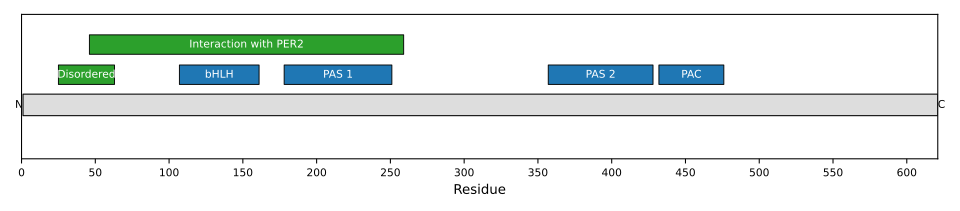
1: Transcriptional activator which forms a core component of the circadian clock. The circadian clock, an internal time-keeping system, regulates various physiological processes through the generation of approximately 24 hour circadian rhythms in gene expression, which are translated into rhythms in metabolism and behavior. It is derived from the Latin roots 'circa' (about) and 'diem' (day) and acts as an important regulator of a wide array of physiological functions including metabolism, sleep, body temperature, blood pressure, endocrine, immune, cardiovascular, and renal function. Consists of two major components: the central clock, residing in the suprachiasmatic nucleus (SCN) of the brain, and the peripheral clocks that are present in nearly every tissue and organ system. Both the central and peripheral clocks can be reset by environmental cues, also known as Zeitgebers (German for 'timegivers'). The predominant Zeitgeber for the central clock is light, which is sensed by retina and signals directly to the SCN. The central clock entrains the peripheral clocks through neuronal and hormonal signals, body temperature and feeding-related cues, aligning all clocks with the external light/dark cycle. Circadian rhythms allow an organism to achieve temporal homeostasis with its environment at the molecular level by regulating gene expression to create a peak of protein expression once every 24 hours to control when a particular physiological process is most active with respect to the solar day. Transcription and translation of core clock components (CLOCK, NPAS2, BMAL1, BMAL2, PER1, PER2, PER3, CRY1 and CRY2) plays a critical role in rhythm generation, whereas delays imposed by post-translational modifications (PTMs) are important for determining the period (tau) of the rhythms (tau refers to the period of a rhythm and is the length, in time, of one complete cycle). A diurnal rhythm is synchronized with the day/night cycle, while the ultradian and infradian rhythms have a period shorter and longer than 24 hours, respectively. Disruptions in the circadian rhythms contribute to the pathology of cardiovascular diseases, cancer, metabolic syndromes and aging. A transcription/translation feedback loop (TTFL) forms the core of the molecular circadian clock mechanism. Transcription factors, CLOCK or NPAS2 and BMAL1 or BMAL2, form the positive limb of the feedback loop, act in the form of a heterodimer and activate the transcription of core clock genes and clock-controlled genes (involved in key metabolic processes), harboring E-box elements (5'-CACGTG-3') within their promoters. The core clock genes: PER1/2/3 and CRY1/2 which are transcriptional repressors form the negative limb of the feedback loop and interact with the CLOCK|NPAS2-BMAL1|BMAL2 heterodimer inhibiting its activity and thereby negatively regulating their own expression. This heterodimer also activates nuclear receptors NR1D1/2 and RORA/B/G, which form a second feedback loop and which activate and repress BMAL1 transcription, respectively. The CLOCK-BMAL2 heterodimer activates the transcription of SERPINE1/PAI1 and BHLHE40/DEC1