Nuclear receptor subfamily 4 group A member 3 (Mitogen-induced nuclear orphan receptor) (Neuron-derived orphan receptor 1) (Nuclear hormone receptor NOR-1)
1_MPCVQ 6_ AQYSP 11_ SPPGS 16_ SYAAQ 21_ TYSSE 26_ YTTEI 31_ MNPDY 36_ TKLTM 41_ DLGST 46_ EITAT 51_ ATTSL 56_ PSIST 61_ FVEGY 66_ SSNYE 71_ LKPSC 76_ VYQMQ 81_ RPLIK 86_ VEEGR 91_ APSYH 96_ HHHHH 101_ HHHHH 106_ HHHQQ 111_ QHQQP 116_ SIPPA 121_ SSPED 126_ EVLPS 131_ TSMYF 136_ KQSPP 141_ STPTT 146_ PAFPP 151_ QAGAL 156_ WDEAL 161_ PSAPG 166_ CIAPG 171_ PLLDP 176_ PMKAV 181_ PTVAG 186_ ARFPL 191_ FHFKP 196_ SPPHP 201_ PAPSP 206_ AGGHH 211_ LGYDP 216_ TAAAA 221_ LSLPL 226_ GAAAA 231_ AGSQA 236_ AALES 241_ HPYGL 246_ PLAKR 251_ AAPLA 256_ FPPLG 261_ LTPSP 266_ TASSL 271_ LGESP 276_ SLPSP 281_ PSRSS 286_ SSGEG 291_ TCAVC 296_ GDNAA 301_ CQHYG 306_ VRTCE 311_ GCKGF 316_ FKRTV 321_ QKNAK 326_ YVCLA 331_ NKNCP 336_ VDKRR 341_ RNRCQ 346_ YCRFQ 351_ KCLSV 356_ GMVKE 361_ VVRTD 366_ SLKGR 371_ RGRLP 376_ SKPKS 381_ PLQQE 386_ PSQPS 391_ PPSPP 396_ ICMMN 401_ ALVRA 406_ LTDST 411_ PRDLD 416_ YSRYC 421_ PTDQA 426_ AAGTD 431_ AEHVQ 436_ QFYNL 441_ LTASI 446_ DVSRS 451_ WAEKI 456_ PGFTD 461_ LPKED 466_ QTLLI 471_ ESAFL 476_ ELFVL 481_ RLSIR 486_ SNTAE 491_ DKFVF 496_ CNGLV 501_ LHRLQ 506_ CLRGF 511_ GEWLD 516_ SIKDF 521_ SLNLQ 526_ SLNLD 531_ IQALA 536_ CLSAL 541_ SMITE 546_ RHGLK 551_ EPKRV 556_ EELCN 561_ KITSS 566_ LKDHQ 571_ SKGQA 576_ LEPTE 581_ SKVLG 586_ ALVEL 591_ RKICT 596_ LGLQR 601_ IFYLK 606_ LEDLV 611_ SPPSI 616_ IDKLF 621_LDTLP
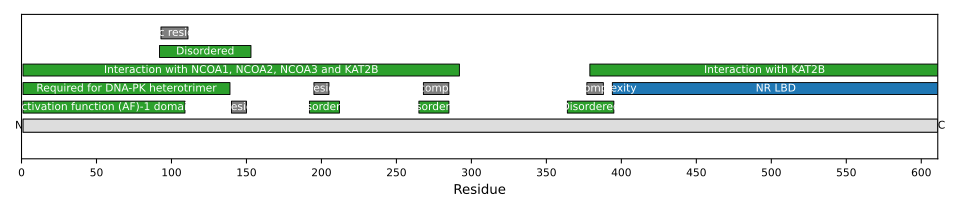
1: Transcriptional activator that binds to regulatory elements in promoter regions in a cell- and response element (target)-specific manner. Induces gene expression by binding as monomers to the NR4A1 response element (NBRE) 5'-AAAAGGTCA-3' site and as homodimers to the Nur response element (NurRE) site in the promoter of their regulated target genes (By similarity). Plays a role in the regulation of proliferation, survival and differentiation of many different cell types and also in metabolism and inflammation. Mediates proliferation of vascular smooth muscle, myeloid progenitor cell and type B pancreatic cells; promotes mitogen-induced vascular smooth muscle cell proliferation through transactivation of SKP2 promoter by binding a NBRE site (By similarity). Upon PDGF stimulation, stimulates vascular smooth muscle cell proliferation by regulating CCND1 and CCND2 expression. In islets, induces type B pancreatic cell proliferation through up-regulation of genes that activate cell cycle, as well as genes that cause degradation of the CDKN1A (By similarity). Negatively regulates myeloid progenitor cell proliferation by repressing RUNX1 in a NBRE site-independent manner. During inner ear, plays a role as a key mediator of the proliferative growth phase of semicircular canal development (By similarity). Also mediates survival of neuron and smooth muscle cells; mediates CREB-induced neuronal survival, and during hippocampus development, plays a critical role in pyramidal cell survival and axonal guidance. Is required for S phase entry of the cell cycle and survival of smooth muscle cells by inducing CCND1, resulting in RB1 phosphorylation. Binds to NBRE motif in CCND1 promoter, resulting in the activation of the promoter and CCND1 transcription (By similarity). Also plays a role in inflammation; upon TNF stimulation, mediates monocyte adhesion by inducing the expression of VCAM1 and ICAM1 by binding to the NBRE consensus site (By similarity) (PubMed:20558821). In mast cells activated by Fc-epsilon receptor cross-linking, promotes the synthesis and release of cytokines but impairs events leading to degranulation (By similarity). Also plays a role in metabolism; by modulating feeding behavior; and by playing a role in energy balance by inhibiting the glucocorticoid-induced orexigenic neuropeptides AGRP expression, at least in part by forming a complex with activated NR3C1 on the AGRP- glucocorticoid response element (GRE), and thus weakening the DNA binding activity of NR3C1. Upon catecholamines stimulation, regulates gene expression that controls oxidative metabolism in skeletal muscle (By similarity). Plays a role in glucose transport by regulating translocation of the SLC2A4 glucose transporter to the cell surface (PubMed:24022864). Finally, during gastrulation plays a crucial role in the formation of anterior mesoderm by controlling cell migration. Inhibits adipogenesis (By similarity). Also participates in cardiac hypertrophy by activating PARP1 (By similarity)