Acidic leucine-rich nuclear phosphoprotein 32 family member B (Acidic protein rich in leucines) (Putative HLA-DR-associated protein I-2) (PHAPI2) (Silver-stainable protein SSP29)
1_MDMKR 6_ RIHLE 11_ LRNRT 16_ PAAVR 21_ ELVLD 26_ NCKSN 31_ DGKIE 36_ GLTAE 41_ FVNLE 46_ FLSLI 51_ NVGLI 56_ SVSNL 61_ PKLPK 66_ LKKLE 71_ LSENR 76_ IFGGL 81_ DMLAE 86_ KLPNL 91_ THLNL 96_ SGNKL 101_ KDIST 106_ LEPLK 111_ KLECL 116_ KSLDL 121_ FNCEV 126_ TNLND 131_ YRESV 136_ FKLLP 141_ QLTYL 146_ DGYDR 151_ EDQEA 156_ PDSDA 161_ EVDGV 166_ DEEEE 171_ DEEGE 176_ DEEDE 181_ DDEDG 186_ EEEEF 191_ DEEDD 196_ EDEDV 201_ EGDED 206_ DDEVS 211_ EEEEE 216_ FGLDE 221_ EDEDE 226_ DEDEE 231_ EEEGG 236_ KGEKR 241_ KRETD 246_DEGED
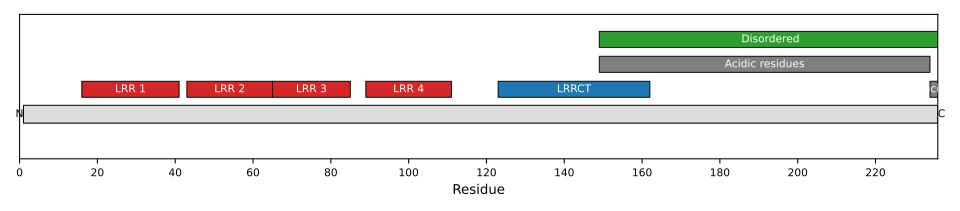
1: Multifunctional protein that is involved in the regulation of many processes including cell proliferation, apoptosis, cell cycle progression or transcription (PubMed:18039846, PubMed:20015864). Regulates the proliferation of neuronal stem cells, differentiation of leukemic cells and progression from G1 to S phase of the cell cycle. As negative regulator of caspase-3-dependent apoptosis, may act as an antagonist of ANP32A in regulating tissue homeostasis (PubMed:20015864). Exhibits histone chaperone properties, able to recruit histones to certain promoters, thus regulating the transcription of specific genes (PubMed:18039846, PubMed:20538007). Also plays an essential role in the nucleocytoplasmic transport of specific mRNAs via the uncommon nuclear mRNA export receptor XPO1/CRM1 (PubMed:17178712). Participates in the regulation of adequate adaptive immune responses by acting on mRNA expression and cell proliferation (By similarity)
2: (Microbial infection) Plays an essential role in influenza A and B viral genome replication (PubMed:31217244, PubMed:33045004). Also plays a role in foamy virus mRNA export from the nucleus to the cytoplasm (PubMed:21159877)