Probable ATP-dependent RNA helicase DDX17 (EC 3.6.4.13) (DEAD box protein 17) (DEAD box protein p72) (DEAD box protein p82) (RNA-dependent helicase p72)
1_MPTGF 6_ VAPIL 11_ CVLLP 16_ SPTRE 21_ AATVA 26_ SATGD 31_ SASER 36_ ESAAP 41_ AAAPT 46_ AEAPP 51_ PSVVT 56_ RPEPQ 61_ ALPSP 66_ AIRAP 71_ LPDLY 76_ PFGTM 81_ RGGGF 86_ GDRDR 91_ DRDRG 96_ GFGAR 101_ GGGGL 106_ PPKKF 111_ GNPGE 116_ RLRKK 121_ KWDLS 126_ ELPKF 131_ EKNFY 136_ VEHPE 141_ VARLT 146_ PYEVD 151_ ELRRK 156_ KEITV 161_ RGGDV 166_ CPKPV 171_ FAFHH 176_ ANFPQ 181_ YVMDV 186_ LMDQH 191_ FTEPT 196_ PIQCQ 201_ GFPLA 206_ LSGRD 211_ MVGIA 216_ QTGSG 221_ KTLAY 226_ LLPAI 231_ VHINH 236_ QPYLE 241_ RGDGP 246_ ICLVL 251_ APTRE 256_ LAQQV 261_ QQVAD 266_ DYGKC 271_ SRLKS 276_ TCIYG 281_ GAPKG 286_ PQIRD 291_ LERGV 296_ EICIA 301_ TPGRL 306_ IDFLE 311_ SGKTN 316_ LRRCT 321_ YLVLD 326_ EADRM 331_ LDMGF 336_ EPQIR 341_ KIVDQ 346_ IRPDR 351_ QTLMW 356_ SATWP 361_ KEVRQ 366_ LAEDF 371_ LRDYT 376_ QINVG 381_ NLELS 386_ ANHNI 391_ LQIVD 396_ VCMES 401_ EKDHK 406_ LIQLM 411_ EEIMA 416_ EKENK 421_ TIIFV 426_ ETKRR 431_ CDDLT 436_ RRMRR 441_ DGWPA 446_ MCIHG 451_ DKSQP 456_ ERDWV 461_ LNEFR 466_ SGKAP 471_ ILIAT 476_ DVASR 481_ GLDVE 486_ DVKFV 491_ INYDY 496_ PNSSE 501_ DYVHR 506_ IGRTA 511_ RSTNK 516_ GTAYT 521_ FFTPG 526_ NLKQA 531_ RELIK 536_ VLEEA 541_ NQAIN 546_ PKLMQ 551_ LVDHR 556_ GGGGG 561_ GGGRS 566_ RYRTT 571_ SSANN 576_ PNLMY 581_ QDECD 586_ RRLRG 591_ VKDGG 596_ RRDSA 601_ SYRDR 606_ SETDR 611_ AGYAN 616_ GSGYG 621_ SPNSA 626_ FGAQA 631_ GQYTY 636_ GQGTY 641_ GAAAY 646_ GTSSY 651_ TAQEY 656_ GAGTY 661_ GASST 666_ TSTGR 671_ SSQSS 676_ SQQFS 681_ GIGRS 686_ GQQPQ 691_ PLMSQ 696_ QFAQP 701_ PGATN 706_ MIGYM 711_ GQTAY 716_ QYPPP 721_PPPPP
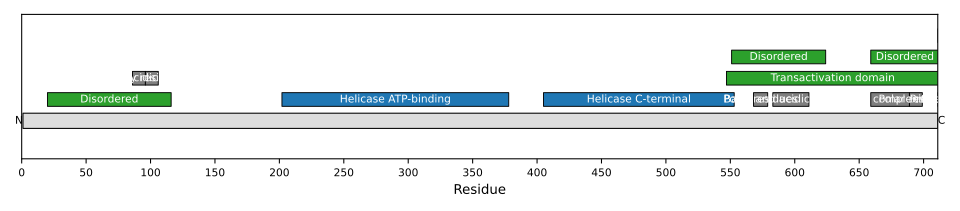
1: As an RNA helicase, unwinds RNA and alters RNA structures through ATP binding and hydrolysis. Involved in multiple cellular processes, including pre-mRNA splicing, alternative splicing, ribosomal RNA processing and miRNA processing, as well as transcription regulation. Regulates the alternative splicing of exons exhibiting specific features (PubMed:12138182, PubMed:22266867, PubMed:23022728, PubMed:24910439). For instance, promotes the inclusion of AC-rich alternative exons in CD44 transcripts (PubMed:12138182). This function requires the RNA helicase activity (PubMed:12138182, PubMed:22266867, PubMed:23022728, PubMed:24910439). Affects NFAT5 and histone macro-H2A.1/MACROH2A1 alternative splicing in a CDK9-dependent manner (PubMed:22266867, PubMed:26209609). In NFAT5, promotes the introduction of alternative exon 4, which contains 2 stop codons and may target NFAT5 exon 4-containing transcripts to nonsense-mediated mRNA decay, leading to the down-regulation of NFAT5 protein (PubMed:22266867). Affects splicing of mediators of steroid hormone signaling pathway, including kinases that phosphorylates ESR1, such as CDK2, MAPK1 and GSK3B, and transcriptional regulators, such as CREBBP, MED1, NCOR1 and NCOR2. By affecting GSK3B splicing, participates in ESR1 and AR stabilization (PubMed:24275493). In myoblasts and epithelial cells, cooperates with HNRNPH1 to control the splicing of specific subsets of exons (PubMed:24910439). In addition to binding mature mRNAs, also interacts with certain pri-microRNAs, including MIR663/miR-663a, MIR99B/miR-99b, and MIR6087/miR-6087 (PubMed:25126784). Binds pri-microRNAs on the 3' segment flanking the stem loop via the 5'-[ACG]CAUC[ACU]-3' consensus sequence (PubMed:24581491). Required for the production of subsets of microRNAs, including MIR21 and MIR125B1 (PubMed:24581491, PubMed:27478153). May be involved not only in microRNA primary transcript processing, but also stabilization (By similarity). Participates in MYC down-regulation at high cell density through the production of MYC-targeting microRNAs (PubMed:24581491). Along with DDX5, may be involved in the processing of the 32S intermediate into the mature 28S ribosomal RNA (PubMed:17485482). Promoter-specific transcription regulator, functioning as a coactivator or corepressor depending on the context of the promoter and the transcriptional complex in which it exists (PubMed:15298701). Enhances NFAT5 transcriptional activity (PubMed:22266867). Synergizes with TP53 in the activation of the MDM2 promoter; this activity requires acetylation on lysine residues (PubMed:17226766, PubMed:19995069, PubMed:20663877). May also coactivate MDM2 transcription through a TP53-independent pathway (PubMed:17226766). Coactivates MMP7 transcription (PubMed:17226766). Along with CTNNB1, coactivates MYC, JUN, FOSL1 and cyclin D1/CCND1 transcription (PubMed:17699760). Alone or in combination with DDX5 and/or SRA1 non-coding RNA, plays a critical role in promoting the assembly of proteins required for the formation of the transcription initiation complex and chromatin remodeling leading to coactivation of MYOD1-dependent transcription. This helicase-independent activity is required for skeletal muscle cells to properly differentiate into myotubes (PubMed:17011493, PubMed:24910439). During epithelial-to-mesenchymal transition, coregulates SMAD-dependent transcriptional activity, directly controlling key effectors of differentiation, including miRNAs which in turn directly repress its expression (PubMed:24910439). Plays a role in estrogen and testosterone signaling pathway at several levels. Mediates the use of alternative promoters in estrogen-responsive genes and regulates transcription and splicing of a large number of steroid hormone target genes (PubMed:19995069, PubMed:20406972, PubMed:20663877, PubMed:24275493). Contrary to splicing regulation activity, transcriptional coregulation of the estrogen receptor ESR1 is helicase-independent (PubMed:19718048, PubMed:24275493). Plays a role in innate immunity. Specifically restricts bunyavirus infection, including Rift Valley fever virus (RVFV) or La Crosse virus (LACV), but not vesicular stomatitis virus (VSV), in an interferon- and DROSHA-independent manner (PubMed:25126784). Binds to RVFV RNA, likely via structured viral RNA elements (PubMed:25126784). Promotes mRNA degradation mediated by the antiviral zinc-finger protein ZC3HAV1, in an ATPase-dependent manner (PubMed:18334637)