SWI/SNF complex subunit SMARCC1 (BRG1-associated factor 155) (BAF155) (SWI/SNF complex 155 kDa subunit) (SWI/SNF-related matrix-associated actin-dependent regulator of chromatin subfamily C member 1)
1_MAAAA 6_ GGGGP 11_ GTAVG 16_ ATGSG 21_ IAAAA 26_ AGLAV 31_ YRRKD 36_ GGPAT 41_ KFWES 46_ PETVS 51_ QLDSV 56_ RVWLG 61_ KHYKK 66_ YVHAD 71_ APTNK 76_ TLAGL 81_ VVQLL 86_ QFQED 91_ AFGKH 96_ VTNPA 101_ FTKLP 106_ AKCFM 111_ DFKAG 116_ GALCH 121_ ILGAA 126_ YKYKN 131_ EQGWR 136_ RFDLQ 141_ NPSRM 146_ DRNVE 151_ MFMNI 156_ EKTLV 161_ QNNCL 166_ TRPNI 171_ YLIPD 176_ IDLKL 181_ ANKLK 186_ DIIKR 191_ HQGTF 196_ TDEKS 201_ KASHH 206_ IYPYS 211_ SSQDD 216_ EEWLR 221_ PVMRK 226_ EKQVL 231_ VHWGF 236_ YPDSY 241_ DTWVH 246_ SNDVD 251_ AEIED 256_ PPIPE 261_ KPWKV 266_ HVKWI 271_ LDTDI 276_ FNEWM 281_ NEEDY 286_ EVDEN 291_ RKPVS 296_ FRQRI 301_ STKNE 306_ EPVRS 311_ PERRD 316_ RKASA 321_ NARKR 326_ KHSPS 331_ PPPPT 336_ PTESR 341_ KKSGK 346_ KGQAS 351_ LYGKR 356_ RSQKE 361_ EDEQE 366_ DLTKD 371_ MEDPT 376_ PVPNI 381_ EEVVL 386_ PKNVN 391_ LKKDS 396_ ENTPV 401_ KGGTV 406_ ADLDE 411_ QDEET 416_ VTAGG 421_ KEDED 426_ PAKGD 431_ QSRSV 436_ DLGED 441_ NVTEQ 446_ TNHII 451_ IPSYA 456_ SWFDY 461_ NCIHV 466_ IERRA 471_ LPEFF 476_ NGKNK 481_ SKTPE 486_ IYLAY 491_ RNFMI 496_ DTYRL 501_ NPQEY 506_ LTSTA 511_ CRRNL 516_ TGDVC 521_ AVMRV 526_ HAFLE 531_ QWGLV 536_ NYQVD 541_ PESRP 546_ MAMGP 551_ PPTPH 556_ FNVLA 561_ DTPSG 566_ LVPLH 571_ LRSPQ 576_ VPAAQ 581_ QMLNF 586_ PEKNK 591_ EKPVD 596_ LQNFG 601_ LRTDI 606_ YSKKT 611_ LAKSK 616_ GASAG 621_ REWTE 626_ QETLL 631_ LLEAL 636_ EMYKD 641_ DWNKV 646_ SEHVG 651_ SRTQD 656_ ECILH 661_ FLRLP 666_ IEDPY 671_ LENSD 676_ ASLGP 681_ LAYQP 686_ VPFSQ 691_ SGNPV 696_ MSTVA 701_ FLASV 706_ VDPRV 711_ ASAAA 716_ KAALE 721_ EFSRV 726_ REEVP 731_ LELVE 736_ AHVKK 741_ VQEAA 746_ RASGK 751_ VDPTY 756_ GLESS 761_ CIAGT 766_ GPDEP 771_ EKLEG 776_ AEEEK 781_ MEADP 786_ DGQQP 791_ EKAEN 796_ KVENE 801_ TDEGD 806_ KAQDG 811_ ENEKN 816_ SEKEQ 821_ DSEVS 826_ EDTKS 831_ EEKET 836_ EENKE 841_ LTDTC 846_ KERES 851_ DTGKK 856_ KVEHE 861_ ISEGN 866_ VATAA 871_ AAALA 876_ SAATK 881_ AKHLA 886_ AVEER 891_ KIKSL 896_ VALLV 901_ ETQMK 906_ KLEIK 911_ LRHFE 916_ ELETI 921_ MDREK 926_ EALEQ 931_ QRQQL 936_ LTERQ 941_ NFHME 946_ QLKYA 951_ ELRAR 956_ QQMEQ 961_ QQHGQ 966_ NPQQA 971_ HQHSG 976_ GPGLA 981_ PLGAA 986_ GHPGM 991_ MPHQQ 996_ PPPYP 1001_ LMHHQ 1006_ MPPPH 1011_ PPQPG 1016_ QIPGP 1021_ GSMMP 1026_ GQHMP 1031_ GRMIP 1036_ TVAAN 1041_ IHPSG 1046_ SGPTP 1051_ PGMPP 1056_ MPGNI 1061_ LGPRV 1066_ PLTAP 1071_ NGMYP 1076_ PPPQQ 1081_ QPPPP 1086_ PPADG 1091_ VPPPP 1096_APGPP
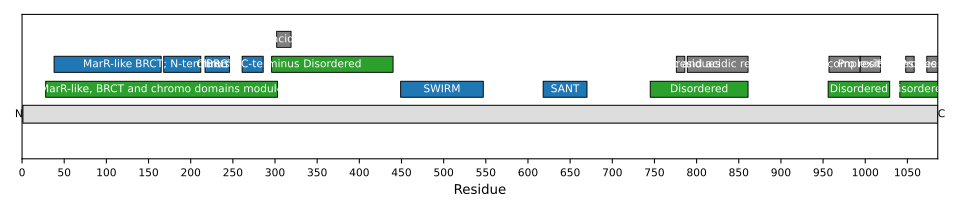
1: Involved in transcriptional activation and repression of select genes by chromatin remodeling (alteration of DNA-nucleosome topology). Component of SWI/SNF chromatin remodeling complexes that carry out key enzymatic activities, changing chromatin structure by altering DNA-histone contacts within a nucleosome in an ATP-dependent manner. May stimulate the ATPase activity of the catalytic subunit of the complex (PubMed:10078207, PubMed:29374058). Belongs to the neural progenitors-specific chromatin remodeling complex (npBAF complex) and the neuron-specific chromatin remodeling complex (nBAF complex). During neural development a switch from a stem/progenitor to a postmitotic chromatin remodeling mechanism occurs as neurons exit the cell cycle and become committed to their adult state. The transition from proliferating neural stem/progenitor cells to postmitotic neurons requires a switch in subunit composition of the npBAF and nBAF complexes. As neural progenitors exit mitosis and differentiate into neurons, npBAF complexes which contain ACTL6A/BAF53A and PHF10/BAF45A, are exchanged for homologous alternative ACTL6B/BAF53B and DPF1/BAF45B or DPF3/BAF45C subunits in neuron-specific complexes (nBAF). The npBAF complex is essential for the self-renewal/proliferative capacity of the multipotent neural stem cells. The nBAF complex along with CREST plays a role regulating the activity of genes essential for dendrite growth (By similarity)