Tumor necrosis factor receptor superfamily member 14 (Herpes virus entry mediator A) (Herpesvirus entry mediator A) (HveA) (Tumor necrosis factor receptor-like 2) (TR2) (CD antigen CD270)
1_MEPPG 6_ DWGPP 11_ PWRST 16_ PKTDV 21_ LRLVL 26_ YLTFL 31_ GAPCY 36_ APALP 41_ SCKED 46_ EYPVG 51_ SECCP 56_ KCSPG 61_ YRVKE 66_ ACGEL 71_ TGTVC 76_ EPCPP 81_ GTYIA 86_ HLNGL 91_ SKCLQ 96_ CQMCD 101_ PAMGL 106_ RASRN 111_ CSRTE 116_ NAVCG 121_ CSPGH 126_ FCIVQ 131_ DGDHC 136_ AACRA 141_ YATSS 146_ PGQRV 151_ QKGGT 156_ ESQDT 161_ LCQNC 166_ PPGTF 171_ SPNGT 176_ LEECQ 181_ HQTKC 186_ SWLVT 191_ KAGAG 196_ TSSSH 201_ WVWWF 206_ LSGSL 211_ VIVIV 216_ CSTVG 221_ LIICV 226_ KRRKP 231_ RGDVV 236_ KVIVS 241_ VQRKR 246_ QEAEG 251_ EATVI 256_ EALQA 261_ PPDVT 266_ TVAVE 271_ ETIPS 276_FTGRS
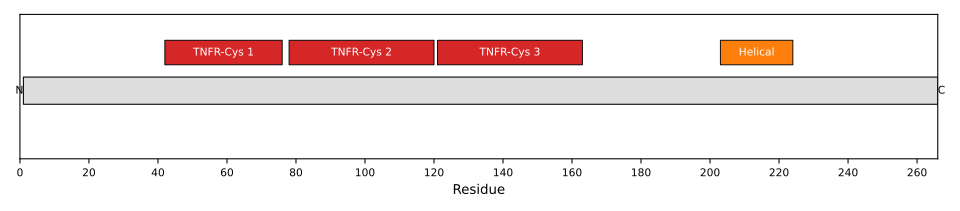
1: Receptor for four distinct ligands: The TNF superfamily members TNFSF14/LIGHT and homotrimeric LTA/lymphotoxin-alpha and the immunoglobulin superfamily members BTLA and CD160, altogether defining a complex stimulatory and inhibitory signaling network (PubMed:10754304, PubMed:18193050, PubMed:23761635, PubMed:9462508). Signals via the TRAF2-TRAF3 E3 ligase pathway to promote immune cell survival and differentiation (PubMed:19915044, PubMed:9153189, PubMed:9162022). Participates in bidirectional cell-cell contact signaling between antigen presenting cells and lymphocytes. In response to ligation of TNFSF14/LIGHT, delivers costimulatory signals to T cells, promoting cell proliferation and effector functions (PubMed:10754304). Interacts with CD160 on NK cells, enhancing IFNG production and anti-tumor immune response (PubMed:23761635). In the context of bacterial infection, acts as a signaling receptor on epithelial cells for CD160 from intraepithelial lymphocytes, triggering the production of antimicrobial proteins and pro-inflammatory cytokines (By similarity). Upon binding to CD160 on activated CD4+ T cells, down-regulates CD28 costimulatory signaling, restricting memory and alloantigen-specific immune response (PubMed:18193050). May interact in cis (on the same cell) or in trans (on other cells) with BTLA (By similarity) (PubMed:19915044). In cis interactions, appears to play an immune regulatory role inhibiting in trans interactions in naive T cells to maintain a resting state. In trans interactions, can predominate during adaptive immune response to provide survival signals to effector T cells (By similarity) (PubMed:19915044)
2: (Microbial infection) Acts as a receptor for Herpes simplex virus 1/HHV-1
3: (Microbial infection) Acts as a receptor for Herpes simplex virus 2/HHV-2