Solute carrier organic anion transporter family member 2A1 (Prostaglandin transporter) (PGT) (Solute carrier family 21 member 2)
1_MGLLP 6_ KLGAS 11_ QGSDT 16_ STSRA 21_ GRCAR 26_ SVFGN 31_ IKVFV 36_ LCQGL 41_ LQLCQ 46_ LLYSA 51_ YFKSS 56_ LTTIE 61_ KRFGL 66_ SSSSS 71_ GLISS 76_ LNEIS 81_ NAILI 86_ IFVSY 91_ FGSRV 96_ HRPRL 101_ IGIGG 106_ LFLAA 111_ GAFIL 116_ TLPHF 121_ LSEPY 126_ QYTLA 131_ STGNN 136_ SRLQA 141_ ELCQK 146_ HWQDL 151_ PPSKC 156_ HSTTQ 161_ NPQKE 166_ TSSMW 171_ GLMVV 176_ AQLLA 181_ GIGTV 186_ PIQPF 191_ GISYV 196_ DDFSE 201_ PSNSP 206_ LYISI 211_ LFAIS 216_ VFGPA 221_ FGYLL 226_ GSVML 231_ QIFVD 236_ YGRVN 241_ TAAVN 246_ LVPGD 251_ PRWIG 256_ AWWLG 261_ LLISS 266_ ALLVL 271_ TSFPF 276_ FFFPR 281_ AMPIG 286_ AKRAP 291_ ATADE 296_ ARKLE 301_ EAKSR 306_ GSLVD 311_ FIKRF 316_ PCIFL 321_ RLLMN 326_ SLFVL 331_ VVLAQ 336_ CTFSS 341_ VIAGL 346_ STFLN 351_ KFLEK 356_ QYGTS 361_ AAYAN 366_ FLIGA 371_ VNLPA 376_ AALGM 381_ LFGGI 386_ LMKRF 391_ VFSLQ 396_ AIPRI 401_ ATTII 406_ TISMI 411_ LCVPL 416_ FFMGC 421_ STPTV 426_ AEVYP 431_ PSTSS 436_ SIHPQ 441_ SPACR 446_ RDCSC 451_ PDSIF 456_ HPVCG 461_ DNGIE 466_ YLSPC 471_ HAGCS 476_ NINMS 481_ SATSK 486_ QLIYL 491_ NCSCV 496_ TGGSA 501_ SAKTG 506_ SCPVP 511_ CAHFL 516_ LPAIF 521_ LISFV 526_ SLIAC 531_ ISHNP 536_ LYMMV 541_ LRVVN 546_ QEEKS 551_ FAIGV 556_ QFLLM 561_ RLLAW 566_ LPSPA 571_ LYGLT 576_ IDHSC 581_ IRWNS 586_ LCLGR 591_ RGACA 596_ YYDND 601_ ALRDR 606_ YLGLQ 611_ MGYKA 616_ LGMLL 621_ LCFIS 626_ WRVKK 631_ NKEYN 636_VQKAA
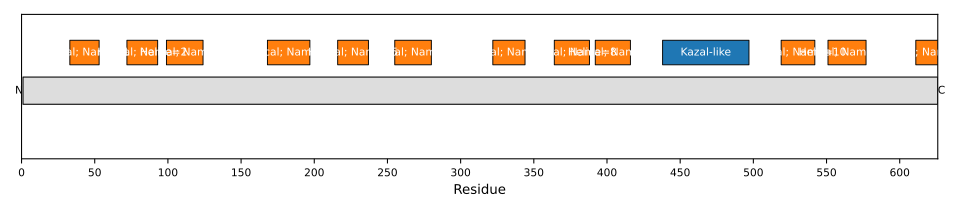
1: Mediates the transport of prostaglandins (PGs, mainly PGE2, PGE1, PGE3, PGF2alpha, PGD2, PGH2) and thromboxanes (thromboxane B2) across the cell membrane (PubMed:11997326, PubMed:26692285, PubMed:8787677). PGs and thromboxanes play fundamental roles in diverse functions such as intraocular pressure, gastric acid secretion, renal salt and water transport, vascular tone, and fever (PubMed:15044627). Plays a role in the clearance of PGs from the circulation through cellular uptake, which allows cytoplasmic oxidation and PG signal termination (PubMed:8787677). PG uptake is dependent upon membrane potential and involves exchange of a monovalent anionic substrate (PGs exist physiologically as an anionic monovalent form) with a stoichiometry of 1:1 for divalent anions or of 1:2 for monovalent anions (PubMed:29204966). Uses lactate, generated by glycolysis, as a counter-substrate to mediate PGE2 influx and efflux (PubMed:11997326). Under nonglycolytic conditions, metabolites other than lactate might serve as counter-substrates (PubMed:11997326). Although the mechanism is not clear, this transporter can function in bidirectional mode (PubMed:29204966). When apically expressed in epithelial cells, it facilitates transcellular transport (also called vectorial release), extracting PG from the apical medium and facilitating transport across the cell toward the basolateral side, whereupon the PG exits the cell by simple diffusion (By similarity). In the renal collecting duct, regulates renal Na+ balance by removing PGE2 from apical medium (PGE2 EP4 receptor is likely localized to the luminal/apical membrane and stimulates Na+ resorption) and transporting it toward the basolateral membrane (where PGE2 EP1 and EP3 receptors inhibit Na+ resorption) (By similarity). Plays a role in endometrium during decidualization, increasing uptake of PGs by decidual cells (PubMed:16339169). Involved in critical events for ovulation (PubMed:27169804). Regulates extracellular PGE2 concentration for follicular development in the ovaries (By similarity). Expressed intracellularly, may contribute to vesicular uptake of newly synthesized intracellular PGs, thereby facilitating exocytotic secretion of PGs without being metabolized (By similarity). Essential core component of the major type of large-conductance anion channel, Maxi-Cl, which plays essential roles in inorganic anion transport, cell volume regulation and release of ATP and glutamate not only in physiological processes but also in pathological processes (By similarity). May contribute to regulate the transport of organic compounds in testis across the blood-testis-barrier (Probable)