Histone acetyltransferase KAT5 (EC 2.3.1.48) (60 kDa Tat-interactive protein) (Tip60) (Histone acetyltransferase HTATIP) (HIV-1 Tat interactive protein) (Lysine acetyltransferase 5) (Protein 2-hydroxyisobutyryltransferase KAT5) (EC 2.3.1.-) (Protein acetyltransferase KAT5) (EC 2.3.1.-) (Protein crotonyltransferase KAT5) (EC 2.3.1.-) (cPLA(2)-interacting protein)
1_MAEVG 6_ EIIEG 11_ CRLPV 16_ LRRNQ 21_ DNEDE 26_ WPLAE 31_ ILSVK 36_ DISGR 41_ KLFYV 46_ HYIDF 51_ NKRLD 56_ EWVTH 61_ ERLDL 66_ KKIQF 71_ PKKEA 76_ KTPTK 81_ NGLPG 86_ SRPGS 91_ PEREV 96_ PASAQ 101_ ASGKT 106_ LPIPV 111_ QITLR 116_ FNLPK 121_ EREAI 126_ PGGEP 131_ DQPLS 136_ SSSCL 141_ QPNHR 146_ STKRK 151_ VEVVS 156_ PATPV 161_ PSETA 166_ PASVF 171_ PQNGA 176_ ARRAV 181_ AAQPG 186_ RKRKS 191_ NCLGT 196_ DEDSQ 201_ DSSDG 206_ IPSAP 211_ RMTGS 216_ LVSDR 221_ SHDDI 226_ VTRMK 231_ NIECI 236_ ELGRH 241_ RLKPW 246_ YFSPY 251_ PQELT 256_ TLPVL 261_ YLCEF 266_ CLKYG 271_ RSLKC 276_ LQRHL 281_ TKCDL 286_ RHPPG 291_ NEIYR 296_ KGTIS 301_ FFEID 306_ GRKNK 311_ SYSQN 316_ LCLLA 321_ KCFLD 326_ HKTLY 331_ YDTDP 336_ FLFYV 341_ MTEYD 346_ CKGFH 351_ IVGYF 356_ SKEKE 361_ STEDY 366_ NVACI 371_ LTLPP 376_ YQRRG 381_ YGKLL 386_ IEFSY 391_ ELSKV 396_ EGKTG 401_ TPEKP 406_ LSDLG 411_ LLSYR 416_ SYWSQ 421_ TILEI 426_ LMGLK 431_ SESGE 436_ RPQIT 441_ INEIS 446_ EITSI 451_ KKEDV 456_ ISTLQ 461_ YLNLI 466_ NYYKG 471_ QYILT 476_ LSEDI 481_ VDGHE 486_ RAMLK 491_ RLLRI 496_ DSKCL 501_ HFTPK 506_DWSKR
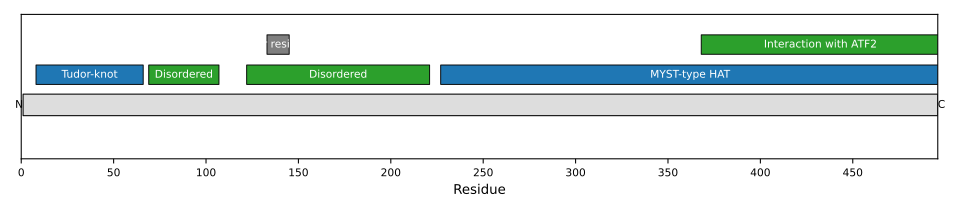
1: Catalytic subunit of the NuA4 histone acetyltransferase complex, a multiprotein complex involved in transcriptional activation of select genes principally by acetylation of nucleosomal histones H2A and H4 (PubMed:12776177, PubMed:14966270, PubMed:15042092, PubMed:15121871, PubMed:15310756, PubMed:16387653, PubMed:19909775, PubMed:25865756, PubMed:27153538, PubMed:29174981, PubMed:29335245, PubMed:32822602, PubMed:33076429). Histone acetylation alters nucleosome-DNA interactions and promotes interaction of the modified histones with other proteins which positively regulate transcription (PubMed:12776177, PubMed:14966270, PubMed:15042092, PubMed:15121871, PubMed:15310756). The NuA4 histone acetyltransferase complex is required for the activation of transcriptional programs associated with proto-oncogene mediated growth induction, tumor suppressor mediated growth arrest and replicative senescence, apoptosis, and DNA repair (PubMed:17709392, PubMed:19783983, PubMed:32832608). The NuA4 complex plays a direct role in repair of DNA double-strand breaks (DSBs) by promoting homologous recombination (HR): the complex inhibits TP53BP1 binding to chromatin via MBTD1, which recognizes and binds histone H4 trimethylated at 'Lys-20' (H4K20me), and KAT5 that catalyzes acetylation of 'Lys-15' of histone H2A (H2AK15ac), thereby blocking the ubiquitination mark required for TP53BP1 localization at DNA breaks (PubMed:27153538, PubMed:32832608). Also involved in DSB repair by mediating acetylation of 'Lys-5' of histone H2AX (H2AXK5ac), promoting NBN/NBS1 assembly at the sites of DNA damage (PubMed:17709392, PubMed:26438602). The NuA4 complex plays a key role in hematopoietic stem cell maintenance and is required to maintain acetylated H2A.Z/H2AZ1 at MYC target genes (By similarity). The NuA4 complex is also required for spermatid development by promoting acetylation of histones: histone hyperacetylation is required for histone replacement during the transition from round to elongating spermatids (By similarity). Component of a SWR1-like complex that specifically mediates the removal of histone H2A.Z/H2AZ1 from the nucleosome (PubMed:24463511). Also acetylates non-histone proteins, such as BMAL1, ATM, AURKB, CHKA, CGAS, ERCC4/XPF, LPIN1, TP53/p53, NDC80/HEC1, NR1D2, RAN, SOX4, FOXP3, SQSTM1, ULK1 and RUBCNL/Pacer (PubMed:16141325, PubMed:17189187, PubMed:17360565, PubMed:17996965, PubMed:24835996, PubMed:26829474, PubMed:29040603, PubMed:30409912, PubMed:30704899, PubMed:31857589, PubMed:32034146, PubMed:32817552, PubMed:34077757). Directly acetylates and activates ATM (PubMed:16141325). Promotes nucleotide excision repair (NER) by mediating acetylation of ERCC4/XPF, thereby promoting formation of the ERCC4-ERCC1 complex (PubMed:32034146). Relieves NR1D2-mediated inhibition of APOC3 expression by acetylating NR1D2 (PubMed:17996965). Acts as a regulator of regulatory T-cells (Treg) by catalyzing FOXP3 acetylation, thereby promoting FOXP3 transcriptional repressor activity (PubMed:17360565, PubMed:24835996). Involved in skeletal myoblast differentiation by mediating acetylation of SOX4 (PubMed:26291311). Catalyzes acetylation of APBB1/FE65, increasing its transcription activator activity (PubMed:33938178). Promotes transcription elongation during the activation phase of the circadian cycle by catalyzing acetylation of BMAL1, promoting elongation of circadian transcripts (By similarity). Together with GSK3 (GSK3A or GSK3B), acts as a regulator of autophagy: phosphorylated at Ser-86 by GSK3 under starvation conditions, leading to activate acetyltransferase activity and promote acetylation of key autophagy regulators, such as ULK1 and RUBCNL/Pacer (PubMed:30704899). Acts as a regulator of the cGAS-STING innate antiviral response by catalyzing acetylation the N-terminus of CGAS, thereby promoting CGAS DNA-binding and activation (PubMed:32817552). Also regulates lipid metabolism by mediating acetylation of CHKA or LPIN1 (PubMed:34077757). Promotes lipolysis of lipid droplets following glucose deprivation by mediating acetylation of isoform 1 of CHKA, thereby promoting monomerization of CHKA and its conversion into a tyrosine-protein kinase (PubMed:34077757). Acts as a regulator of fatty-acid-induced triacylglycerol synthesis by catalyzing acetylation of LPIN1, thereby promoting the synthesis of diacylglycerol (PubMed:29765047). In addition to protein acetyltransferase, can use different acyl-CoA substrates, such as (2E)-butenoyl-CoA (crotonyl-CoA), S-lactoyl-CoA (lactyl-CoA) and 2-hydroxyisobutanoyl-CoA (2-hydroxyisobutyryl-CoA), and is able to mediate protein crotonylation, lactylation and 2-hydroxyisobutyrylation, respectively (PubMed:29192674, PubMed:34608293, PubMed:38961290). Acts as a key regulator of chromosome segregation and kinetochore-microtubule attachment during mitosis by mediating acetylation or crotonylation of target proteins (PubMed:26829474, PubMed:29040603, PubMed:30409912, PubMed:34608293). Catalyzes acetylation of AURKB at kinetochores, increasing AURKB activity and promoting accurate chromosome segregation in mitosis (PubMed:26829474). Acetylates RAN during mitosis, promoting microtubule assembly at mitotic chromosomes (PubMed:29040603). Acetylates NDC80/HEC1 during mitosis, promoting robust kinetochore-microtubule attachment (PubMed:30409912). Catalyzes crotonylation of MAPRE1/EB1, thereby ensuring accurate spindle positioning in mitosis (PubMed:34608293). Catalyzes lactylation of NBN/NBS1 in response to DNA damage, thereby promoting DNA double-strand breaks (DSBs) via homologous recombination (HR) (PubMed:38961290)
2: (Microbial infection) Catalyzes the acetylation of flavivirus NS3 protein to modulate their RNA-binding and -unwinding activities leading to facilitate viral replication