Ubiquitin carboxyl-terminal hydrolase 7 (EC 3.4.19.12) (Deubiquitinating enzyme 7) (Herpesvirus-associated ubiquitin-specific protease) (Ubiquitin thioesterase 7) (Ubiquitin-specific-processing protease 7)
1_MNHQQ 6_ QQQQQ 11_ KAGEQ 16_ QLSEP 21_ EDMEM 26_ EAGDT 31_ DDPPR 36_ ITQNP 41_ VINGN 46_ VALSD 51_ GHNTA 56_ EEDME 61_ DDTSW 66_ RSEAT 71_ FQFTV 76_ ERFSR 81_ LSESV 86_ LSPPC 91_ FVRNL 96_ PWKIM 101_ VMPRF 106_ YPDRP 111_ HQKSV 116_ GFFLQ 121_ CNAES 126_ DSTSW 131_ SCHAQ 136_ AVLKI 141_ INYRD 146_ DEKSF 151_ SRRIS 156_ HLFFH 161_ KENDW 166_ GFSNF 171_ MAWSE 176_ VTDPE 181_ KGFID 186_ DDKVT 191_ FEVFV 196_ QADAP 201_ HGVAW 206_ DSKKH 211_ TGYVG 216_ LKNQG 221_ ATCYM 226_ NSLLQ 231_ TLFFT 236_ NQLRK 241_ AVYMM 246_ PTEGD 251_ DSSKS 256_ VPLAL 261_ QRVFY 266_ ELQHS 271_ DKPVG 276_ TKKLT 281_ KSFGW 286_ ETLDS 291_ FMQHD 296_ VQELC 301_ RVLLD 306_ NVENK 311_ MKGTC 316_ VEGTI 321_ PKLFR 326_ GKMVS 331_ YIQCK 336_ EVDYR 341_ SDRRE 346_ DYYDI 351_ QLSIK 356_ GKKNI 361_ FESFV 366_ DYVAV 371_ EQLDG 376_ DNKYD 381_ AGEHG 386_ LQEAE 391_ KGVKF 396_ LTLPP 401_ VLHLQ 406_ LMRFM 411_ YDPQT 416_ DQNIK 421_ INDRF 426_ EFPEQ 431_ LPLDE 436_ FLQKT 441_ DPKDP 446_ ANYIL 451_ HAVLV 456_ HSGDN 461_ HGGHY 466_ VVYLN 471_ PKGDG 476_ KWCKF 481_ DDDVV 486_ SRCTK 491_ EEAIE 496_ HNYGG 501_ HDDDL 506_ SVRHC 511_ TNAYM 516_ LVYIR 521_ ESKLS 526_ EVLQA 531_ VTDHD 536_ IPQQL 541_ VERLQ 546_ EEKRI 551_ EAQKR 556_ KERQE 561_ AHLYM 566_ QVQIV 571_ AEDQF 576_ CGHQG 581_ NDMYD 586_ EEKVK 591_ YTVFK 596_ VLKNS 601_ SLAEF 606_ VQSLS 611_ QTMGF 616_ PQDQI 621_ RLWPM 626_ QARSN 631_ GTKRP 636_ AMLDN 641_ EADGN 646_ KTMIE 651_ LSDNE 656_ NPWTI 661_ FLETV 666_ DPELA 671_ ASGAT 676_ LPKFD 681_ KDHDV 686_ MLFLK 691_ MYDPK 696_ TRSLN 701_ YCGHI 706_ YTPIS 711_ CKIRD 716_ LLPVM 721_ CDRAG 726_ FIQDT 731_ SLILY 736_ EEVKP 741_ NLTER 746_ IQDYD 751_ VSLDK 756_ ALDEL 761_ MDGDI 766_ IVFQK 771_ DDPEN 776_ DNSEL 781_ PTAKE 786_ YFRDL 791_ YHRVD 796_ VIFCD 801_ KTIPN 806_ DPGFV 811_ VTLSN 816_ RMNYF 821_ QVAKT 826_ VAQRL 831_ NTDPM 836_ LLQFF 841_ KSQGY 846_ RDGPG 851_ NPLRH 856_ NYEGT 861_ LRDLL 866_ QFFKP 871_ RQPKK 876_ LYYQQ 881_ LKMKI 886_ TDFEN 891_ RRSFK 896_ CIWLN 901_ SQFRE 906_ EEITL 911_ YPDKH 916_ GCVRD 921_ LLEEC 926_ KKAVE 931_ LGEKA 936_ SGKLR 941_ LLEIV 946_ SYKII 951_ GVHQE 956_ DELLE 961_ CLSPA 966_ TSRTF 971_ RIEEI 976_ PLDQV 981_ DIDKE 986_ NEMLV 991_ TVAHF 996_ HKEVF 1001_ GTFGI 1006_ PFLLR 1011_ IHQGE 1016_ HFREV 1021_ MKRIQ 1026_ SLLDI 1031_ QEKEF 1036_ EKFKF 1041_ AIVMM 1046_ GRHQY 1051_ INEDE 1056_ YEVNL 1061_ KDFEP 1066_ QPGNM 1071_ SHPRP 1076_ WLGLD 1081_ HFNKA 1086_ PKRSR 1091_ YTYLE 1096_KAIKI
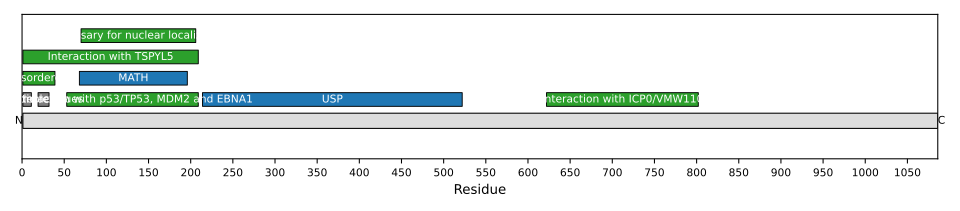
1: Hydrolase that deubiquitinates target proteins such as ARMC5, FOXO4, DEPTOR, KAT5, p53/TP53, MDM2, ERCC6, DNMT1, UHRF1, PTEN, KMT2E/MLL5 and DAXX (PubMed:11923872, PubMed:15053880, PubMed:16964248, PubMed:18716620, PubMed:25283148, PubMed:25865756, PubMed:26678539, PubMed:28655758, PubMed:33544460, PubMed:35216969). Together with DAXX, prevents MDM2 self-ubiquitination and enhances the E3 ligase activity of MDM2 towards p53/TP53, thereby promoting p53/TP53 ubiquitination and proteasomal degradation (PubMed:15053880, PubMed:16845383, PubMed:18566590, PubMed:20153724). Deubiquitinates p53/TP53, preventing degradation of p53/TP53, and enhances p53/TP53-dependent transcription regulation, cell growth repression and apoptosis (PubMed:25283148). Deubiquitinates p53/TP53 and MDM2 and strongly stabilizes p53/TP53 even in the presence of excess MDM2, and also induces p53/TP53-dependent cell growth repression and apoptosis (PubMed:11923872, PubMed:26786098). Deubiquitination of FOXO4 in presence of hydrogen peroxide is not dependent on p53/TP53 and inhibits FOXO4-induced transcriptional activity (PubMed:16964248). In association with DAXX, is involved in the deubiquitination and translocation of PTEN from the nucleus to the cytoplasm, both processes that are counteracted by PML (PubMed:18716620). Deubiquitinates KMT2E/MLL5 preventing KMT2E/MLL5 proteasomal-mediated degradation (PubMed:26678539). Involved in cell proliferation during early embryonic development. Involved in transcription-coupled nucleotide excision repair (TC-NER) in response to UV damage: recruited to DNA damage sites following interaction with KIAA1530/UVSSA and promotes deubiquitination of ERCC6, preventing UV-induced degradation of ERCC6 (PubMed:22466611, PubMed:22466612). Involved in maintenance of DNA methylation via its interaction with UHRF1 and DNMT1: acts by mediating deubiquitination of UHRF1 and DNMT1, preventing their degradation and promoting DNA methylation by DNMT1 (PubMed:21745816, PubMed:22411829). Deubiquitinates alkylation repair enzyme ALKBH3. OTUD4 recruits USP7 and USP9X to stabilize ALKBH3, thereby promoting the repair of alkylated DNA lesions (PubMed:25944111). Acts as a chromatin regulator via its association with the Polycomb group (PcG) multiprotein PRC1-like complex; may act by deubiquitinating components of the PRC1-like complex (PubMed:20601937). Able to mediate deubiquitination of histone H2B; it is however unsure whether this activity takes place in vivo (PubMed:20601937). Exhibits a preference towards 'Lys-48'-linked ubiquitin chains (PubMed:22689415). Increases regulatory T-cells (Treg) suppressive capacity by deubiquitinating and stabilizing the transcription factor FOXP3 which is crucial for Treg cell function (PubMed:23973222). Plays a role in the maintenance of the circadian clock periodicity via deubiquitination and stabilization of the CRY1 and CRY2 proteins (PubMed:27123980). Deubiquitinates REST, thereby stabilizing REST and promoting the maintenance of neural progenitor cells (PubMed:21258371). Deubiquitinates SIRT7, inhibiting SIRT7 histone deacetylase activity and regulating gluconeogenesis (PubMed:28655758). Involved in the regulation of WASH-dependent actin polymerization at the surface of endosomes and the regulation of endosomal protein recycling (PubMed:26365382). It maintains optimal WASH complex activity and precise F-actin levels via deubiquitination of TRIM27 and WASHC1 (PubMed:26365382). Mediates the deubiquitination of phosphorylated DEPTOR, promoting its stability and leading to decreased mTORC1 signaling (PubMed:35216969)
2: (Microbial infection) Contributes to the overall stabilization and trans-activation capability of the herpesvirus 1 trans-acting transcriptional protein ICP0/VMW110 during HSV-1 infection
3: (Microbial infection) Upon infection with Epstein-Barr virus, the interaction with viral EBNA1 increases the association of USP7 with PML proteins, which is required for the polyubiquitylation and degradation of PML